
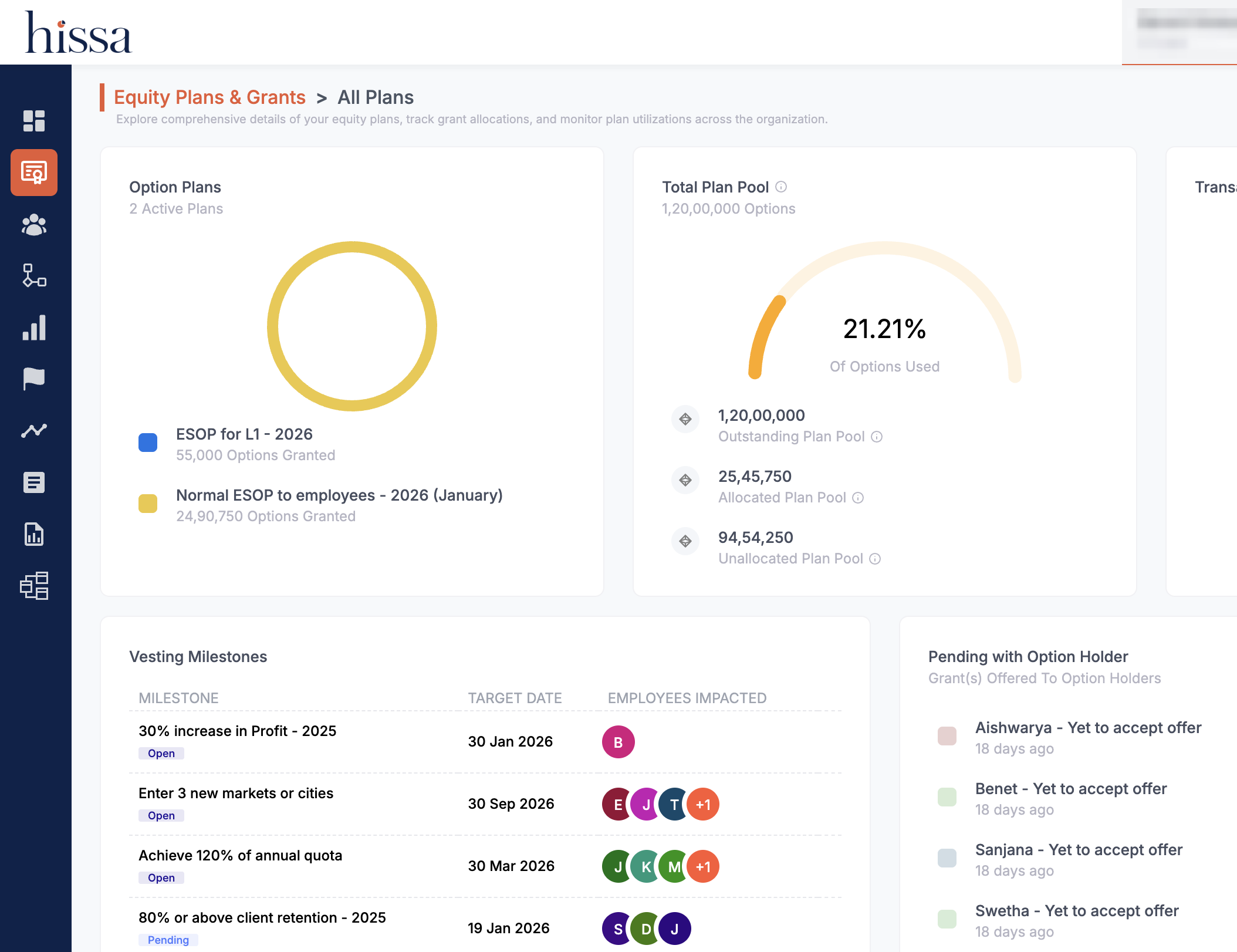
Green checkmarks on table comparison can tell you which is the best ESOP management software on paper, but they actually tell you nothing about what happens when reality gets messy. And ESOPs are messy by design.
Most buyers start the same way. They go to G2, search “ESOP management software” and land on a clean comparison grid. Rows of features. Columns of vendors. Lots of green checkmarks.
At first glance, everything looks identical. So they reach an obvious conclusion: “All tools are basically the same. Let’s pick the cheapest or the most popular.“
That’s where things start to go wrong.
Typical best ESOP management software comparison view
Capability |
Hissa |
Platform A |
Platform
|
Platform
|
Platform D |
|
Scheme creation |
✓ |
✓ |
✗ |
Templated |
✗ |
|
Board & shareholder approvals |
✓ |
✓ |
Beta |
✗ |
✓ |
|
Grant issuance (ESOP, SAR, RSU) |
✓ |
✓ |
✓ |
ESOP only |
US rules |
|
Vesting — time, performance & pause |
✓ |
✓ |
✓ |
✓ |
Time only |
|
Exercise workflows (buyback & surrender) |
✓ |
✓ |
Fragmented |
Manual |
✓ |
|
IND AS 102 + SH-6 reporting |
✓ |
✓ |
Unclear |
✗ |
✗ |
|
Demat support (MCA mandate) |
✓ |
✓ |
✗ |
✗ |
✗ |
|
Multi-entity support |
✓ |
✓ |
✗ |
✗ |
✗ |
|
Dedicated ESOP secondary fund(own capital deployed for employees) |
✓ |
✗ |
✗ |
✗ |
✗ |
|
Pre-IPO employee cash-out |
✓ |
✗ |
✗ |
✗ |
✗ |
This table is technically correct, but completely useless.
Feature comparison tables assume software is a checklist. A checklist tells you what exists. It tells you nothing about how it behaves when conditions get complicated.
ESOPs sit at the intersection of HR processes, financial calculations, legal constraints, and human behavior – and they deal with money people don’t fully understand yet.
Every “simple feature” is actually a system of decisions.
At Hissa, we’ve always seen ESOP management software as a financial system, not record-keeping software. That means designing for nuance, not just functionality.
Here’s how that plays out across the features every vendor claims to support.
1. Grant Management
The illusion of simplicity
“Supports grants” is one of the most meaningless checkmarks in ESOP software. Grants are not just records, they are the entry point of financial allocation logic.
What actually matters is…
- Grant by value vs. count vs. model – Granting ₹10L worth of ESOPs requires precise conversion into option counts. No fractional shares, so rounding decisions matter. Inconsistency leads to pool mismatches and audit issues.
- Model-driven grants – Role-based or level-based allocation, integration with hiring plans, and guardrails to prevent over-allocation.
- Grant date alignment – Real companies don’t issue grants on joining dates. They batch monthly, quarterly, or on a fixed cycle. Systems must normalize dates without breaking vesting logic.
BASIC SYSTEM –
Records grants.
GOOD SYSTEM –
Behaves like compensation engine.
2. Vesting Management
Time is only half the story
Every tool supports vesting. But vesting is not just “X years with a 1-year cliff.” There are two dimensions most systems ignore entirely.
What actually matters is – whether your platform can handle
Time-based complexity
- Pauses – e.g., during notice period
- Extensions or early exits
- Retroactive corrections to schedules
Performance-based vesting
- Milestone-linked vesting schedules
- Board-triggered acceleration events
- KPI-based conditions that modify timelines
Most systems struggle to combine time + performance conditions, or treat performance vesting as a manual override. The result: inconsistent records, audit ambiguity, and employee confusion.
The real question:
Can the system handle dynamic vesting states without breaking history?
3. Resignation Workflows
Where systems meet reality
Resignations are not clean workflows. They evolve. Someone resigns, gets convinced to stay, extends notice, or leaves earlier than planned. Each change impacts vesting, exercise windows, and grant validity.
Key nuances…
- Vesting pause on resignation – Pause automatically, resume if employee stays, adjust if last working day changes.
- Multiple grants across plans – Different expiry rules, different exercise windows, parallel computations required.
- Resignation as a timeline – Most systems treat it as a single event. In reality, it’s a sequence of uncertain states.
The system either adapts to this uncertainty or your team fixes it manually every single time.
4. HRMS Integration
Why this isn’t just an API problem
Most vendors say “We integrate with HRMS.” What they mean: “We pull employee data via API.” That’s not integration – that’s data sync.
Real integration means
- Joining triggers eligibility, which triggers grant logic
- Role change impacts future grant allocations
- Exit triggers vesting changes + expiry rules
- Edge cases handled – backdated joins, role corrections, no silent failures
This is workflow orchestration across systems, mapping HR events to ESOP logic and ensuring nothing falls through the cracks.
The real question:
Does the system understand what an HR event means for equity?
5. Reports
Beyond “Export to Excel”
Every tool says “custom reports available”, usually meaning you can select columns and export a spreadsheet. But ESOP reporting isn’t about data extraction. It’s about decision-grade outputs.
What actually matters…
- Structured outputs – Pre-formatted sheets for specific use cases, plus raw data for custom builds.
- Multiple audiences – Board sees dilution and pool usage. Finance sees expense recognition. Employees see personal value.
- Consistency – The same number must mean the same thing everywhere.
The system either adapts to this uncertainty or your team fixes it manually every single time.
WEAK SYSTEM –
Gives you data.
STRONG SYSTEM –
Gives you confidence in the data.
6. Liquidity Workflows
Where complexity explodes
The first generation of ESOP software in India – Qapita, EquityList, and Trica solved the administration problem. Grants are digital. Vesting is automated. Cap tables are clean. That was the right problem to solve first, and those platforms solved it.
But none of them answered the question employees eventually ask: when can I access the money my equity is worth?
What actually matters…
No other ESOP management platform in India operates a dedicated secondary fund.
- Qapita facilitates company-led buybacks and surrender programmes.
- EquityList supports secondary transactions as part of fundraising workflows.
- Trica does not offer liquidity infrastructure. None of them deploy their own proprietary capital to purchase employee shares.
Hissa Fund I does. A ₹35M SEBI-registered AIF built exclusively to purchase vested shares from employees at growth-stage Indian startups before an IPO, before a buyback, independent of what the company decides to do.
T+5 settlement. Partial sales allowed. Founder consent and board approval required for each transaction.
At this stage, you are no longer evaluating ESOP software. You are evaluating whether the platform has built the infrastructure to make employee equity ownership real — not just administered.
7. Enterprise Readiness
More than skin deep
Enterprise buyers often ask: Can we customize the logo? Change the language? Control notifications?
That’s not enterprise readiness.
Real enterprise complexity are…
- Policy configurability – Multiple plans across entities, country-specific rules, custom vesting, expiry, and eligibility logic.
- Workflow configurability – Approval layers, grant cycles, exception handling paths.
- Data & permissions – Who sees what, and how information flows across teams.
Enterprise systems aren’t branded SMB tools. They’re configurable engines that adapt to organizational complexity.
The Takeaway
If you take one thing away from this, let it be this:
In ESOP software, features are table stakes. Behavior under complexity is the product. And that is something no “best ESOP management software” comparison table will ever show you.
About Hissa
Hissa is India’s most comprehensive ESOP company. Hissa combines equity management software, India’s first dedicated ESOP secondary fund – serving founders, employees, and investors across the Indian startup ecosystem.