Insights on equity,
ownership, and private markets
Guides, analysis, and news for founders, employees, and investors navigating India's private equity ecosystem.

Latest articles

Pari Passu Clause: Equal Ranking of Share Classes and What It Means in an Exit
How a pari passu clause ranks share classes equally and what it means for payouts in an exit.

Special Purpose Vehicles (SPVs) in India: How Syndicates and Angels Pool Investments on Your Cap Table
How SPVs and syndicates pool angel investments behind one cap table entry in India.

Related Party Transactions Under Section 188: Approvals, Disclosures and Board Reporting
Section 188 related party transactions: approvals, exemptions, disclosures and board reporting.

Form INC-20A: Declaration of Commencement of Business and What Happens If You Miss It
Form INC-20A explained: who files, the 180-day deadline, fees, penalties and how to fix a missed declaration.
How Venture Capital Funds Work in India: Fund Structure, AIF Categories and What VCs Look For
How a venture capital fund works in India: structure, AIF categories, fees and what VCs look for.

DIR-3 KYC: Director KYC Filing, Due Date and Penalty for Late Filing
DIR-3 KYC: the triennial cycle, due dates, fees and what a deactivated DIN blocks.

Startup India Registration and DPIIT Recognition in 2026
Startup India registration and DPIIT recognition under the 2026 rules, and what it changes for your equity.
How ESOPs Affect Diluted Earnings per Share Under Ind AS 33
How ESOPs affect diluted earnings per share under Ind AS 33.

Do Stock Options Expire? ESOP Expiry and Exercise Deadlines in India
Do stock options expire? Exercise windows, deadlines and what happens after you leave.

ESOP Benefits and Drawbacks for Employees and Founders in India
The benefits and drawbacks of ESOPs for employees and founders in India.
Equity Value vs Enterprise Value vs Market Cap Explained for Founders and Employees
Equity value, enterprise value and market cap explained for founders and employees.

Form AOC-4: Filing Financial Statements with the ROC, Due Dates and Attachments
Form AOC-4: filing financial statements with the ROC, due dates and attachments.
Form DIR-12: Filing Director Appointments, Resignations and Changes with the ROC
Form DIR-12: filing director appointments, resignations and changes with the ROC.
IRR Meaning, MOIC, and TVPI: How Investors Measure Returns on Unlisted Holdings
IRR, MOIC and TVPI: how investors measure returns on unlisted holdings.
What Is Vesting? Vesting Period, Cliff and Schedule Explained for Indian Employees
Vesting explained: the vesting period, cliff and schedule for Indian employees.

FEMA Compliance for Issuing Shares to Foreign Investors: FC-GPR, FC-TRS and Cap Table Records
FEMA rules for issuing shares to foreign investors: FC-GPR, FC-TRS and cap table records.

IPO Readiness Checklist for Indian Startups: Cap Table, ESOP and Compliance Clean-Up
IPO readiness checklist for Indian startups: clean up your cap table, ESOPs and compliance.

ESOP Lock-in Period: The Freeze After Exercise and the Lock-in After IPO
ESOP lock-in explained: the freeze after exercise and the lock-in after IPO.

Black-Scholes Model for ESOP Valuation: Formula, Inputs and Worked Example
Black-Scholes for ESOP valuation: the formula, the inputs and a worked example.

Fixed, Variable, and Equity Pay: How to Structure CTC with ESOPs
How to structure CTC with fixed pay, variable pay and ESOPs.

ESOP Buybacks by Indian Startups: Examples and What Employees Received
Real ESOP buybacks from Indian startups, and what employees actually received.

Data Room for Startups: What to Include and How to Set One Up for Fundraising in India
What a startup data room should hold, and how to set one up before you raise.

Carta Alternatives in India: Equity Management Platforms for Indian Startups
Carta alternatives built for Indian startups. What to compare before you switch.

How to Sell ESOP Shares in India
How to sell ESOP shares in India: your options, the steps, and what tax to expect.

Fair Market Value of Shares in India: Calculation, Certificates and Compliance
How share FMV is worked out in India, who certifies it, and when you need a certificate.

Portfolio Monitoring for VCs, AIFs and Family Offices: What to Track and How
What VCs, AIFs and family offices should track, and a review cycle that keeps it current.

Companies in India That Offer ESOPs: Examples from Startups and Listed Companies
Companies in India that offer ESOPs, with examples from startups and listed companies.

Pre-Money vs Post-Money Valuation: How It Changes Your Cap Table and Founder Ownership
Pre-money vs post-money valuation, and how each changes your cap table and founder ownership.
Tender Offer vs Buyback vs Secondary Sale: How Startups Give Employees Liquidity
Three ways to give employees liquidity before an IPO. How each one differs.

How to Calculate What Your ESOPs Are Actually Worth
Work out what your ESOPs could be worth: strike price, vested options, tax and exit scenarios.

Forfeiture of Shares: Process, Accounting Treatment, and Legal Position in India
When can a company forfeit shares, and what happens next? The process, accounting and legal position.

ESOP Financing: A Complete Guide for India
Employees often need cash to exercise. See how ESOP financing works in India and what to check first.

SEBI ESOP Regulations (SBEB): A 2027 Guide for Listed Companies
Listed-company ESOPs follow SEBI’s SBEB rules. Here is what the regulations require.

SEBI PIT Regulations and ESOP Exercise Blackout Dates in India
Can you exercise ESOPs in a blackout? How SEBI’s PIT rules treat each transaction.
Long-Term Incentive Plans in India: Meaning, Types, Benefits, and Examples
ESOPs, RSUs, SARs and performance shares: how long-term incentive plans work in India.

ESOPs for Startups in India: Benefits, Costs, Rules, and Taxation
Benefits, costs, rules and taxation: what a startup should know before launching an ESOP plan.

What Is an RSU? Meaning and Full Form in an Indian Salary
RSUs can be taxed before you sell a single share. See how they vest and what to track.
What Is Ind AS 102: Share-Based Payments Breakdown
Ind AS 102 sets how share-based payments are measured and expensed. A plain-English breakdown.

Exit Waterfall: How Liquidation Preferences Decide Who Gets What
At exit, liquidation preferences decide who gets paid first. See how the waterfall works.
How to Pass a Board Resolution in India (2027 Guide)
Every allotment starts with a board resolution. Pass it right and keep the trail.

Cap Tables: Structure, Maintenance and Common Mistakes
Every ownership number should tie back to a source. Here is how to build that.

Foreign ESOPs and US RSUs: Tax and ITR Reporting for Indian Employees
Your RSUs vested. Here is what Indian tax rules and your ITR expect next.

8 Best Equity Management Software Platforms for Startups: Features, Pricing and Comparison
Eight platforms tested against your next funding round and your messiest grant.

10 Best Cap Table Management Software Platforms in India: Features, Pricing and Comparison
Ten platforms compared on the one test that matters: your hardest ownership event.

Sweat Equity Shares in India: Rules, Limits and How They Differ from ESOPs
Sweat equity is not a casual label for hard work. Here is when the rules apply.

Qapita vs Hissa: Which Equity Management Platform Fits Your Company?
Qapita brings international reach. Hissa goes deeper on India. See which fits how you operate.

EquityList vs Hissa: Which Equity Management Platform Fits Your Company?
Same core features, different depth. See where each platform fits your equity operations.

ESOP Compliance in India: A Complete Guide for Companies
From board approvals to exercise tax, here is what stays on your compliance list at every stage.

Annual Filing Checklist for Private Limited Companies in India
Books, audit, AGM, AOC-4, MGT-7 and ITR. The annual filing sequence, step by step.

Employee Stock Option Management Software: A Complete Guide for India
Grants, vesting, Ind AS 102 and exits in one system. What to test before you buy.

What Is Cap Table Management? A Practical Guide for Indian Companies
A cap table records who owns what. Managing it is what keeps that record true after every event.

Cap Table for Startups: A Founder’s Guide to Ownership, Dilution and Fundraising
Your spreadsheet and your investor’s model may disagree. Here is how to keep one cap table you can defend.

Cap Table Management for Startups: A Complete Guide
Founders, investors, ESOP grants and funding rounds all change ownership. Keep one record you can trust.

ESOP Management Software in India: 7 Platforms Compared
Green checkmarks tell you nothing about what happens when reality gets messy.

ESOP Buyback in India: What It Is and How It Works
Your company offers cash for your vested options. Here is what to check before you accept.

How Are ESOPs Taxed in India?
Two tax events, two different gains. See how timing your sale can cut the bill.
How to Set Up and Manage ESOPs in India
Board resolution, shareholder approval, pool sizing, grant letters - the full process.

What Is an ESOP Secondary Fund? How It Works in India
A dedicated fund that buys vested employee shares before an IPO.

ESOP Liquidity in India: 5 Ways to Convert Shares to Cash
Five ways to turn ESOP shares into cash, and what to check before you pick one.
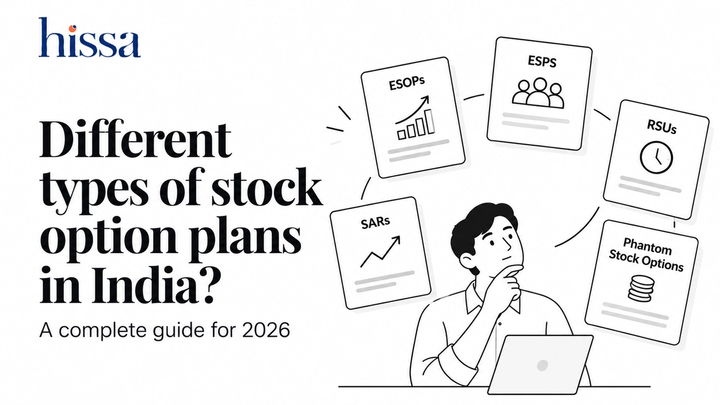
What Are the Different Types of Stock Option Plans in India? A Complete Guide for 2027
ESOP, SAR, RSU, ESPS, Phantom Stock - what each means and which fits your situation.

What Is an ESOP in India? A Complete Guide for Employees
From grant to cash - five stages every employee needs to understand.
What Is Capital Gains Tax on ESOP Shares in India?
The 24-month threshold that separates 12.5% LTCG from slab-rate STCG.
Perquisite Tax on ESOPs in India: What Every Employee Must Know
Why most Indian startup employees never exercise - and what perquisite tax actually costs.
How to Read Your ESOP Grant Letter: Indian Startup Employee Must Know
Six things to check before you sign. Most employees skip these - and pay for it later.

How to Assess If Your ESOP Plan Is Good
Five criteria that separate a compelling equity offer from a paper promise.