Best ESOP management software in India in 2026
The best ESOP management software in India in 2026 includes Hissa, Qapita, EquityList, Vestd India (formerly Trica Equity), Xumane, ESOP Guardian and Ealkay. Each suits a different combination of company stage, statutory footprint, integration requirement and budget.
Hissa brings ESOP plan design, grant issuance, automated vesting, exercise management and Ind AS 102 accounting into one connected platform. Founders and HR teams can track pool utilisation and option status, finance teams can generate audit-ready reports, and employees can see their grants, vesting schedules and equity value.
Alongside that ESOP management foundation, Hissa offers a fund-backed route to eligible employee liquidity before an IPO or a company-led buyback. Qapita and EquityList offer cap table depth and automation for venture backed companies. Vestd India, which acquired Trica Equity in 2025, positions itself as an equity platform for scaling companies.
Xumane and ESOP Guardian compete on statutory reporting and administration.
This guide compares all seven on the criteria that actually decide fit: grant logic, vesting behaviour, resignation handling, HRMS orchestration, reporting depth, liquidity infrastructure and configurability.
Who actually needs ESOP management software?
ESOP management software holds the plan, the grants and the vesting logic, keeps the cap table and the ESOP register in sync, and produces the statutory, tax and board outputs an equity programme requires.You may be ready for ESOP management software if equity administration has outgrown your current tools. Look for these signs:
Grants are spread across spreadsheets, offer letters, and email threads.
Your cap table and ESOP pool don’t always reconcile.
Vesting and employee exits require manual recalculations.
Exercise, perquisite tax, and capital gains calculations happen employee by employee.
Finance rebuilds Ind AS 102 expense schedules from raw data every reporting cycle.
Board and investor reports take days to prepare.
Employees have little visibility into the value of their options.
Quick test: If two or more of these sound familiar, it may be time to move beyond manual equity administration. The next question is which platform can handle your specific complexity.
How we evaluated the tools in this comparison
These seven factors form the buying framework for this guide. Product descriptions are based on each platform’s published materials and available documentation. Use demos to establish how each shortlisted platform handles your specific requirements.
1. Core capability depth: How well does the platform perform the category's primary job: plan setup, grants, vesting, exercises and the register?
2. Workflow and automation under complexity: How does it behave when grants are batched, vesting pauses, resignations reverse, and schedules are corrected retroactively?
3. India statutory depth: Native support for Ind AS 102 accounting, Companies Act and FEMA reporting, Demat, and both stages of ESOP taxation.
4. Integrations and HRMS orchestration: Whether HR events are merely synced or actually understood as equity events.
5. Administration, permissions and configurability: Who can see and change what, and how much of the platform's logic a company can configure without raising a change request.
6. Implementation and time to value: What has to migrate, who signs off, and how long before the platform produces usable outputs.
7. Total cost of ownership: Assess the complete investment across licensing, implementation, add-on modules, internal administration, and migration.
Best ESOP management software in India at a glance
| Tool | Primary consideration | Pricing | Product focus |
|---|---|---|---|
| Hissa | Connected ESOP management for founders, HR, finance and employees | Contact Hissa for current scope and pricing | Plan design, grants, automated vesting and exercises, pool tracking, Ind AS 102 reports and employee visibility, with a fund-backed liquidity offering |
| Qapita | Growing companies evaluating equity administration | Confirm current terms with provider | Cap table and ESOP management, including a listed-company offering |
| EquityList | Startups evaluating equity administration | Confirm current terms with provider | Cap table and ESOP workflows |
| Vestd India (formerly Trica Equity) | Companies evaluating ownership management | Confirm current terms with provider | Cap tables, ESOPs and ownership records |
| Xumane | Buyers exploring additional India-focused options | Confirm current terms with provider | Validate plan configuration and statutory reporting in a demo |
| ESOP Guardian | Companies evaluating ESOP administration | Confirm current terms with provider | Grant, vesting and settlement workflows |
| Ealkay | HR teams evaluating ESOP administration | Confirm current terms with provider | Stock-plan automation and vesting tracking |
Top ESOP management software in India: platforms and key capabilities
We start with Hissa and the ESOP management capabilities that connect your company's equity programme from plan design to employee ownership. The other platforms follow as concise alternatives for your shortlist.
1. Hissa: Connected ESOP management, built for Indian companies
Best for:
Founders, CFOs, HR teams and company secretaries that need to manage ESOPs across growing, multi-entity or listed-company structures, with configurable controls, India-focused accounting and employee liquidity workflows in one platform.
Your ESOP programme should not depend on someone remembering which spreadsheet is current. Hissa's ESOP management platform brings plan setup, grant allocation, vesting, exercises, reporting and employee visibility into a connected workflow. It is designed to support straightforward plans as well as programmes that involve parent and subsidiary companies, custom allocation rules, regulated-plan controls and corporate actions.
That breadth matters as an equity programme grows. Founders need to know how much of the pool is committed. HR needs visibility into grants, performance conditions and vesting. Finance needs expense calculations and financial disclosures. Company secretaries and governance teams need controlled workflows and accurate records.
Employees need to understand what they own and what they can do next. Hissa brings these needs together around the same equity lifecycle.
Hissa’s ESOP management key features:
1. Design the ESOP plan and track your pool
Hissa supports ESOP policy and pool design, helping you put the structure of your programme in place before issuing grants. Once the programme is running, you can track pool utilisation alongside granted, vested, exercised and forfeited options.
For founders and HR teams, this makes the allocation position visible. You can see how the pool is being used and bring that information into hiring and compensation discussions instead of assembling it from disconnected records.
2. Configure complex plans across entities
Hissa supports enterprise ESOP structures that require more than a standard vesting template. Companies can configure and customise workflows across parent and subsidiary entities, connect grants and performance vesting to custom allocation matrices, and manage fractional options.
For regulated or governance-sensitive setups, controls such as malus and clawback can be incorporated into the programme. This gives large private companies and listed companies a way to reflect plan rules, approval requirements and organisational structures inside the system rather than managing exceptions outside it.
3. Issue grants and manage the option lifecycle
Grant administration is the operational foundation of an ESOP programme. Hissa lets you issue grants and follow their progress through vesting and exercise, bringing the records into the same environment as your pool and plan information.
This gives your team a clearer answer to everyday questions: what has been granted, what has vested, what has been exercised and what has been forfeited? The programme becomes something you can monitor continuously rather than reconcile only at reporting time.
4. Automate vesting and exercise workflows
Hissa supports automated vesting and exercise workflows, including performance vesting connected to custom allocation matrices. Teams can track vesting progress and option status without treating each stage as a separate spreadsheet process.
For an employee, vesting is a personal milestone. For the company, it is also an administrative event. Connecting those views helps HR and finance explain the employee's position using the same underlying programme information.
5. Bring Ind AS 102 accounting into ESOP management
Accounting should align seamlessly with the programme, creating a connected and efficient reporting process. Hissa offers automated Ind AS-compliant ESOP accounting, expense calculations and financial disclosures. Its ESOP Management page also identifies Ind AS 102 reporting as part of the platform.
Finance teams can generate audit-ready ESOP reports and use those outputs to support their accounting process. The practical benefit is a closer connection between the options you administer and the financial information you need to prepare.
6. Apply security and privacy controls to sensitive equity data
ESOP records contain compensation, identity and ownership data. Hissa supports security and privacy requirements including ISO 27001, SOC 2, GDPR and India’s DPDP framework.
Administrative controls include two-factor authentication, password protection for reports and the removal of personally identifiable information where reports or workflows do not require it. Buyers should confirm the scope and current status of certifications, controls and data-processing arrangements during diligence.
7. Give employees a live view of their equity
The Employee Equity Portal lets employees see their grants, vesting schedules and live equity value. It also supports modelling of perquisite tax and capital gains before employees make an exercise or sale decision.
An ESOP grant becomes easier to understand when an employee can see its progress. Hissa gives your team a way to make equity visible beyond the grant letter, with a dashboard employees can return to as their ownership develops.
8. Manage exercises, buybacks and liquidity events together
Hissa supports exercises, buybacks, liquidity events and cash-outs through a single workflow. Alongside the software, the ESOP Liquidity Fund adds a route to eligible employee liquidity before an IPO or a company-funded buyback.
Keep that distinction clear: administering an exercise is different from completing a share sale. Liquidity transactions remain subject to eligibility, transaction terms, founder consent and board approval. The advantage is that Hissa connects ongoing ESOP administration with an offering designed to address the employee's eventual need for cash.
9. Manage corporate transactions without rebuilding the ESOP record
Bonus issues, stock splits, consolidations and conversion-ratio changes can alter option quantities and economics across an entire programme. Hissa supports these corporate transactions so the underlying grant, vesting and ownership records can be updated within the platform.
This becomes particularly important for companies approaching a public listing, completing a restructuring or administering plans after listing. Hissa supports both private and listed companies, allowing the programme to continue as the company’s capital structure changes.
Hissa pros and cons:
Pros
- Enterprise configurability: Supports parent and subsidiary structures, custom allocation matrices, performance vesting, fractional options, and regulated-plan controls such as malus and clawback.
- Connected ESOP administration: Plan design and grant issuance sit alongside automated vesting, exercise and cash-out workflows.
- India-focused accounting: Ind AS 102 capabilities and audit-ready reporting support finance teams’ recurring work.
- Security controls: Supports recognised security and privacy requirements, alongside 2FA, report password protection and PII-removal controls.
- Corporate-action support: Handles bonus issues, stock splits, consolidations and conversion-ratio changes.
- Employee visibility: The employee portal combines grant and vesting information with modelling for perquisite tax and capital gains.
- Listed-company support: The platform can support equity programmes beyond the private-company stage.
- Separate fund-backed liquidity offering: The ₹300 Cr. Hissa Fund provides a route for eligible employee-held share sales before an IPO or company-funded buyback.
Cons and buying considerations:
- Liquidity remains conditional: Eligibility and transaction terms govern availability, with founder consent and board approval required.
- Configuration requires scoping: Multi-entity rules, custom matrices, integrations and regulated-plan controls should be mapped during implementation.
- Security diligence remains necessary: Buyers should verify the scope and current status of certifications, privacy commitments and security controls against their procurement requirements.
- Commercial scope requires a proposal: Subscription costs, implementation work, modules and ongoing administration need provider confirmation before a meaningful price comparison.
Hissa's ESOP management scale in numbers
Hissa’s published platform figures put its offering in context:
- US$3.5 billion in ESOP grants managed: the scale of grants reported across Hissa’s platform.
- 350 million+ stock options tracked: the option-level scale published for Hissa’s employee equity offering.
- ₹300 Cr. Hissa Fund: a separate liquidity capability alongside the ESOP management software.
The first two figures speak directly to equity administration. The fund adds another part of the lifecycle by creating an opportunity for eligible employees to access liquidity. These are Hissa’s published figures and should remain attributed as such.
Pricing: Contact Hissa for a proposal covering your ESOP programme, implementation requirements and required modules.
What to explore in your Hissa demo: YBring your most complex plan configuration. Test a parent-subsidiary setup, a performance-linked grant, a resignation or exercise scenario, a corporate action, an Ind AS 102 output and the employee portal. If you are listed or preparing to list, include your governance, permission and reporting requirements.
2. Qapita: For seed to IPO companies that need cap table depth
Best for:
Companies that expect to grow from venture rounds to a public listing and need cap table, ESOP and cross border structures in one system.
Qapita is an equity management platform covering cap tables, ESOP administration and shareholder records, with a listed company offering SEBI compliance for public entities.
What makes it different:
Depth of cap table and analytics across entities, and a product line that extends to listed companies rather than stopping at the private market.
Qapita’s pros and cons
| Pros | Cons |
|---|---|
| Efficient ESOP management with user-friendly features and streamlined processes. | Limited customization can make tailored ESOP reporting and workflows difficult. |
| Centralized ESOP management helps keep equity-related processes organized and efficient. | Complex reporting processes due to limited customization and reconciliation inefficiencies. |
| User-friendly interface makes ESOP-related tasks easier to navigate and manage. | Workflow inefficiencies caused by inflexible customization and excessive clicks during navigation. |
Pricing: Confirm current pricing and which modules are included before comparing totals.
Check before choosing: How cross border entities and multiple plans sit in one register; what the listed company module costs as an add on; and how much configuration implementation requires.
3. EquityList: For venture backed teams that want simple automation
Best for:
Early stage and venture backed startups that want vesting, exercises and compliance automated without a heavy implementation.
EquityList is an equity management platform aimed at startups, covering ESOP administration, cap table and compliance workflows. Its published guidance describes automated workflows for vesting, exercises and compliance, which is the core of what most venture backed teams need in their first years.
What makes it different:
A straightforward onboarding path for companies that do not yet have complex, multi entity equity structures.
EquityList pros and cons:
| Pros | Cons |
|---|---|
| Easy grant management with a user-friendly interface. | Limited features can restrict how equity and share statuses are represented. |
| Easy equity and cap table management for tracking ownership and grants. | Confusing navigation can make equity-management tasks harder to complete. |
| User-friendly dashboard simplifies equity management and visibility. | Limited flexibility in managing and organizing equity-related information. |
| Clear equity visualization makes cap table and ownership information easier to understand. | Technical issues can occasionally disrupt equity-management workflows. |
Pricing: Request current terms and ask how pricing changes as headcount and plan count grow.
Check before choosing: How the platform handles performance vesting and resignation timelines; whether Ind AS 102 outputs are native or assembled by your finance team; and what support is available during an audit cycle.
4. Vestd India (formerly Trica Equity): For scaling companies moving onto a full stack platform
Best for:
Scaling companies that want shareholder records, vesting and governance workflows in one platform with a UK parent.
Vestd acquired Trica Equity in 2025, and Trica's site now states that Trica Equity is Vestd India. The combined platform positions itself as a full stack equity management offering for Indian companies, covering cap tables, ESOPs and ownership records, with ISO 27001 security referenced on its India pages.
What makes it different:
The consolidation itself. A buyer now gets a larger product surface, but should confirm which platform, which roadmap and which support organisation they are contracting with.
Vestd pros and cons:
| Pros | Cons |
|---|---|
| User-friendly interface makes ESOP and equity management straightforward. | Reporting features could be improved for more comprehensive ESOP reporting. |
| Responsive customer support helps users resolve ESOP-related queries efficiently. | Limited customization may restrict flexibility in tailoring ESOP management and reporting. |
| Streamlined ESOP processes help reduce manual effort and improve efficiency. | Greater reporting flexibility could make it easier to manage complex ESOP requirements. |
| Real-time visibility provides clearer oversight of equity and ESOP data. | Additional customization options could better support different ESOP structures and workflows. |
Pricing: Confirm current pricing and implementation scope with the provider.
Check before choosing: How the migration from Trica to Vestd India affects existing customers; whether India specific statutory outputs such as Ind AS 102 and FEMA reporting are native; and where the support team sits.
5. Xumane: For teams prioritising statutory reporting customisation
Best for:
Companies whose priority is configurability of statutory reporting rather than breadth of cap table features.
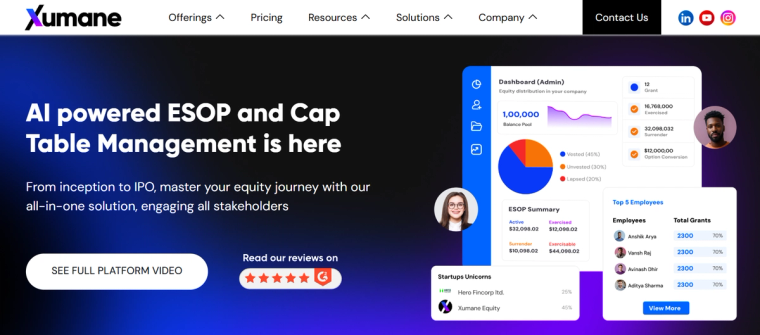
Xumane appears in AI generated comparisons of Indian ESOP platforms as an India first solution focused on customisation and statutory compliance reporting. Public documentation is thinner than for the larger platforms, so evaluate it on demonstrated outputs rather than marketing pages.
What makes it different:
An India first design intent, which suits companies with unusual reporting requirements.
Xumane pros and cons:
| Pros | Cons |
|---|---|
| A comprehensive dashboard makes ESOP management and ownership tracking easier. | Limited personalization in the user interface may affect the overall ESOP management experience. |
| Automated compliance tasks reduce manual effort and help minimize errors. | |
| Easy navigation simplifies cap table and ESOP management. | |
| Insightful dashboards and reports provide visibility into equity and ESOP data. | |
| Real-time ESOP tracking provides comprehensive insights into employee equity. |
Pricing: Confirm current pricing and implementation scope with the provider.
Check before choosing: Ask for a sample Ind AS 102 output and a sample register; confirm the implementation team's capacity; and check how the platform handles multi entity plans.
6. ESOP Guardian: For companies that want administration with advisory support

Best for: Companies that want the ESOP lifecycle administered with professional services alongside the software.
ESOP Guardian is an Indian ESOP administration platform covering grant issuance, vesting and settlement workflows. It combines software with advisory work, which suits finance teams that want fewer internal responsibilities rather than more tooling.
What makes it different: The services layer. Buyers should price that layer explicitly, because it is often where both the value and the cost sit.
ESOP Guardian pros and cons: Not enough user reviews on review aggregator sites
Pricing: Request separate costs for software, implementation and advisory services.
Check before choosing: What is software versus service; who owns the data if you later move to a self-serve platform; and how the platform handles performance vesting and liquidity events.
7. Ealkay: For HR led teams that want ESOP workflows in a broader stack
Best for: Companies that prefer to run ESOP administration from the HR side rather than the finance side.
Ealkay publishes ESOP management software for Indian companies, positioned around automating stock plans, tracking vesting and equity, and streamlining workflows for HR teams. It ranks highly in this category's search results, which is a signal of relevance rather than of product depth.
What makes it different: An HR first framing, which fits companies where the people function owns equity administration.
Ealkay pros and cons: Not enough user reviews on review aggregator sites
Pricing: Confirm current pricing and implementation scope with the provider.
Check before choosing: Whether finance grade outputs such as Ind AS 102 schedules are produced natively; how multiple plans are handled; and what the reporting looks like for a board pack.
How ESOP management software works across the equity lifecycle
- Stage 1: Plan and pool setup: The company defines the ESOP pool, plan rules, vesting templates, exercise windows and eligibility. Everything downstream inherits these decisions, which is why poor plan configuration is expensive to correct later.
- Stage 2: Grant issuance: A grant converts a value or a level decision into a specific option count at a specific date. This is arithmetic with legal consequences: no fractional shares, so rounding decisions must be consistent across the pool.
- Stage 3: Vesting and exercise: Time based schedules run automatically, performance and milestone conditions modify them, and exercises trigger tax events. Perquisite tax applies at exercise, capital gains tax at sale, and both need to be modelled before an employee makes a decision.
- Stage 4: Compliance, accounting and reporting: Ind AS 102 requires fair value measurement, typically through a Black-Scholes model, plus a recognised expense schedule. The register, the cap table and the financial statements have to agree.
- Stage 5: Liquidity and settlement: Vested equity becomes cash, through a buyback, a secondary sale or a fund purchase. Most platforms stop before this stage. The ones that support it differ sharply in how.
How the top ESOP tools compare
Use the seven tests to compare demonstrated workflows, rather than treating a product description as proof that every exception is automated.
| Evaluation area | Hissa's published capability | What to demonstrate in your shortlist demos |
|---|---|---|
| Grants and pool | Policy and pool design, grant issuance and pool tracking | Your allocation model, rounding rules and grant cycle |
| Vesting | Automated vesting workflows and progress tracking | Your time-based and performance conditions, including corrections |
| Resignations | Option-status tracking, including forfeited options | Notice changes, withdrawal of resignation and plan-specific exercise windows |
| HRMS integration | No specific HRMS connector established by the product sources cited here | Named connectors, supported events, backdated changes and error handling |
| Accounting and reports | Ind AS-compliant accounting, expense calculations, financial disclosures and audit-ready reports | Your finance team's required schedules and reconciliations |
| Liquidity | Exercise and buyback workflows, plus Hissa Fund | Eligibility, approvals, exercise requirements and settlement terms |
| Enterprise readiness | Policy and pool design | Multi-entity configuration, permissions and approval layers |
Sources: ESOP Management and Employee Equity Portal
How to choose the right ESOP management software
1. Start with your primary use case
Decide what you are actually solving: replacing manual work, scaling a process that works but no longer fits, consolidating several tools into one, or adding liquidity. Those four answers produce different shortlists.
2. Assess your workflow complexity
Count your plans, entities, approval layers, grant cycles and geographies. Then count the exceptions you handled last quarter. Exception handling is where inexpensive platforms become expensive.
3. Consider your existing technology stack
Your HRMS, payroll, accounting and registrar systems determine how much of the platform you can actually use. Prioritise a platform that fits the systems your team already runs and supports the handoffs your ESOP programme depends on.
4. Decide who administers it
Name the person who will own the platform after implementation. If the answer is finance, alongside everything else, a services heavy option may suit better than a self serve one. This decision is usually made last and matters most.
5. Compare total cost of ownership
Factor in licence, implementation, add-on modules, internal administration, training, migration, and the cost of the next stage of growth. Ask every vendor for the full first-year investment alongside the subscription cost.
6. Consider time to value
How quickly do you need the platform live, how much historical data must migrate, and are you replacing a system other teams depend on? A long implementation is only acceptable if the deadline is genuinely flexible.
Which type of ESOP software is right for you?
- A lightweight platform if your structure is a single plan with straightforward time based vesting, your team has limited administrative capacity, and speed of adoption matters more than configurability.
- A mid market platform if you run multiple plans, you are hiring quickly, and you need HRMS and payroll integration that works without manual reconciliation.
- An enterprise platform if you have multiple entities, formal approval layers, and governance or permission requirements that internal audit will examine.
- A liquidity-first platform fits when employees are asking when they can access value and the company is building its path to liquidity through a dedicated mechanism. The key criterion is the platform’s ability to facilitate share purchases directly, alongside the depth of its liquidity capabilities.
Questions to ask before choosing ESOP software
Bring your most complex workflow to the demo and evaluate how the platform supports your real-world requirements.
- Can the platform handle our most complex grant, vesting or resignation scenario, using our data?
- Which capabilities do we need in additional modules, and what do they cost?
- Which integrations are native, and which require custom development?
- Who will administer the platform in our company, and what training do they get?
- What is the typical implementation timeline for a company our size?
- What is the full first year cost, including implementation and modules?
- What data migration is required, and who does it?
- How hard is it to change vesting rules or plan structure later?
- What happens to pricing when our headcount or plan count grows?
- Can we speak to a customer that looks like us, in our sector and at our stage?
Why Hissa: take control of your ESOP programme from grant to growth
Your team deserves an ESOP programme it can run with confidence. Your employees deserve equity they can understand. Hissa gives private and listed companies the tools to deliver both.
With Hissa, you can design your plan, issue grants, automate time-based and performance vesting, manage exercises and cash-outs, and track how your option pool is being used. The platform can be configured for parent and subsidiary companies, custom allocation matrices, fractional options, and regulated-plan controls such as malus and clawback.
Instead of moving between separate files to answer basic questions, your team can administer the programme in one connected environment.
- Give founders visibility into the pool: Track allocation and option status so equity decisions start with a clear view of the programme.
- Give HR configurable grant and vesting workflows: Connect grants and performance vesting to custom allocation matrices, then manage the operational journey from grant to exercise without treating every stage as a separate project.
- Give finance accounting outputs built for the job: Automate Ind AS-compliant expense calculations and financial disclosures, and generate audit-ready ESOP reports.
- Give governance teams control across entities: Manage parent and subsidiary structures, approval requirements, malus and clawback provisions, and permission-sensitive workflows. Hissa also supports listed-company ESOP programmes.
- Protect sensitive equity information: Support security and privacy requirements including ISO 27001, SOC 2, GDPR and DPDP, with controls such as 2FA, password-protected reports and PII removal. Confirm certification scope and current status during procurement.
- Keep the ESOP record accurate through corporate actions: Manage bonus issues, stock splits, consolidations and conversion-ratio changes without rebuilding grant and vesting records outside the platform.
- Give employees a reason to engage with their equity: Let them see their grants, vesting schedules and live equity value, then model perquisite tax and capital gains before making a decision.
- Take the programme beyond administration: Run exercise, cash-out, auto-cash-out and auto-exercise workflows, connect employees to ESOP financing, and manage buybacks and liquidity events. Hissa’s fund-backed offering adds a separate route to liquidity for eligible employees, subject to transaction terms, founder consent and board approval.
With US$3.5 billion in ESOP grants managed and 350 million+ stock options tracked, Hissa brings published scale to a practical promise: help companies manage equity through increasing complexity, and help employees understand the ownership they are building.
Build an ESOP programme that can grow with your company, from private-company grants and multi-entity structures to corporate actions, liquidity and listed-company administration.