What Is an ESOP Buyback?
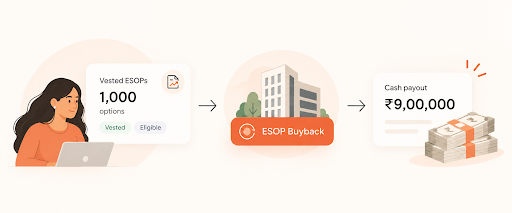
An ESOP buyback is a transaction in which a company offers cash in exchange for eligible employee stock options. The employee surrenders the options directly under the buyback programme, creating a liquidity event without first exercising the options and receiving shares.
The company sets the buyback price, eligible options, participation terms, and acceptance window. The price is generally linked to the company's fair market value or another valuation method specified for the transaction.
An ESOP buyback differs from a share buyback because the two transactions involve different assets. An ESOP buyback deals with employee stock options, while a share buyback involves shares already held by shareholders.
The distinction is important because exercising an option creates share ownership and can trigger an exercise-stage tax event. An ESOP buyback can provide liquidity while the options remain unexercised.
Why Do Companies Run an ESOP Buyback?
Companies use ESOP buybacks to provide employees with a liquidity route and manage equity as the business grows. The decision usually depends on available cash, company valuation, employee tenure, and upcoming corporate events.
Common reasons companies run buybacks
- Employee liquidity: A buyback can give employees access to cash while the company remains private and an IPO remains some distance away
- Employee exit management: A company can use a buyback to settle eligible options held by departing employees under the applicable plan terms
- Corporate restructuring: A buyback can help simplify the equity structure ahead of an acquisition, merger, or potential listing
- Cap table administration: Consolidating small option holdings can make ongoing equity administration easier
A buyback requires company approval and available funds. Employees receive an opportunity created by the company rather than an automatic entitlement.
How Is the ESOP Buyback Price Calculated?
The buyback price starts with the valuation method applicable to the company and transaction. For a private company, the process generally involves a valuation of the underlying shares, while a listed company's market price provides a publicly observable reference.
- For listed companies: FMV is based on the market price of the shares on the buyback date, which is publicly available and straightforward.
- For unlisted companies: FMV is determined by an independent registered valuer or a merchant banker engaged by the company. A fresh valuation is typically required before initiating a buyback.
Your potential gain can then be understood through three figures, the buyback price, your strike price, and the number of options you surrender.
| Element | How it is determined |
|---|---|
| Buyback price | Price offered per eligible option under the buyback programme |
| Strike price | Exercise price stated in your ESOP grant |
| Options surrendered | Number of eligible vested options you accept the offer for |
| Potential gain | Buyback price minus strike price, multiplied by options surrendered |
Worked example
Suppose your buyback price is ₹100 per option and your strike price is ₹10. If you surrender 1,000 vested options, the difference is ₹90 per option.
Your gross value would therefore be:
₹90 × 1,000 = ₹90,000
Your final amount depends on the tax treatment applicable to your transaction.
The valuation methodology and transaction documents should provide the basis for the buyback price. Employees should review the offer terms before accepting the programme.
How Is an ESOP Buyback Taxed in India?
The tax treatment of an ESOP buyback depends on the nature of the transaction and whether the options have been exercised.
Historically, companies have often treated payouts from the surrender of unexercised ESOPs as salary income and deducted TDS under the salary provisions. A recent Bengaluru ITAT ruling involving vested, unexercised options took a different view in that specific case. The tribunal held that the options represented a capital asset and that the proceeds from their repurchase were taxable as capital gains because the employee had never exercised the options or received shares.
This distinction is important because the regular ESOP tax framework applies when options are exercised and shares are allotted. The Income Tax Department states that the difference between the fair market value at exercise and the amount paid by the employee is treated as a perquisite. A later sale of those shares creates a separate capital gains event.
An unexercised option buyback can follow a different tax analysis. The 2026 ITAT decision provides an important precedent, while its application to other transactions depends on the facts and structure of each case.
TAX TREATMENT NEEDS A CLOSE LOOK
The tax outcome can depend on whether your options were exercised, how the buyback was structured, and the applicable law. Get the transaction reviewed by a qualified tax professional before accepting a significant buyback.
If you exercise options separately and later sell the resulting shares, the standard ESOP tax framework applies. The exercise can create a salary perquisite, while a subsequent sale can create capital gains.
Hissa's Perquisite Tax Calculator can help employees understand the exercise-stage calculation when they are converting options into shares.
How Does an ESOP Buyback Work for Employees?
An ESOP buyback gives eligible employees a defined opportunity to exchange some or all of their eligible options for cash. Your offer letter and ESOP plan provide the terms that determine how you can participate.
The typical employee process
- Receiving the offer: The company provides the buyback price, eligible option count, response deadline, and applicable terms
- Reviewing your options: Check how many vested options qualify and how the proposed transaction affects your remaining equity
- Choosing your participation: The offer can allow you to surrender all eligible options, a portion of them, or none
- Submitting your acceptance: Complete the required documentation before the stated deadline
- Receiving the proceeds: After the transaction closes, the company processes the payment according to the offer terms
Partial participation can give employees a way to access some liquidity while retaining eligible options for a future event.
Former employees can also qualify when the company extends the offer to eligible alumni. The plan and buyback documentation determine the exact eligibility.
Buyback offers operate within a defined acceptance window. Once the window closes, the company can move ahead with the transaction based on the accepted offers.
If you decline an offer, your remaining options continue under the applicable ESOP plan terms. Future liquidity could come through another buyback, a secondary transaction, an acquisition, or an IPO.
What happens if you surrender all your eligible options?
You receive the applicable cash consideration and surrender the options covered by the transaction. Since the transaction occurs at the option stage, you do not receive shares from those surrendered options.
Can an ESOP Buyback Be Compulsory?
An ESOP buyback can be compulsory when the company's ESOP plan contains a provision that requires the repurchase or cancellation of options in specified circumstances.
The exact trigger and treatment depend on the plan. Possible circumstances can include employment termination, a change of control, or a specified breach of the plan's terms.
Common triggers include
- Termination of employment: The plan can specify different treatment based on the reason for termination
- Change of control: An acquisition or merger can trigger specific treatment for vested and unvested options
- Specified contractual events: The plan can define additional circumstances that affect an employee's options
Read the compulsory buyback provision alongside the leaver clauses. The two sections can determine what happens to your vested options when your employment ends.
How Do Leaver Provisions Affect Your ESOP Buyback?
Leaver provisions determine how your options are treated when your employment ends. They can also affect your eligibility for a future buyback.
Plans often distinguish between good leavers and bad leavers, with different treatment for vested options.
1. Good leavers
A good leaver provision can cover situations such as resignation in good standing, retirement, or an agreed separation. The employee may retain vested options for a defined period after leaving.
If a buyback takes place during that period and the former employee qualifies under the offer, those vested options may be eligible.
2. Bad leavers
A bad leaver provision can apply to circumstances such as termination for cause, fraud, or a specified contractual breach. Depending on the plan, vested options can face cancellation or different treatment.
The exact definition matters. Review the wording in your ESOP plan instead of relying on labels used informally by the company.
If you are considering resignation, check the leaver provisions and post-resignation exercise window before making a decision about your options.
How Is an ESOP Buyback Different from a Share Buyback?
The two terms sound similar but operate under entirely different rules. Key practical differences:
- ESOP buybacks have no quantity limit, no mandatory wait period between rounds, and no dilutive effect on shareholding.
- Companies have significantly more flexibility running an ESOP buyback than a formal share buyback under the Companies Act.
Here is a direct comparison:
| ESOP Buyback | Share Buyback | |
|---|---|---|
| What is repurchased | Vested stock options | Issued shares |
| From whom | Employees (option holders) | Shareholders |
| Quantity limit | None | 25% of paid-up capital |
| Frequency | As often as cash allows | Minimum 6-month interval |
| Cap table impact | Option pool rebalanced; no dilution | Reduces share count |
| Tax for recipient | Salary income (TDS at source) | Capital gains |
The fundamental distinction is that a share buyback changes the company's equity structure, while an ESOP buyback does not. An ESOP buyback stays entirely within the option pool. Only the options move from allocated to unallocated, and the cap table is untouched.
What Do Companies Need to Run an ESOP Buyback?
A company needs a clear legal and operational framework before launching an ESOP buyback. The ESOP plan, valuation process, available cash, approvals, and employee communication all need to align.
1. Buyback provision in the ESOP plan
The plan should contain the relevant provision that permits the company to undertake the transaction. The exact wording determines which options can be repurchased and under what conditions.
2. Cash reserves
The company needs sufficient funds to meet the expected payout. The total requirement depends on the number of eligible options and the approved buyback price.
3. Current valuation
The company needs an appropriate basis for determining the value used in the transaction. For unlisted companies, valuation requirements can involve qualified professionals and prescribed methodologies.
4. Board approval and documentation
The company needs the relevant corporate approvals and transaction documents. Employee communications should clearly state the buyback price, eligible options, acceptance period, and applicable terms.
5. Employee eligibility
The company decides which employees or former employees can participate based on the ESOP plan and buyback programme. Eligibility can cover a defined employee group or a wider pool of vested option holders.
The exact legal process depends on the company's structure and the securities involved. Section 68 of the Companies Act, 2013 governs company buybacks of shares and specified securities, while employee option transactions can involve additional ESOP-specific provisions.
Does an ESOP Buyback Affect Shareholding or Dilute the Cap Table?
No. An ESOP buyback of unexercised options generally operates before those options become shares. The transaction therefore does not create new shares through exercise.
The effect on the cap table depends on how the company records the surrendered options and the definition of the cap table being used. Issued and outstanding shareholding can remain unchanged, while the number of outstanding options can change.
When an ESOP buyback happens
- Eligible options are surrendered: The employee gives up the options covered by the transaction
- The option pool changes: The treatment of surrendered options depends on the ESOP plan
- Issued shares remain unchanged: Surrendering unexercised options does not create additional shares
The distinction between options and shares is important here. Exercising an option results in share allotment and can affect the fully diluted ownership structure. Surrendering an unexercised option removes that option from the employee's holdings without creating the underlying shares.
The company should therefore communicate the effect using the relevant cap table basis, particularly when discussing fully diluted ownership.
How Big Is the ESOP Buyback Market in India?
ESOP buybacks have become a visible liquidity mechanism in India's startup ecosystem. Inc42 reported that 12 Indian startups ran ESOP buyback programmes in 2025, benefiting more than 9,265 employees and generating more than ₹1,409 crore in value. The report also noted that the number of participating startups and total value were lower than in 2024.
The figure provides context for the scale of employee liquidity programmes, while individual eligibility still depends on each company's ESOP plan and buyback offer.
What Should Employees Check Before Accepting an ESOP Buyback?
An employee can assess a buyback offer by looking at the terms attached to the options and the cash being offered.
Check these details
- Buyback price: Compare the offer price with your strike price
- Eligible options: Confirm how many vested options qualify
- Tax treatment: Understand how the transaction is expected to be reported and taxed
- Acceptance deadline: Check the final date for submitting your decision
- Remaining options: Calculate how many options you retain after the transaction
- Future liquidity: Review the company's other potential liquidity routes
- Leaver terms: Check how resignation or termination could affect your remaining options
A buyback converts an option into cash today under the terms of a specific programme. Retaining the option leaves the future outcome tied to the company's valuation and another potential liquidity event.
The right comparison therefore starts with the actual offer rather than a general assumption about ESOP value.
What Happens After an ESOP Buyback?
After the transaction closes, the company completes the surrender or repurchase of the eligible options and processes the applicable payment.
The employee's remaining options continue under the ESOP plan if the employee retains any. The treatment of surrendered options depends on the plan and transaction documents.
The company also needs to complete its internal equity records and applicable compliance steps. Employees should retain the offer letter, acceptance documents, payment record, and tax documentation for their records.
Turn Your Vested Options Into Liquidity With Hissa
An ESOP buyback can be a meaningful liquidity moment for employees who have been waiting to see their equity convert into something real, and for companies that want to reward their team without waiting for an IPO.
If you are an employee, the key questions are what the buyback price implies about the company's current valuation, how much of your gain will be taxed, and whether retaining some options makes sense given where the company is headed.
If you are a company, the foundation is always the same: a clean ESOP plan with a buyback clause, a current valuation, board approval, and a structured offer process.
A buyback is one of four liquidity paths available to Indian startup employees. The others are a company acquisition, an IPO, and a secondary sale to a dedicated ESOP fund that provides cash exits to startup employees before an IPO or acquisition. Understanding all four helps you make a better decision about whether to participate in a buyback now or hold for something else.
If you want to understand what is right for your situation, feel free to talk to us.