Equity operations rarely remain confined to the cap table. As grants, reporting periods, employee questions and corporate events accumulate, the ownership record begins to affect the work of finance, HR, legal and company-secretarial teams.
The relevant question is therefore not only whether a platform records equity accurately, but how far that record carries into the surrounding workflows.
EquityList and Hissa both cover more than ownership administration. EquityList brings cap tables, awards, governance, accounting and employee access into a platform designed for multi-jurisdiction operations. Hissa is built around the Indian equity lifecycle, with particular emphasis on ESOP configuration, cap-table management, Ind AS 102, employee tax context and eligible fund-backed liquidity.
In this article, we’ll compare how both platforms handle the practical demands of equity management, from maintaining ownership records and administering plans to supporting accounting, governance, and employee participation.
EquityList vs Hissa at a glance
EquityList and Hissa differ in where they place the emphasis across the equity lifecycle. EquityList supports equity administration across multiple jurisdictions, while Hissa brings India-specific equity management, ESOP accounting, employee workflows, and eligible liquidity into a connected operating model.
The comparison below shows how that distinction plays out across the areas that may matter to your company.
| Decision area | EquityList | Hissa | What to consider |
|---|---|---|---|
| Core proposition | Cap table, compensation and compliance platform with AI-assisted queries and operations | India-focused cap table, ESOP, compensation modeling, accounting, employee and liquidity platform | Whether the priority is multi-jurisdiction breadth, India-specific depth or a particular workflow model |
| Geographic focus | Supports global plans and multiple accounting frameworks; public material refers to the US, India, UK, Singapore, MENA and Europe | Primarily focused on Indian companies, employees, accounting and private-market workflows | Entity locations, employee locations, award types and applicable regulations |
| Cap-table management | Fully diluted ownership, securities, historical transactions, scenarios, valuations, data rooms and multi-entity support | Transactions, audit trails, stakeholder rights, corporate actions, parent-subsidiary structures and scenario modeling | Security types, historical records, rights, entities and transaction complexity |
| ESOP and equity plans | Options, RSUs, SARs, grants, vesting, exercises, buybacks and configurable enterprise workflows | Configurable ESOP plans, complex and performance-linked vesting, fractional options, malus, clawback and multiple exercise or cash-out routes | Plan rules, approval requirements, forfeitures, performance conditions and corporate actions |
| Employee equity | Employee dashboards for grants, vesting, value, FMV, documents and exercise status | Grant, vesting and value visibility with Indian perquisite-tax and capital-gains context | The information and decisions employees should be able to manage without HR involvement |
| Accounting | Public material states support for ASC 718, IFRS 2 and Ind AS 102; Ind AS 102 appears from the Growth tier | Ind AS 102 expense calculations, reserves, disclosures, Black-Scholes and audit-ready reporting | Applicable standards, modification and forfeiture treatment, entity consolidation and audit outputs |
| Valuation | 409A service plus separately quoted merchant-banker, registered-valuer and Black-Scholes services | Black-Scholes valuation connected to ESOP accounting and reporting | Whether the requirement is a valuation service, a software workflow or both |
| Compliance and governance | Activity logs, approvals, SH-6 registers, data rooms, consents, filings, SSO and security certifications | Indian ESOP governance, role-based controls, audit trails, reporting controls and privacy configurations | Approval chains, statutory records, auditability, security and plan governance |
| Liquidity | Exercises, buybacks and enterprise tender offers, surrenders and bonus programmes | Eligible employee liquidity through a ₹300 crore SEBI-registered Category II AIF | Capital source, eligibility, company approvals, transaction structure and settlement |
| Integrations | Named HRMS connections include BambooHR, Keka, Darwinbox and GreytHR; enterprise integrations are available on the custom tier | Integration requirements are assessed against the company’s implementation and operating setup | Required systems, API availability, data ownership, exports and synchronization rules |
| Pricing | Published India plans from free to custom enterprise, priced by stakeholder count and AI allowance; add-on services quoted separately | Standard SaaS tiers are not publicly listed; terms are proposal-led | Comparable modules, stakeholder counts, migration, services, support, integrations and transaction costs |
EquityList overview
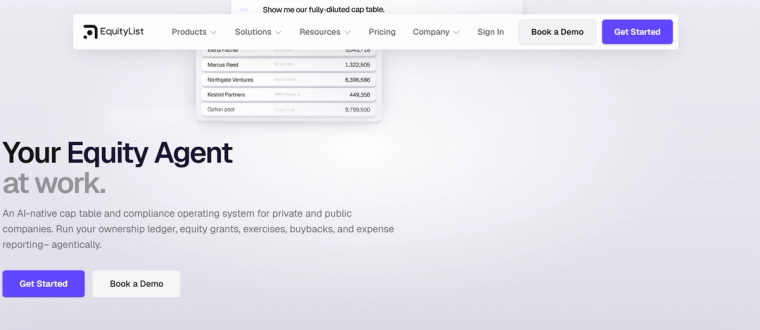
EquityList supports equity operations across cap tables, equity awards, shareholder records, accounting reports, governance, and employee access. Its public offering also includes valuation services, secretarial compliance, dematerialisation, and an AI agent for working with equity records.
The platform supports multi-entity and global grant administration, with reporting across ASC 718, IFRS 2, and Ind AS 102. EquityList publishes India pricing across Free, Build, Growth, and Enterprise plans, but capabilities and services vary by tier.
For companies considering EquityList, the relevant question is how much of the required workflow sits within the selected plan. Jurisdiction coverage, integrations, accounting requirements, and separately priced services can affect the overall scope and cost.
Hissa overview
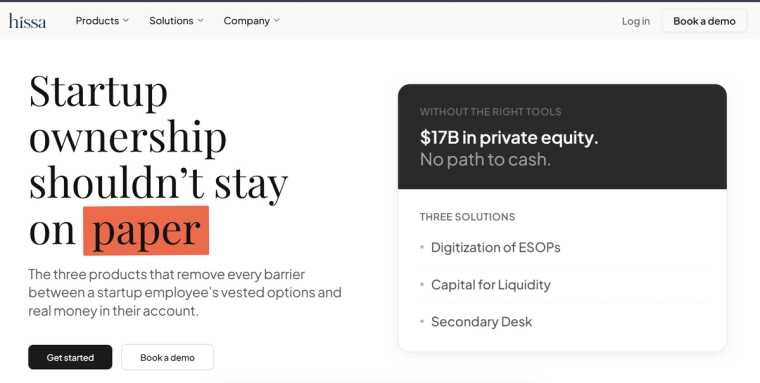
Hissa focuses on equity management for Indian companies, connecting cap-table records with ESOP administration, accounting, employee workflows, and eligible liquidity. It also supports requirements such as parent-subsidiary structures, complex vesting, corporate actions, and listed-company workflows.
Ind AS 102 sits within the equity workflow, covering Black-Scholes valuation, expense calculations, reserve tracking, disclosures, and reporting. Employees can also view their grants and equity value while modeling Indian perquisite tax and capital gains.
For eligible liquidity transactions, Hissa provides access to a ₹300 crore SEBI-registered Category II AIF, subject to applicable terms and approvals. Pricing is proposal-led, so the overall commercial scope depends on the implementation, accounting, support, and liquidity requirements included.
EquityList vs Hissa: Feature-by-feature comparison
1. Cap-table management
EquityList
EquityList maintains fully diluted ownership across shares, options, and fundraising instruments. Its public materials cover common and preferred shares, SAFEs, convertibles, warrants, option pools, historical transactions, and fundraising scenarios.
Multi-entity support is available under its Growth plan, while AI-assisted capabilities vary across pricing tiers. The relevance of these features depends on the company’s entity structure and the plan selected.
Hissa
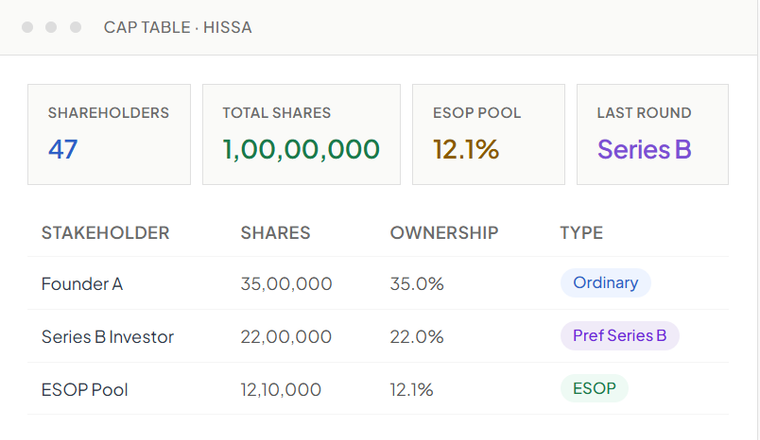
Hissa manages share issuances, transfers, buybacks, and conversions with an audit trail and updated ownership records. It also supports stakeholder-rights matrices, funding-round and exit modelling, parent-subsidiary structures, and listed-company requirements.
Corporate actions such as bonus issues, stock splits, consolidations, and conversion-ratio changes connect with the underlying cap table. This can be particularly relevant for Indian companies that want ownership changes to carry through to ESOP, accounting, and related equity workflows.
What to consider
The distinction becomes more relevant as the ownership structure becomes complex. Security types, historical transactions, stakeholder rights, multiple entities, and corporate actions can determine how much work remains outside the platform.
For Indian companies managing these requirements alongside ESOP and accounting workflows, Hissa’s connection between the cap table and the wider equity record may be an important consideration.
2. ESOP and equity-plan management
EquityList
EquityList supports options, RSUs, and SARs across employees, advisers, and consultants. Its workflows cover plan and pool management, grant issuance, vesting, exercises, buybacks, e-signatures, and grant documents.
While EquityList covers a broad set of plan-management requirements, companies may need a higher pricing tier for some of the configuration and governance capabilities relevant to more complex plans.
Hissa
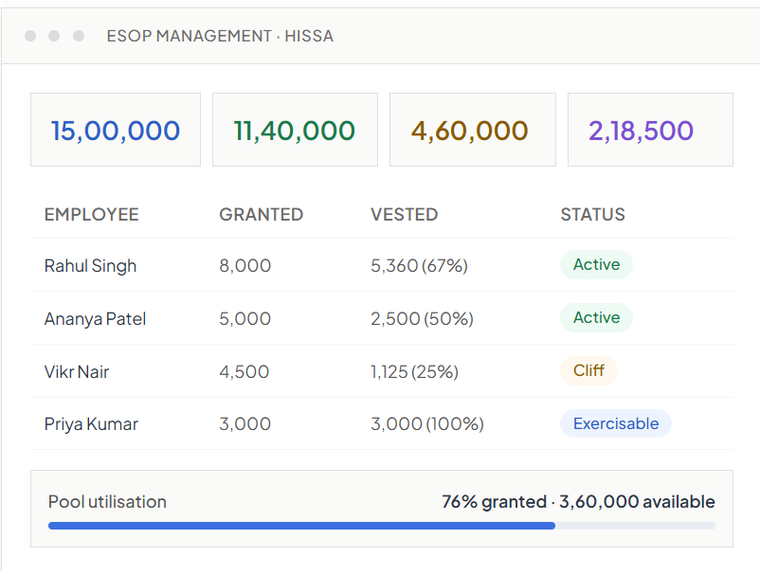
Hissa supports the ESOP lifecycle from plan and pool configuration through grants, vesting, exercise, forfeiture, and eligible liquidity. Its configuration includes performance-linked vesting, custom allocation matrices, fractional options, malus and clawback provisions, and parent-subsidiary structures.
Exercise and cash-out workflows can also connect with the underlying equity record. For Indian companies with complex plan rules, this provides a closer link between plan administration, corporate actions, accounting, and employee equity workflows.
Recommended read: What Is an ESOP Buyback and How Does It Work in India?
What to consider
Plan complexity can provide a clearer basis for comparison than the number of supported features. Vesting conditions, resignation treatment, performance rules, exercise policies, and subsidiary arrangements can determine how much configuration a company needs.
The level at which these capabilities become available also matters. EquityList places some advanced workflows within its Enterprise tier, while Hissa’s relevance may depend on the configuration and services included in its proposal.
3. Employee equity management
EquityList
EquityList gives employees visibility into grants, vested units, value, exercise eligibility, status, and relevant documents. Its broader workflows also cover exercises and buybacks, with additional employee lifecycle capabilities available at the Enterprise level.
This provides employees with access to their equity information, but the depth of workflows available depends partly on the selected plan and company setup.
Hissa
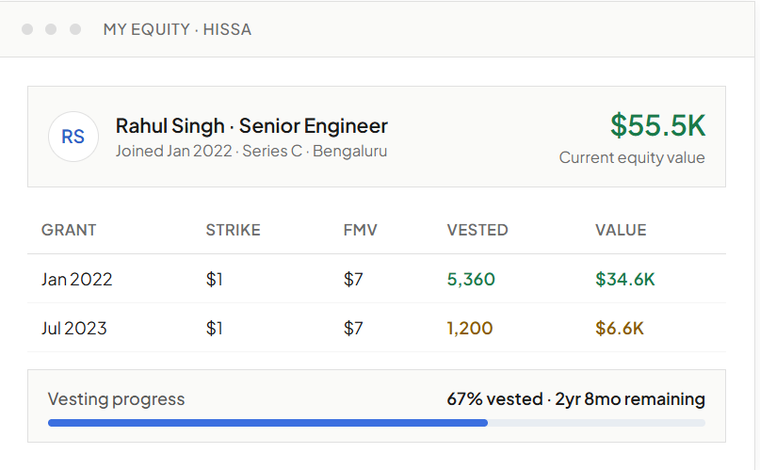
Hissa shows employees their grants, vesting progress, and current equity-value context. It adds India-specific context through calculators for perquisite tax, exercise scenarios, and capital gains.
Employee records can also connect with exercise, financing, and eligible liquidity workflows. This may be particularly relevant when employees need to understand the financial implications of their equity before making a decision.
What to consider
Employee visibility goes beyond showing vested options. Tax implications, exercise costs, documents, approvals, and potential liquidity can determine how useful the portal is in practice.
For Indian employees, Hissa’s tax and exercise context may provide more relevant decision support alongside the underlying grant information.
4. Accounting and financial reporting
EquityList
EquityList supports expense reporting across ASC 718, IFRS 2, and Ind AS 102. Its public materials describe grants, vesting events, forfeitures, and modifications as inputs to financial reporting, alongside multi-entity and jurisdiction-specific reports.
However, companies with more detailed accounting requirements may need to confirm how the platform handles calculations, assumptions, modifications, audit schedules, and any professional services beyond the standard reports.
Hissa
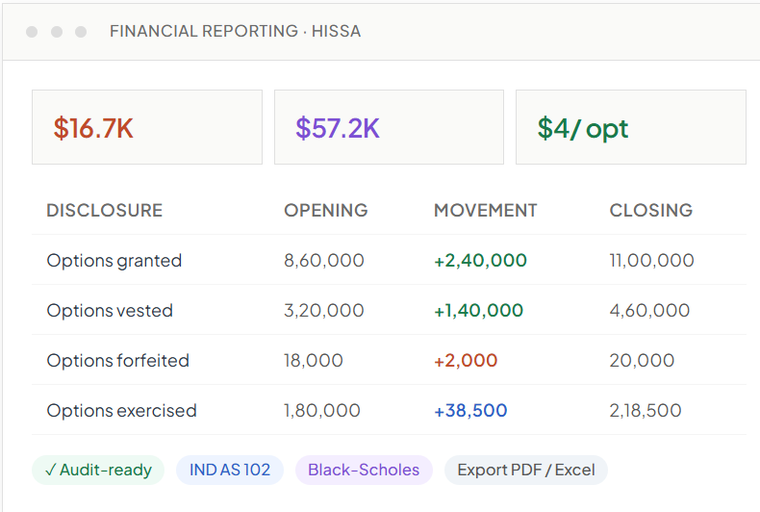
Hissa builds its accounting workflow specifically around Ind AS 102. It covers Black-Scholes valuation, expense calculations, reserve tracking, disclosures, and audit-ready reports for finance teams, auditors, and company secretaries.
These outputs connect with the underlying grant records. Changes to vesting, forfeitures, or grant status can flow into accounting, giving finance teams clearer traceability between an equity event and its financial impact.
What to consider
The relevant accounting standard will influence the comparison. Companies reporting across jurisdictions may value EquityList’s coverage of multiple standards, whereas Indian companies may find Hissa’s deeper focus on Ind AS 102 more aligned with their reporting requirements.
Accounting depth matters as well. Treatment of vesting, forfeitures, modifications, performance conditions, and corporate actions can affect expenses and reserves, making the connection between equity records and accounting outputs an important consideration.
5. Valuation
EquityList
EquityList offers independent 409A valuation services through its platform, with public materials covering the US, India, and UK. For India, merchant-banker and registered-valuer valuations and Black-Scholes valuation are available as separately quoted services.
The valuation route therefore depends on the specific requirement. Companies may need to account for separate service scope and pricing when valuations form a recurring part of their equity operations.
Hissa
Hissa integrates Black-Scholes valuation with its ESOP and Ind AS 102 accounting workflow. Valuation inputs connect directly with expense calculations, reserves, disclosures, and reporting.
For Indian companies managing ESOP accounting, this connection can reduce the operational separation between option valuation and the financial reporting that depends on it.
What to consider
The relevant requirement may be an independent or statutory valuation, an option-pricing calculation, or both. The purpose of the valuation, required methodology, qualified provider, and frequency can determine which approach is more suitable.
For recurring ESOP accounting, the flow from valuation inputs into Ind AS 102 reporting is also relevant. Hissa’s integrated approach may be useful where finance teams want valuation and accounting to remain connected to the underlying equity records.
6. Compliance and governance
EquityList
EquityList includes activity logs, board and shareholder approvals, SH-6 registers, data rooms, consents, and statutory reporting. Enterprise plans add capabilities such as SAML/SSO, custom dashboards, and enterprise integrations.
Some governance and security capabilities depend on the selected plan, which may affect companies with more detailed approval or access requirements.
Hissa
Hissa connects governance controls with Indian ESOP and equity administration. Its capabilities include role-based access, audit trails, malus and clawback provisions, and support for listed-company and corporate-action workflows.
Its documented security and privacy framework includes ISO 27001, SOC 2, GDPR, and DPDP, alongside two-factor authentication, password-protected reports, and PII removal. This combination may be particularly relevant for Indian companies managing employee data alongside equity and governance records.
What to consider
Governance depends on how records, approvals, and permissions work together. The level of access control, audit history, statutory reporting, and documentation required will vary with the company’s structure and internal policies.
Security certifications provide useful context, but data residency, retention, SSO, export controls, and deletion policies may also influence the decision.
7. Liquidity
EquityList
EquityList supports exercises and buybacks within its equity-plan workflows. Tender offers, surrenders, and bonus programmes are available under its Enterprise plan.
Its public materials do not identify a standing capital pool for purchasing employee shares. The source of capital, transaction structure, and eligibility may therefore depend on the individual liquidity programme.
Hissa
Hissa provides an eligible employee-liquidity route through its ₹300 crore SEBI-registered Category II AIF, registration IN/AIF2/23-24/1439. The fund can provide institutional capital for qualifying private-market transactions, reducing the need for the company to fund the transaction from its own balance sheet.
Hissa states T+5 business-day settlement where applicable. Transactions remain subject to employee and company eligibility, approvals, fair value, transfer restrictions, and applicable fund terms.
What to consider
The main distinction is the mechanism behind the liquidity offering. EquityList supports transaction workflows such as buybacks and tender offers, while Hissa provides a defined fund-backed route for eligible employee transactions.
For Indian companies considering employee liquidity, the capital source, eligibility requirements, company balance-sheet impact, approvals, and settlement process may carry more weight than the availability of a liquidity feature alone.
8. Geographic coverage
EquityList
EquityList supports equity administration across multiple countries, plans, and currencies. Its public materials reference US ISOs and NSOs, Indian ESOPs, European RSUs, and reporting under ASC 718, IFRS 2, and Ind AS 102.
This broader coverage may be relevant for companies with employees and entities across jurisdictions. However, multi-entity support begins with the Growth plan, and geographic coverage alone does not indicate the depth of local accounting, tax, or statutory workflows available in each market.
Hissa
Hissa concentrates on the requirements of Indian companies. Its capabilities cover Indian ESOP structures, Ind AS 102, employee tax context, local governance, demat-related requirements, and eligible private-market liquidity through a SEBI-registered fund.
It also supports parent-subsidiary structures and listed-company requirements. This India-focused depth may be more relevant for companies whose primary equity, accounting, and employee requirements sit within India.
What to consider
Geographic coverage matters in relation to where the company actually operates. A business with entities and employees across several jurisdictions may value broader international support.
For an India-focused company, the comparison shifts towards the depth of local workflows. Accounting, employee taxation, corporate actions, governance, and liquidity may carry more practical weight than the number of countries a platform supports.
9. Pricing
EquityList
EquityList publishes India pricing based on stakeholder limits and AI credits:
- Free: ₹0 per month for up to 10 stakeholders
- Build: ₹5,000 per month when billed annually for up to 50 stakeholders
- Growth: ₹15,000 per month when billed annually for up to 100 stakeholders
- Enterprise: Custom pricing and stakeholder limits
Some services are priced separately, including secretarial retainers, dematerialisation, valuation work, scheme advisory, and employee town halls. AI-credit usage and additional stakeholder charges can also affect the total cost beyond the base subscription.
Hissa
Hissa follows a proposal-led pricing model rather than fixed SaaS tiers. The commercial proposal can be tailored to factors such as the company’s stakeholder base, implementation requirements, accounting scope, employee workflows, support needs, and eligible liquidity requirements.
This approach gives companies more flexibility to evaluate the platform around their specific equity management needs and the mix of services they require. For Indian companies with more complex or evolving equity workflows, a customized proposal can provide a clearer view of the technology and services needed for their particular setup.
What to consider
The two platforms take different approaches to pricing. EquityList provides published subscription tiers, which can help companies get an initial sense of platform costs based on stakeholder count. Hissa takes a more customized approach, with pricing shaped around the company’s requirements and the scope of services included in the proposal.
A useful cost comparison should therefore look beyond the headline subscription price and consider:
- Platform and recurring subscription fees
- Stakeholder limits and overage charges
- Implementation and migration
- Integrations and API access
- Support and managed administration
- Accounting and valuation services
- Secretarial or advisory services
- AI usage charges
- Liquidity and transaction-related fees
- Contract terms and service limits
For companies evaluating EquityList and Hissa, the better fit may depend on whether they prefer a defined subscription tier or a solution and commercial scope tailored to their specific equity management requirements.
EquityList vs Hissa: Where each platform may be more relevant
The differences between EquityList and Hissa become clearer when viewed against the company’s operating requirements. Geographic footprint, accounting standards, plan complexity, employee needs, and liquidity can each influence which platform is more relevant.
When EquityList may be more relevant
EquityList may suit companies managing equity across several jurisdictions, particularly where ASC 718, IFRS 2, and Ind AS 102 form part of a multi-entity reporting model.
Its AI-assisted workflows, published pricing tiers, and named HRMS integrations may also be relevant to teams that prioritise these capabilities. Some advanced workflows sit within higher pricing tiers or separately quoted services, so the required scope can influence the overall commercial model.
When Hissa may be more relevant
Hissa may suit companies with India at the centre of their equity operations. Its Ind AS 102 workflow connects accounting with grant records and Black-Scholes inputs, while its plan administration supports complex vesting, malus and clawback provisions, fractional options, and Indian corporate actions.
The employee experience also adds Indian perquisite-tax and capital-gains context to grant information. For companies considering employee liquidity, Hissa provides an eligible fund-backed route through its SEBI-registered Category II AIF, subject to applicable eligibility, approvals, and transaction terms.
When both platforms meet your requirements
Both platforms may be relevant when a company combines Indian equity requirements with international operations. In these cases, the distinction may come down to the depth of the required workflows, implementation scope, and total commercial terms.
For India-focused companies, Hissa’s connection between ESOP administration, Ind AS 102, employee tax context, and eligible liquidity may carry greater relevance as those requirements become more complex.
How to compare EquityList and Hissa in practice
A product comparison becomes more useful when it reflects the company’s actual equity structure. The same ownership records, plan rules, accounting requirements, and employee events can reveal how much of each workflow the platform handles and where additional services or manual work remain.
For example, the comparison could reflect an Indian parent with a subsidiary, ordinary and preference shares, an existing ESOP pool, performance-based grants, a forfeiture event, and an upcoming corporate action or employee exercise.
Relevant areas to consider include:
- Equity structure: How well does each platform support the company’s entities, securities, and plan rules?
- Accounting: How do forfeitures, modifications, and performance outcomes affect ownership records and accounting reports?
- Employee workflows: What information can employees view, model, and act on without relying on HR?
- Governance: How are permissions, approvals, signatures, and audit trails maintained?
- Corporate actions: How do ownership and grant records change after a split, bonus issue, conversion, or similar event?
- Migration: What is included in data migration, cleanup, reconciliation, and historical record reconstruction?
- Integrations: Which connections are standard, and which require additional implementation?
- Commercial scope: Which software capabilities and services are included in the proposal, and which valuation, support, AI usage, or transaction costs are separate?
Looking at these areas against the same company scenario provides a more consistent basis for understanding the differences between EquityList and Hissa.
EquityList vs Hissa: Which platform aligns better with your equity operations?
EquityList and Hissa cover many of the same foundational requirements, including cap tables, equity plans, employee access, reporting, and governance. The distinction becomes clearer when India-specific accounting, plan complexity, employee tax context, and the structure of liquidity become part of the requirement.
For companies operating primarily in India, Hissa brings these workflows closer to the same equity record. Ind AS 102 reporting, configurable ESOP administration, employee decision support, and eligible fund-backed liquidity can therefore carry more relevance than broader geographic coverage alone.
The final choice will still depend on your company structure, existing systems, and upcoming equity events. Looking at how each platform supports those requirements provides a more useful basis for comparison than feature counts.
If Hissa is part of your evaluation, you can use your cap table, plan rules, and upcoming equity events to see how these workflows would work for your company. Book a demo with Hissa.