
The right equity management software should keep your ownership records accurate as your startup grows. A long feature list means little when your team still has to reconcile cap tables, grant records, and exercise details across separate files.
The leading options include Hissa, Qapita, EquityList, Vestd India, Carta, Ledgy, Pulley, and Cake. Each platform serves different company stages, entity structures, employee equity needs, and internal administration requirements.
A founder preparing for a seed round has different requirements from a Series C finance team managing subsidiaries and performance-linked awards.
For Indian startups, local accounting and tax requirements also matter. Ind AS 102 reporting, Companies Act processes, and employee tax visibility should be part of your evaluation when comparing equity management platforms.
We’ve compared these platforms across their features, use cases, and suitability for different types of companies. Let’s look at what each one offers and where it may fit into your equity management process.
What is equity management software for startups?
Equity management software helps startups maintain ownership records and manage employee equity from a shared data source. Depending on the platform, it can cover cap tables, ESOPs, dilution modeling, stakeholder reporting, and related compliance workflows.
The categories can overlap, so it helps to understand what each type of software is designed to manage.
- Cap table software: Records securities, transactions, and current ownership, including fully diluted ownership.
- ESOP management software: Manages option plans, grants, vesting, exercises, and employee workflows.
- Equity management software: Connects company ownership and employee equity across funding, grant, and reporting events.
- Company secretarial software: Handles statutory registers, resolutions, and filing workflows.
- Portfolio management software: Helps investors track holdings across multiple companies.
Before you choose a platform, ask yourself this:
Ask your finance, HR, and legal teams for the latest issued ownership, fully diluted ownership, available option pool, and outstanding grants. If those figures come from different files or produce different answers, review how you maintain your equity records.
Best equity management software for startups at a glance
The right platform depends on where your company operates and how it manages equity. For Indian startups, the comparison should cover ownership records, ESOP administration, local accounting requirements, data governance, and employee equity visibility alongside general cap table features.
| Platform | Best for | Pricing approach | India-specific strengths and considerations |
|---|---|---|---|
| Hissa | Indian startups seeking connected cap table, ESOP, accounting, and employee equity management | Custom quote based on plan, company structure, and requirements | India-focused equity management with Ind AS 102 reporting, employee tax modeling, statutory ESOP workflows, configurable equity plans, and corporate-action support. Includes governance controls such as SSO, maker-checker approvals, PII protection, and audit trails. |
| Qapita | Venture-backed companies managing equity through multiple growth stages | Quote-based plans; optional services and integrations may cost extra | Broad cap table and ESOP administration, with support for Indian accounting and statutory workflows. A wider range of modules and services may require careful scope and cost evaluation. |
| EquityList | Early-stage and venture-backed startups formalizing equity administration | Free tier for up to 10 stakeholders; paid and enterprise plans available | Startup-focused cap table and ESOP management, with related valuation and data-room services. Verify the availability and scope of advanced accounting outputs, audit support, and complex equity workflows. |
| Vestd India | Indian companies evaluating ownership and employee option management | Custom quote based on company and ESOP requirements | India-focused offering backed by a broader equity management platform. Confirm the specific product configuration, statutory coverage, accounting outputs, and support included in the proposed plan. |
| Carta | Startups managing ownership and equity across international markets | Free plan for eligible companies; paid plans are quote-based | Established global equity management ecosystem with cap table, equity administration, and valuation-related products. Indian companies should confirm coverage for local instruments, accounting, statutory processes, and employee tax workflows. |
| Ledgy | International startups managing employee equity across multiple countries | Free entry tier; paid plans and reporting add-ons available | Multi-country employee equity and stakeholder workflows. Companies with Indian entities should verify local accounting outputs, tax workflows, and corporate-action support. |
| Pulley | Historically, venture-backed startups focused on fundraising and dilution modeling | Published startup and growth pricing; enterprise pricing is custom | Startup-oriented cap table and financing workflows. Its announced December 8, 2026, shutdown date makes current service availability and continuity essential to verify before shortlisting. |
| Cake | Early-stage startups setting up cap table and option-plan administration | Free entry tier; paid plans based on stakeholder limits and features | Accessible equity administration with published pricing. Indian startups should validate statutory coverage, local accounting workflows, and support for more complex ownership structures before committing. |
Pricing and feature availability can change. Confirm current plan limits, security documentation, data-handling arrangements, implementation scope, and India-specific capabilities directly with each provider before making a decision.
How we evaluated these eight platforms
The right equity management software depends on your company stage, equity structure, and the work your finance, HR, and legal teams need to manage. We evaluated these eight platforms from the perspective of an Indian startup moving from early equity administration to growth-stage operations.
We looked at the areas that typically matter most during that transition:
- Cap table and dilution: Ownership records, share classes, options, convertibles, transaction history, and financing scenarios.
- ESOP management: Option pools, grants, vesting, exercises, forfeitures, resignations, and employee access.
- India compliance: Ind AS 102, Companies Act requirements, FEMA, demat processes, and tax considerations.
- Usability: Setup, data migration, day-to-day administration, and vendor support.
- Integrations: Connections with HR, payroll, finance, and legal workflows.
- Scalability: Multiple plans, entities, approval workflows, performance vesting, and corporate actions.
- Security and cost: Access controls, certifications, implementation requirements, and ongoing administration costs.
The comparison reflects the needs of the buyer described above, rather than a universal product ranking.
The 8 best equity management software platforms for startups
Each profile focuses on the work a startup needs to manage, from ownership and fundraising to employee equity, with key questions to ask during a product demo.
1. Hissa: For Indian startups managing equity from grant to growth
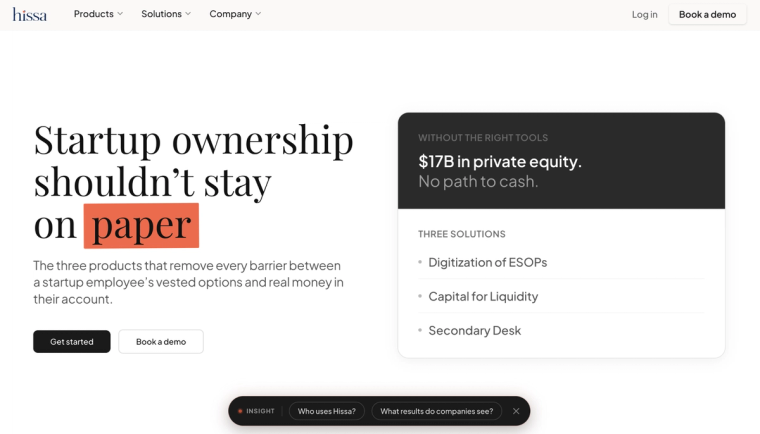
Best for: Indian founders and operating teams managing cap tables, ESOPs, accounting, and employee equity in one system.
A startup’s first cap table often starts as a simple ownership record. As fundraising and employee grants increase, the same records need to support dilution modelling, vesting, exercises, and financial reporting.
Hissa supports the full equity lifecycle. Its public product information covers cap table management, ESOP administration, grant issuance, vesting and exercise workflows, along with Ind AS 102 reporting.
The employee experience includes grant and vesting visibility, equity value information, and tax modeling to help employees understand the financial implications of an exercise.
Hissa also offers liquidity workflows for eligible exercises and cash-outs through a separate fund-backed route. These workflows have their own eligibility requirements and transaction terms, so buyers should evaluate them separately from the core equity management software.
Recommended reading: What Is an ESOP in India? A Complete Guide for Employees
Hissa’s ESOP management key features:
1. Design and manage the ESOP plan
Hissa supports ESOP policy and pool design, with visibility into granted, vested, exercised, and forfeited options. This helps founders and HR teams track pool utilisation when planning future grants.
2. Configure plans across entities
Companies can configure plans across parent and subsidiary entities, including performance vesting, custom allocation matrices, fractional options, malus, and clawback provisions. Review these configurations against your actual plan rules before implementation.
3. Manage grants, vesting, and exercises
Hissa connects grant issuance with vesting and exercise workflows, keeping option status within the same ESOP record. Teams can track grants, vesting, exercises, and forfeitures without maintaining separate records.
4. Support Ind AS 102 reporting
Hissa provides Ind AS 102 accounting, expense calculations, and reporting within its ESOP management offering. Finance teams can review the schedules and reports generated for their accounting and audit processes.
5. Give employees equity visibility
The Employee Equity Portal lets employees view grants, vesting schedules, and equity value, with tools to model perquisite tax and capital gains. This helps employees understand the financial implications before exercising or selling.
6. Manage liquidity and corporate actions
Hissa supports exercises, buybacks, liquidity events, and corporate transactions such as stock splits and conversion-ratio changes. Its separate ESOP Liquidity Fund provides a liquidity route for eligible employees, subject to applicable terms and approvals.
Recommended reading: Best ESOP Management Software in India (2026): Why Hissa Is Built Differently
Where Hissa fits: The platform is designed for Indian companies, with ownership management, ESOP administration, employee visibility, and Ind AS 102 reporting in the same system.
Hissa pros and cons:
| Pros | Cons |
|---|---|
| Cap table management: Tracks ownership, transactions, and dilution scenarios | Complex cap tables and historical records may require detailed migration work |
| ESOP administration: Supports grants, vesting, exercises, and related employee workflows | Advanced workflows and integrations may require additional configuration |
| India-focused reporting: Includes Ind AS 102 calculations and reporting capabilities | |
| Employee visibility: Gives employees access to grant details, vesting information, equity value, and tax modelling | |
| Growth-stage workflows: Supports configurable vesting and multi-entity requirements |
What you should consider before buying: Define the scope for historical cap table and grant migration before implementation. Pricing can vary based on company structure, modules, implementation requirements, and integrations.
Pricing approach: Ask Hissa for a proposal covering the entities, stakeholders, grants, migration work, and integrations you expect to use. Request both the first-year cost and recurring cost after implementation.
Test before choosing:
- Opening record: Rebuild your current and fully diluted cap table using sample company data.
- Funding event: Model the ownership impact of a proposed funding round.
- Complex grant: Configure a performance-linked award using your actual vesting rules.
- Employee exit: Process a resignation, exercise, and forfeiture using the same records.
- Finance outputs: Generate Ind AS 102 schedules and board reports from administered grants.
- Corporate action: Demonstrate how the system handles a stock split or conversion-ratio change.
2. Qapita: For venture-backed startups managing equity across growth stages
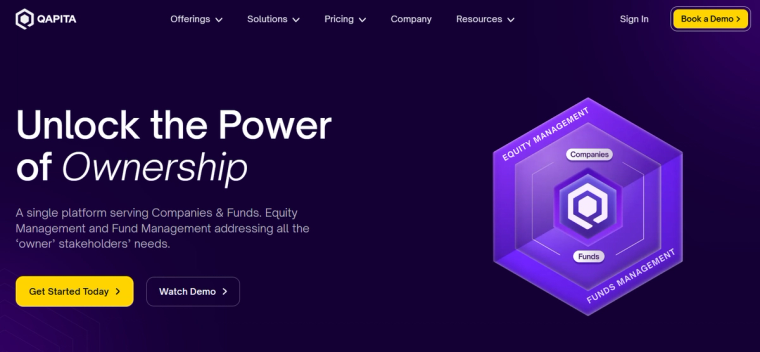
Best for: Venture-backed companies managing cap tables and stock plans across multiple stages of private-company growth.
Qapita positions its platform around cap tables, stock plans, stakeholder reporting, and tender offers. This range can support startups managing repeated funding rounds and growing employee-equity programs.
Evaluate how these capabilities work together in daily administration. Ask the team to process a preference round, convertible instrument, and employee exit using the same sample company.
What makes it different: Broad equity administration across private-company growth stages and regional markets.
Qapita pros and cons:
| Pros | Cons |
|---|---|
| Cap table and stock-plan tools support growth-stage equity management. | Multiple modules may increase implementation complexity and total cost. |
| Stakeholder reporting supports communication and ownership visibility. | India accounting outputs need detailed review against auditor requirements. |
| Tender-offer capabilities support liquidity-related transactions. | Migration responsibilities and module boundaries should be confirmed before implementation. |
Pros and cons of Qapita based on publicly available product information and G2 user reviews.
Pricing approach: Qapita offers quote-based Starter, Growth and Enterprise plans, with no base subscription prices published. Optional services are generally custom-priced; published charges include employee town halls at $500 per hour and analyst support at $125 per hour, while integrations may carry one-off setup fees.
Buyer considerations: Review how the modules connect and assess India accounting outputs against your auditor’s requirements.
Test before choosing: Preference instruments, convertibles, multi-entity records, corporate actions, and migration workflows.
Hissa versus Qapita: Qapita may suit teams looking for broad equity administration across growth stages and markets. Hissa fits Indian startups that place greater weight on India-focused ESOP accounting, employee tax visibility, and corporate-action workflows.
3. EquityList: For early-stage startups seeking straightforward cap table and ESOP management
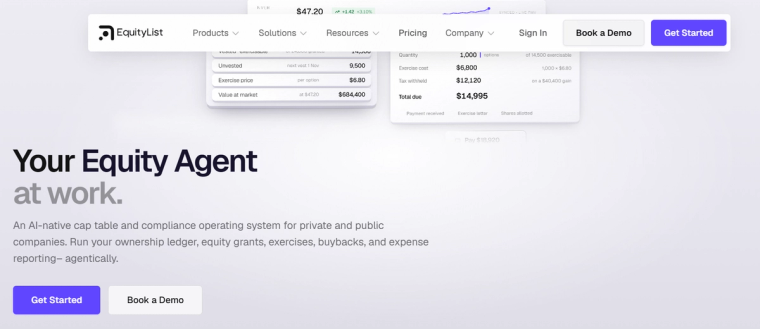
Best for: Early-stage and venture-backed startups moving from spreadsheets to structured cap table and grant management.
EquityList’s current platform covers cap tables and equity grants, including ESOP and SAR administration. It also offers valuation services and data rooms, which can support financing and diligence processes.
The platform can suit startups formalizing their equity records for the first time. During a demo, test actual preference terms, vesting rules, and resignation scenarios to see how the system handles exceptions.
What makes it different: Startup-focused cap table and ESOP management with related valuation and data-room services.
EquityList pros and cons:
| Pros | Cons |
|---|---|
| Cap table and grant tools support startups moving away from spreadsheets. | Complex instruments and performance vesting need testing at growth stage. |
| Valuation and compliance services can support related equity requirements. | Ind AS 102 schedules and audit support should be verified in the current product. |
| Data-room capabilities can support financing and diligence workflows. | Advanced workflows may require additional validation during implementation. |
Pros and cons of EquityList based on publicly available product information and user reviews on G2.
EquityList pricing: EquityList offers a free plan for up to 10 stakeholders. Annual plans start at ₹60,000 per year for Build and ₹1,80,000 per year for Growth, with additional stakeholder charges; Enterprise pricing and advisory services are custom-quoted.
Buyer considerations: Growth-stage teams should test complex instruments, performance vesting, Ind AS 102 schedules, and audit support.
Test before choosing: Preference shares and convertibles, performance vesting, resignation timelines, and audit outputs.
Hissa versus EquityList: EquityList may suit teams looking for straightforward startup equity administration. Hissa fits teams that place more weight on India accounting, corporate actions, employee tax context, and eligible liquidity workflows.
4. Vestd India: For scaling Indian startups managing ownership and option plans
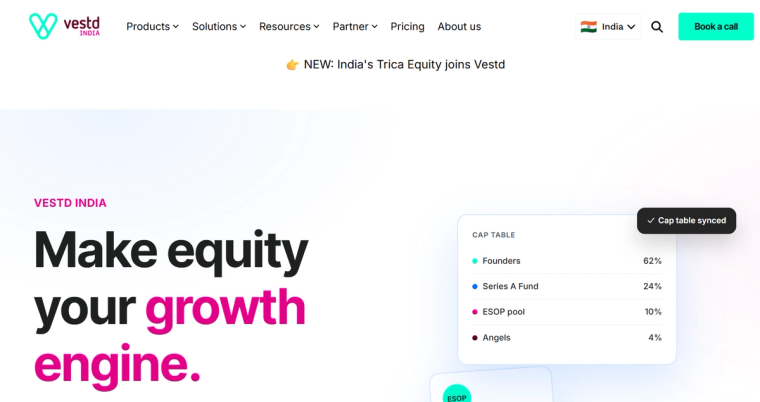
Best for: Scaling Indian companies evaluating cap table and option-plan management with an international platform.
Vestd maintains a dedicated India presence and publishes content for Indian ESOP buyers. Its wider platform covers cap tables and share schemes, with employee portals and migration support among its listed capabilities.
Buyers should verify the India-specific setup before choosing the platform. Confirm the contracting entity, product used in India, local accounting outputs, and statutory support.
What makes it different: An India presence connected to Vestd’s wider ownership and option-management platform.
Vestd India pros and cons:
| Pros | Cons |
|---|---|
| A dedicated India presence gives Indian buyers a local evaluation path. | India-specific accounting and statutory capabilities need validation. |
| Cap table and share-scheme tools support core ownership and option workflows. | Buyers should confirm the contracting entity and product available in India. |
| Migration support can help teams move existing equity records to the platform. | Data hosting, migration responsibilities, and local support should be confirmed. |
Pros and cons of Vestd India based on publicly available product information and user reviews on G2.
Vestd India pricing: Vestd India does not publish fixed subscription prices. It offers one plan with all platform features included, with a tailored quote based on the company’s stage, team size, cap table and ESOP requirements.
Buyer considerations: Confirm the contracting entity, product used in India, support location, and coverage for local accounting and statutory requirements.
Test before choosing: India accounting outputs, corporate actions, data hosting, migration responsibilities, and local support.
Hissa versus Vestd India: Vestd India may suit teams looking for an India presence within an international ownership platform. Hissa fits Indian startups that need equity administration connected with local accounting, employee tax context, and corporate-action workflows.
Recommended reading: What Is Capital Gains Tax on ESOP Shares in India?
5. Carta: For startups managing complex equity across global markets
Best for: Startups with cross-border entities and stakeholders that need a broad global equity platform.
Carta has strong recognition in cap table and equity administration. Its wider product ecosystem also includes valuation-related services and resources for startup ownership management.
Indian buyers should verify local requirements during procurement. Ask for specific evidence on supported instruments, statutory reporting, and employee tax workflows, then review the outputs with legal and tax advisers.
What makes it different: A broad global equity ecosystem with cap table, equity administration, and valuation-related services.
Carta pros and cons:
| Pros | Cons |
|---|---|
| Global coverage suits startups with cross-border entities and stakeholders. | Indian accounting and statutory requirements need specific validation. |
| Cap table and equity administration cover core ownership workflows. | Local service coverage and data residency require review. |
| Valuation-related services can support financing and reporting needs. | India-specific instruments and compliance workflows should be tested before implementation. |
Pros and cons of Carta based on publicly available product information and G2 user reviews.
Carta pricing: Carta offers a free Launch plan for eligible companies with up to 25 stakeholders and less than $1 million raised. Build, Grow and Scale are quote-based, with pricing determined by the package, stakeholder count and selected add-ons.
Buyer considerations: Verify support for Indian instruments, demat requirements, Ind AS 102, FEMA, and employee tax workflows.
Test before choosing: Indian instruments, demat readiness, Ind AS 102 reporting, FEMA requirements, and employee-tax workflows.
Hissa versus Carta: Carta may suit startups managing equity across multiple countries. Hissa fits Indian teams that need equity administration connected with local accounting and employee tax context.
6. Ledgy: For international startups managing employee equity across countries
Best for: International startups with distributed teams and multi-country equity plans.
Ledgy focuses on employee equity and stakeholder workflows for growing companies. Its approach can support finance and people teams managing grants across multiple countries.
Indian operations still need local validation. If your company has an Indian entity, confirm the platform’s accounting and tax outputs before choosing it.
What makes it different: International employee-equity workflows for companies operating across multiple jurisdictions.
Ledgy pros and cons:
| Pros | Cons |
|---|---|
| Employee equity management supports distributed teams. | Indian accounting and tax requirements need specific validation. |
| Stakeholder workflows support equity administration across internal teams. | Local compliance support may require implementation partners or additional processes. |
| International focus suits companies with employees across multiple countries. | Complex Indian corporate actions should be tested before implementation. |
Pros and cons of Ledgy based on publicly available product information and user reviews on G2.
Ledgy pricing: Ledgy offers a free Launch plan, while Scale starts at €5,000 per year and Enterprise at €18,000 per year. Financial reporting is an add-on, starting at €3,000 per year for Essentials and €5,000 per year for Advanced.
Buyer considerations: Confirm India entity coverage and identify which local accounting and tax outputs the platform supports natively.
Test before choosing: Indian tax and accounting workflows, corporate actions, HRMS events, and local support.
Hissa versus Ledgy: Ledgy may suit internationally distributed startups managing equity across countries. Hissa fits Indian startups that need equity administration connected with local accounting and employee tax context.
7. Pulley: For venture-backed startups focused on fundraising and dilution modeling
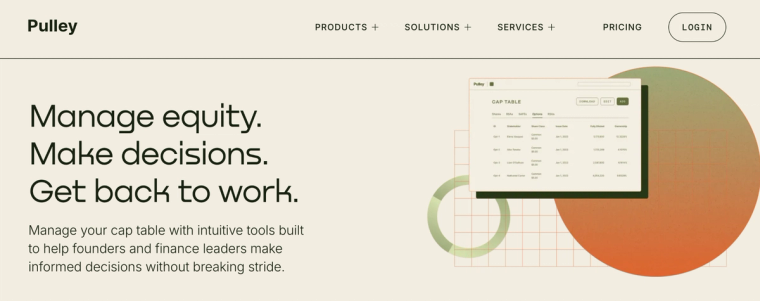
Best for: Historically, venture-backed startups focused on cap table management, fundraising, and dilution modeling.
Pulley built its platform around cap table management, fundraising scenarios, and ownership modeling for startups. These capabilities made it relevant to founders and finance teams managing funding rounds.
However, Pulley’s current service status needs verification before evaluation. Its website states that the service is scheduled to shut down on December 8, 2026. Buyers should confirm this directly with the provider before considering the platform.
What makes it different: Pulley focuses on startup cap tables, fundraising scenarios, and dilution modeling.
Pulley pros and cons:
| Pros | Cons |
|---|---|
| Cap table tools supported startup ownership management. | Reported service shutdown creates significant continuity concerns. |
| Fundraising and dilution modelling supported financing decisions. | New buyers should verify whether the platform is accepting customers. |
| Startup-focused workflows suited venture-backed companies. | Existing customers may need to plan data export and migration. |
Pros and cons of Pulley based on publicly available information and user reviews on G2.
Pulley pricing: Pulley’s Startup plan costs $1,200 per year for the first 25 stakeholders, while Growth costs $3,500 per year for the first 40 stakeholders. Enterprise pricing is custom and can include financial reporting, managed administration and secondary-liquidity modules.
Buyer considerations: Confirm service continuity, contract terms, data export options, and migration support before evaluation.
Test before choosing: Current service availability, data export completeness, migration support, and access to records after the reported shutdown date.
Hissa versus Pulley: Hissa provides an active India-focused equity management option covering cap tables and ESOP administration. Pulley should be evaluated only after its current service status is confirmed.
8. Cake: For early-stage startups seeking accessible cap table and option-plan management
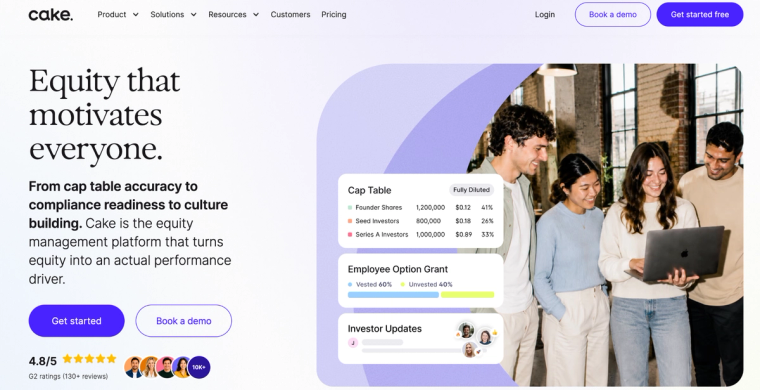
Best for: Early-stage startups setting up formal cap table and option-plan management.
Cake positions its platform around cap table management and stock-option administration for growing companies. Its public pricing information can also help startups set an initial budget.
Early-stage simplicity matters, but the platform should also support your next stage of growth. Test how Cake handles Indian instruments, resignations, accounting workflows, and more complex ownership structures before choosing it.
What makes it different: An accessible approach to cap table and option-plan management.
Cake pros and cons:
| Pros | Cons |
|---|---|
| Startup-focused tools support early cap table and option-plan management. | Indian statutory and accounting requirements may need additional validation. |
| A straightforward setup can make adoption easier for early-stage teams. | Multi-entity and complex corporate-action workflows should be tested before scaling. |
| Published pricing information can help with initial budget planning. | Historical data migration requirements may vary by existing records. |
Pros and cons of Cake based on publicly available product information and buyer considerations.
Buyer considerations: Confirm support for Indian statutory requirements and accounting outputs. Test multi-entity records and corporate actions if your startup expects to grow.
Pricing approach: Review current pricing and check how stakeholder counts affect plan limits and costs.
Cake pricing: Cake offers a free plan for up to five stakeholders. Build costs $1,000 per year for 25 stakeholders, while Team costs $2,750 per year for 40 stakeholders and includes two 409A valuations annually. Pro is custom-priced, includes 100 stakeholders, and supports annual or quarterly billing. Each additional stakeholder costs $60.
Test before choosing: Indian entities and instruments, accounting workflows, resignation events, and historical data migration.
Hissa versus Cake: Cake may suit early-stage teams looking for accessible equity administration. Hissa is designed for Indian startups that need equity management connected with local accounting and employee tax context.
Who actually needs equity management software?
Startups that issue employee equity, manage multiple ownership instruments, or prepare for fundraising can benefit from equity management software. As these activities grow, teams need a reliable way to track ownership, administer grants, and keep records current.
Look for these signs:
- The cap table and option pool sit in separate spreadsheets.
- Different teams produce different ownership figures.
- Your team models funding-round dilution manually.
- Grant approvals and records sit across emails and board documents.
- Your team recalculates vesting and exercises manually.
- Finance rebuilds Ind AS 102 schedules for each reporting cycle.
- Investor or audit requests take days to answer.
- Employees lack a current view of their vested options and exercise tax.
- A new subsidiary or ESOP plan has increased administrative work.
Check whether your team can answer two basic questions from the same record: How much of the company has been issued, and what does the fully diluted ownership look like? You should also be able to trace every outstanding grant to its approval.
If your team needs several files to answer these questions, your equity records need attention. The extra work can slow diligence, complicate financial reporting, and make it harder for employees to understand their equity.
What capabilities should startup equity management software include?
Test the platform against the ownership and employee-equity work your team handles today. These eight capabilities cover the core areas to review when comparing equity management software.
| Capability | What it helps a startup do |
|---|---|
| Cap table and ownership records | Maintain shareholders, securities, issuances, transfers, conversions, and fully diluted ownership. |
| Fundraising and dilution modeling | Model funding rounds, option pool changes, and dilution before updating live records. |
| ESOP and grant management | Manage option pools, grants, vesting, exercises, forfeitures, and employee equity records. |
| Employee equity portal | Give employees access to grants, vesting schedules, equity value, exercise details, and tax information. |
| Accounting and compliance | Support Ind AS 102 calculations, financial reporting, disclosures, and audit schedules. |
| Integrations and workflows | Connect equity records with HRMS, payroll, finance, approvals, and stakeholder workflows. |
| Multi-entity and corporate actions | Manage parent and subsidiary records and process stock splits, bonus issues, and conversion changes. |
| Security and liquidity | Control access through permissions and audit trails while supporting approved exercises, cash-outs, or secondary transactions. |
A feature checklist shows what a platform offers. To assess how well it works, test it against the equity events that create the most work for your team.
1. Fundraising readiness requires more than a clean cap table
A funding model depends on accurate ownership, option-pool assumptions, outstanding instruments, and grant records. Ask the vendor to model a pool increase or instrument conversion, then show how approved changes update the live record.
2. HR events must be treated as equity events
Joining dates, role changes, resignations, and corrections can affect eligibility, vesting, or exercise windows. Test a withdrawn resignation or corrected last working date to see whether the platform applies the plan rules and preserves the history.
3. Employees need context for equity decisions
Employees need to understand what has vested, what exercise will cost, and how taxes may apply at exercise or sale. Check whether the portal explains these details clearly and presents relevant scenarios without replacing personal tax advice.
How to choose equity management software for your startup
The right platform should fit the way your startup manages equity today and the complexity you expect as it grows. Use the following checks to compare platforms against your actual workflows.
- Start with the next major event: Use an upcoming fundraise or ESOP launch to identify the workflows your team needs.
- Map every instrument: List shares, options, warrants, convertibles, pools, vesting rules, and exercise windows.
- Include historical exceptions: Test how the platform handles unusual grants, corrections, and legacy records without relying on manual work.
- Test the hardest workflow: Bring a backdated correction or performance-linked grant to the demo and ask the vendor to process it live.
- Record manual work: Track spreadsheet steps, support requests, and workarounds needed to complete each workflow.
- Confirm India-specific outputs: Review Ind AS 102 schedules, Companies Act records, FEMA requirements, and demat workflows that apply to your company.
- Review outputs with advisers: Ask finance and legal advisers to validate the reports before procurement.
- Assign migration ownership: Define who cleans historical records, approves opening balances, and signs off on migrated data.
- Calculate total cost: Include subscription, implementation, migration, integrations, and internal administration.
- Use a two-year view: Factor in expected growth in entities, stakeholders, grants, and required modules.
Which type of equity management software fits your startup?
Company stage can help narrow the options, while your next equity event can show what your team actually needs.
- Lightweight startup platform: One entity, simple instruments, and a straightforward ESOP plan.
- Growth-stage equity platform: Multiple funding rounds, regular grants, investor reporting, and recurring accounting.
- Enterprise-ready platform: Multiple entities, approval workflows, detailed permissions, and performance vesting.
- Global equity platform: Employees and entities across multiple countries with different regulatory requirements.
- Connected equity lifecycle platform: Cap tables and ESOPs linked with accounting, employee access, and corporate actions.
Shortlist two or three platforms that fit your operating model. Give each vendor the same scenario and compare the output, manual work, and exceptions.
Which equity management software should your startup choose?
The right fit depends on the workflows your team needs to manage and the markets you operate in.
- Hissa: Indian startups managing cap tables, ESOPs, accounting, employee equity, and eligible liquidity workflows.
- Qapita: Companies assessing broader equity administration across India and other markets.
- EquityList: Early-stage startups looking for cap table and ESOP administration.
- Vestd India: Indian companies evaluating dedicated equity and option management.
- Carta: Startups looking for a broad global equity management ecosystem.
- Ledgy: International companies managing employee equity across multiple countries.
- Pulley: Companies considering Pulley should confirm its current product and service availability before evaluation.
- Cake: Early-stage companies looking for cap table and option-plan administration.
Use the same company data and scenario for every shortlisted platform. This gives you a clearer view of how each system handles your actual ownership records, difficult events, and day-to-day administration.
Why Hissa stands out for startup equity management
For Indian startups, equity management extends beyond maintaining a cap table. As the company grows, founders, finance, HR, company secretarial teams, employees, investors, and auditors all work with the same ownership records.
Hissa brings these workflows into one system:
- Maintain one ownership record: Track security holders, transactions, share classes, and fully diluted ownership.
- Manage the ESOP programme: Design the pool, issue grants, and manage vesting, exercises, and forfeitures.
- Support finance and reporting: Generate Ind AS 102 calculations, disclosures, and audit-ready reports from the administered programme.
- Give employees equity visibility: Show grants, vesting, equity value, and relevant tax information before an exercise or sale.
- Manage complex plans: Support subsidiaries, performance vesting, custom allocation matrices, fractional options, malus, clawback, permissions, and approval workflows.
- Record corporate actions: Manage bonus issues, stock splits, consolidations, and conversion-ratio changes within the ownership record.
- Support liquidity workflows: Manage eligible exercises, cash-outs, buybacks, and secondary liquidity, subject to applicable approvals and terms.
- Support growth-stage requirements: Keep ownership, reporting, and governance workflows connected as the company adds entities, investors, and employees.
The real test is how these workflows work together. Bring your current cap table, grant records, and an upcoming equity event to a Hissa demo and ask the team to walk through the records, approvals, and outputs using your actual requirements.
If you are reviewing equity management software, you can start with your current records and a specific workflow. You can bring your current cap table, grant records, and an upcoming equity event to a Hissa demo. See how the platform handles your workflows and assess whether it fits your team’s needs.
See how Hissa handles your ownership record
A startup does not choose equity software for the dashboard it has today. The system should stay reliable through the next funding round, employee grants, audit, exits, and corporate actions.
Shortlist platforms based on your stage, then test them with your hardest real workflow. Ask each provider to reconstruct the opening position, process an exception, and produce company, employee, and finance outputs from the same records.
Bring your current cap table, grant register, and an upcoming equity event to a Hissa demo. Use the session to see how the records and workflows connect and decide whether the platform fits your needs.