In July 2026, the Registrar of Companies in Uttar Pradesh fined a private company and its officers ₹45,000 over board minutes written ten years earlier. The minutes of board meetings held between April and November 2016 left out details SS-1 requires, such as each meeting's serial number and day, along with the time the meeting concluded.
Lapses like these tend to surface at the worst moment, when investor counsel asks for the resolution behind every allotment since incorporation. One missing page can then hold up a round while your team rebuilds the trail, chasing ratification signatures from directors in three cities.
Every share allotment and bank mandate in an Indian company traces back to a board resolution. This guide shows company secretaries and CFOs how to pass one correctly and keep a record that holds up when auditors and investors test it. With Hissa, you can tie each resolution to the cap table entry it creates, so your paper trail is ready before anyone asks for it.
What is a board resolution under the Companies Act, 2013?
A board resolution is the formal record of a decision your board takes together. The Act treats the board as one collective body under Section 2(10), so a single director binds the company only when a resolution authorises that act.
Shareholders sit on the other side of the line. They decide their own set of matters through ordinary and special resolutions under Section 114, where an ordinary resolution needs more votes for than against and a special one needs at least three times as many.
Board voting follows your articles of association. Under Table F, the model articles in Schedule I, each question goes by a majority of votes, and the chairperson holds a casting vote to break a tie, as Vinod Kothari's analysis of casting votes sets out.
| Point | Board resolution | Shareholder resolution |
|---|---|---|
| Passed by | Directors | Members |
| Forum | Meeting or circulation | General meeting or postal ballot |
| Voting rule | Majority of directors present and voting (Table F) | Ordinary: more votes for than against. Special: at least three times as many for as against |
| Typical matters | Allotting shares, approving borrowings | Approving an ESOP scheme by special resolution |
Why do board resolutions matter for finance and secretarial teams?
Banks and auditors act only on documented authority, and a certified resolution is that document. You will reach for one in three recurring situations:
- Bank mandates: A certified true copy tells the bank which officer may operate the account, and up to what limit.
- Evidence: Minutes kept under Section 118(7) are evidence of the proceedings they record.
- Due diligence: Investor counsel matches each allotment in the register of members to the resolution that approved it.
Statutory auditors run a similar check from their side of the table. They match large borrowings and investments in the books to the board approvals behind them, so a missing approval turns into an audit query.
Which decisions need a board resolution passed at a meeting?
Ten specific powers in Section 179(3), plus any others the government prescribes, can be exercised by your board only at a meeting. Attendance can be in person or by video conference, as long as the item is taken up and minuted at that meeting.
Rule 8 of the Companies (Meetings of Board and its Powers) Rules, 2014 adds to that list. Its additions include appointing or removing key managerial personnel and making political contributions.
| Clause | Power | Example for an Indian private company |
|---|---|---|
| (a) | Making calls on unpaid share capital | Calling the balance due on partly paid shares |
| (b) | Authorising a buy-back under Section 68 | Approving an ESOP buyback offer |
| (c) | Issuing securities, including debentures | Allotting Series A preference shares |
| (d) | Borrowing money | Taking a working-capital loan |
| (e) | Investing the company's funds | Placing surplus cash in mutual funds |
| (f) | Granting loans, guarantees or security | Guaranteeing a subsidiary's bank loan |
| (g) | Approving the financial statements and the board's report | Signing off annual accounts before the AGM |
| (h) | Diversifying the business | Adding a new line of business |
| (i) | Approving amalgamation, merger or reconstruction | Merging a subsidiary into the parent |
| (j) | Taking over a company or acquiring a controlling stake | Buying 51% of a target company |
| (k) | Any other prescribed matter | Items added by Rule 8 |
Your board can delegate clauses (d) to (f) to a committee of directors or the managing director, among others. Its conditions for that delegation are themselves set in a resolution passed at a meeting.
Everyday approvals outside these lists, such as changing a bank signatory, can usually pass by circulation. Check Secretarial Standard 1 (SS-1) before you rely on that route.
Revised SS-1, in force since 1 April 2024, carries an illustrative list in Annexure A of items that must go before a meeting. Whether an item suits circulation is the chairperson's call, made before the draft goes out, so run any new item type past your company secretary first.
A simple habit saves trouble later. Keep a one-page list of meeting-only items next to your board calendar, and mark the ones your board has delegated.
How is a board resolution passed at a board meeting?
A meeting resolution was held up when the notice was valid and a quorum was present before anyone voted. Secretarial teams usually work through these steps in order.
1. Send notice at least seven days ahead
Notice of at least seven days must reach every director in writing, at the address registered with the company, under Section 173(3). Post and electronic delivery both count, so an emailed agenda with draft resolutions meets the rule.
2. Confirm the quorum
Quorum under Section 174 is one-third of the board's total strength or two directors, whichever is higher. On a nine-member board, three directors make a quorum, and those joining by video conference count toward it.
3. Record interests before the vote
Directors with a concern or interest in a contract disclose it at the meeting and stay out of that item, under Section 184(2). Minute who stepped out, since a contract approved with an interested director taking part is voidable at the company's option.
4. Declare the result
After discussion, the chairperson puts the operative text to vote and announces the outcome. Votes for and against go into the minutes, along with any abstention.
Short-notice meetings
Urgent business can go to a meeting called at shorter notice under Section 173(3). At least one independent director must attend, where the company has one. If none attends, decisions circulate to all directors and become final once an independent director ratifies them.
How does a board resolution by circulation work under section 175?
Circulation lets your directors approve a resolution in writing, with no meeting. The draft and its supporting papers go to every director, and the resolution passes once a majority of the directors entitled to vote approve it, under Section 175.
Email is a valid channel, and Rule 5 of the Meetings of Board Rules names it specifically. Ask each director to reply with a clear approval or dissent, so the count stays clean. One safeguard protects directors who want a proper discussion. If one-third of the total directors ask for the item to go to a meeting, the chairperson must put it before the board. A circulated resolution also shows up in later records. Under Section 175(2), it is noted at the next board meeting and made part of that meeting’s minutes. Circulation suits routine items when your directors sit in different cities. Shifting the registered office within the same city under Section 12, or adding a signatory to a current account, are typical examples.
| Point | Board meeting | Resolution by circulation |
|---|---|---|
| Legal basis | Sections 173 and 174 | Section 175 and Rule 5 |
| Notice or delivery | Seven days' written notice | Draft and papers sent to every director |
| Threshold | Quorum, then majority of directors present and voting | Majority of directors entitled to vote |
| Section 179(3) items | Permitted | Excluded |
| Where it is minuted | Minutes of that meeting | Minutes of the next meeting |
What should a board resolution format include?
A good format lets an outsider, such as a bank officer, confirm who decided what and under which power. The certified true copy repeats the same text and adds a signed certification block.
- Heading: Company name and CIN, then the meeting reference and its date
- Quorum line: Confirmation that quorum was present throughout
- Operative text: “RESOLVED THAT” followed by the action and the section relied on
- Consequential authority: “RESOLVED FURTHER THAT” naming the officer who files the forms
- Certification: Signatory’s name and designation, with DIN or membership number
Write the operative text so it stands up when read on its own. Spell out the share numbers and the allottee in full, since a bank or investor will often see only the extract.
Below is a sample allotment resolution, with every variable in square brackets. Fill each bracket from the board papers, and confirm the allotment section with your company secretary before use.
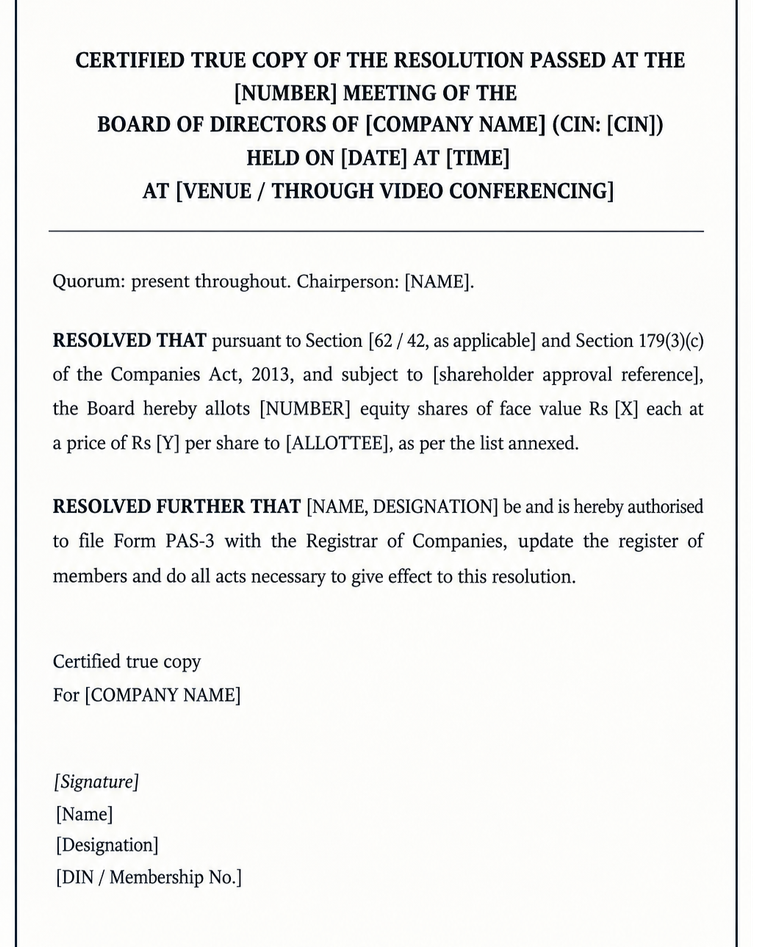
Each field in the sample maps to a record your company keeps, such as the minutes and the register of members. ESOP allotments on exercise follow the same skeleton, and the ESOP compliance guide covers the scheme approvals that come first.
When does a board resolution need Form MGT-14?
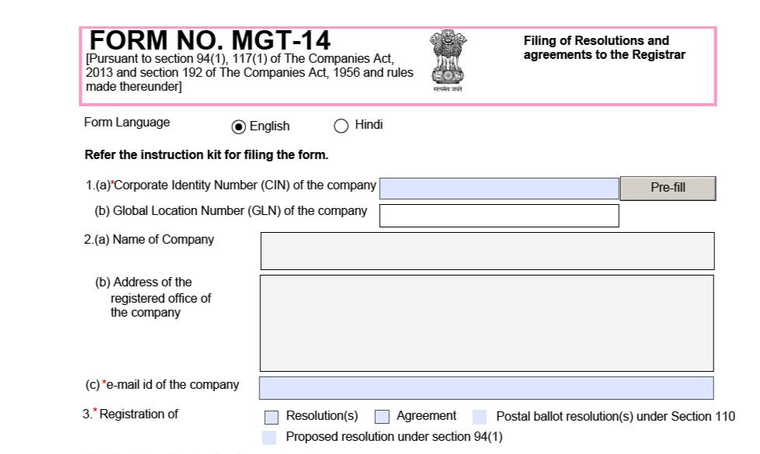
Form MGT-14 is how certain resolutions reach the Registrar of Companies, and it is due within 30 days of passing them. Which resolutions qualify is set by Section 117(3), covering every special resolution and, under clause (g), resolutions passed under Section 179(3).
Private companies have a conditional exemption for those Section 179(3) items. It holds only while the company is current on its financial statements under Section 137 and its annual return under Section 92.
Public companies, listed or unlisted, file MGT-14 for each Section 179(3) resolution. Other clauses of Section 117(3) apply to every company type, so check the full list item by item.
Missing the filing attracts a penalty under Section 117(2) of ₹10,000, plus ₹100 for each day the default continues. The company’s penalty is capped at ₹2 lakh, and each officer in default faces up to ₹50,000. For the wider ROC calendar, see the annual filing checklist.
Public companies, listed or unlisted, file MGT-14 for each Section 179(3) resolution. Other clauses of Section 117(3) apply to every company type, so check the full list item by item. For the wider ROC calendar, see the annual filing checklist.
| Company | Files MGT-14 for 179(3) items? | Condition |
|---|---|---|
| Private company | Exempt | Current on filings under Sections 137 and 92 |
| Private company in default | Due within 30 days | Exemption lost during the default |
| Public company, listed or unlisted | Due within 30 days | None |
How should board resolutions and minutes be recorded and kept?
Board minutes go in their own minute book under Rule 25 of the Companies (Management and Administration) Rules, 2014, with a separate book for each board committee. Entries are made within 30 days of the meeting, and the date of entry is recorded.
Pages are initialled or signed, and the last page of each meeting's record is dated and signed. The chairperson of that meeting, or of the next one, signs board minutes.
Custody rests with the company secretary or a director the board authorises. Preservation is permanent for board minute books, kept at the registered office or another place the board decides.
Properly kept minutes are evidence of the proceedings under Section 118, and the meeting is presumed duly held until proved otherwise. Default costs the company ₹25,000 and each officer in default ₹5,000.
Registrars do act on this. In a June 2026 order, ROC Delhi penalised a company that admitted deficiencies in the minutes of a board meeting held on 29 July 2024, including non-circulation of draft minutes to directors.
Tampering with minutes is a criminal offence, punishable with up to two years' imprisonment and a fine of ₹25,000 to ₹1 lakh. Every company must also observe the ICSI secretarial standards under Section 118(10), and SS-1 was revised with effect from 1 April 2024.
Resolution record pack
File these together under each resolution number. Keeping one folder per resolution lets an auditor test it in a single request.
Signed minutes extract
Certified true copies issued, with recipient and date
MGT-14 service request number, where filed
Updated statutory register entry, such as the register of members
Papers the directors saw at the meeting
Number resolutions in one running series per financial year, such as BR/2026-27/014. Quote that number on every certified copy, so a bank's file and your minute book point to the same record.
How Do Equity Resolutions Connect to the Cap Table?
Every equity decision travels from the minute book into the statutory registers, and from there into your cap table. A share allotment starts as a board decision and ends as new lines in the register of members.
Take a Series A allotment approved as BR/2026-27/014. After the board vote, the company files its return of allotment in Form PAS-3 within 15 days under Section 42(8), and the cap table entry quotes the same resolution number.
Dematerialisation adds one more link to that chain. Since 30 June 2025, Rule 9B requires private companies other than small companies to issue securities only in demat form, so each allotment also has to match the credit in the investor’s demat account.
Linking the two pays off when a round opens. If every cap table line carries a resolution number, pre-round reconciliation becomes a lookup exercise.
Pre-round reconciliation
Pick five holdings from the cap table before a funding round. Trace each one back to its resolution number and its register entry, and fix any mismatch before investor counsel asks.
Hissa's cap table management records every share issuance and buyback with a full audit trail and real-time ownership updates. Corporate actions such as bonus issues and stock splits run through the same record. Hissa ESOP management holds grant letters and vesting schedules along with it.
Before your next board resolution meeting
The cheapest time to fix a resolution is the week your board passes it. Once a round opens, a missing signature becomes a ratification exercise, and a mismatched register entry becomes a question from investor counsel.
Start with one change at your next meeting. Give each resolution a running number, such as BR/2026-27/014, and quote it on the certified copy and the cap table entry. When your minutes and register tell the same story, the record holds up to any diligence request.
For ownership questions beyond resolutions, the guide to cap table management picks up where this leaves off. If you want equity decisions and the cap table in one system, Book a demo with Hissa.