
A founder issues shares at incorporation. An investor joins a year later. The company creates an ESOP pool, employees receive grants, and a few team members exercise their options. Soon, the ownership record spans several files, approvals, and transaction dates.
A capitalization table records who owns what. Cap table management is the continuing work that keeps that record accurate, traceable, and ready for decisions. It covers ownership data, ESOP events, corporate actions, scenario models, permissions, and reporting.
This guide shows what to track and how the workflow operates. It also explains when spreadsheets become hard to control. Hissa helps Indian companies manage cap tables and the connected ESOP lifecycle in one system.
Quick answer
A cap table becomes useful when every figure can be traced to an approved event and supporting document. Accuracy depends on the workflow behind the table, not its appearance.
What is cap table management?
Cap table management is the ongoing process of recording, checking, and reporting a company’s equity ownership. It tracks each holder, security, transaction, and attached right. It also keeps the ownership model aligned with approvals, legal documents, ESOP records, and financing activity.
The process starts with a reliable opening record. Every later issuance, grant, exercise, transfer, cancellation, conversion, or corporate action changes the current position or potential ownership. Each event needs a date, quantity, price, approval trail, and supporting document.
A useful system shows both legal ownership today and possible dilution in a fully diluted view. It also lets authorized teams model a proposed funding round before anyone signs the documents.
Cap table vs. cap table management
The table below shows how the ownership record differs from the process that keeps it accurate.
| Cap table | Cap table management |
|---|---|
| The current record of holders, securities, and ownership percentages | The processes that create, update, check, secure, and report that record |
| A point-in-time output | A continuing equity-governance workflow |
| Shows the result of approved transactions | Preserves calculations, controls, approvals, documents, and audit history |
What information does a cap table track?
A practical cap table combines holder data with instrument terms and transaction history. Each field helps the company answer a specific ownership question.
1. Shareholders and stakeholders
The holder register usually includes founders and investors. It can also include employees, advisors, trusts, funds, and corporate entities.
Names should match the relevant legal and transaction records. A group structure may require separate records for a parent and each subsidiary, plus a consolidated view for authorized users.
2. Equity and security types
Common shares and preferred shares sit at the center of many cap tables. Their rights may differ across voting, conversion, liquidation, anti-dilution, or information provisions.
The table may also track stock options, warrants, and convertible instruments. Reserved but unallocated ESOP pool capacity belongs in the model because it can affect fully diluted ownership.
3. Ownership and transaction details
Each entry needs enough detail to reproduce the ownership calculation. Typical fields include:
- Quantity: Number of shares, options, warrants, or convertible securities
- Ownership percentage: The holder's quantity divided by the clearly labeled denominator
- Event date: Issue, grant, transfer, exercise, lapse, cancellation, or conversion date
- Economic terms: Issue price, grant price, exercise price, or conversion basis
- Award terms: Vesting schedule, cliff, performance condition, and expiry date
- Rights and class: Security class and its attached contractual rights
- Evidence: Board approval, shareholder approval, grant letter, transfer document, or transaction agreement
4. Valuation and financing information
Financing records commonly include pre-money valuation and post-money valuation. The resulting price per share should tie back to the round documents and approved model.
A historical view can show each funding round and the conversion assumptions used for outstanding instruments. Teams can then compare the signed outcome with earlier pro forma scenarios.
How does cap table management work?
Cap table management follows a recurring sequence. The company establishes the opening position, records each approved event, recalculates ownership, preserves evidence, and reports through controlled access.
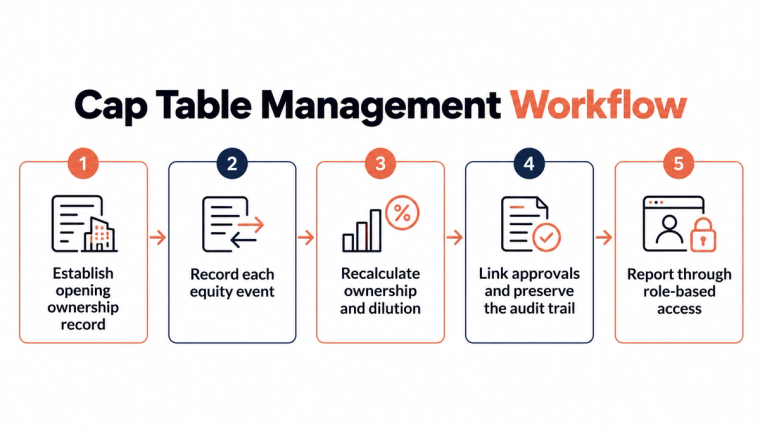
1. Establish the opening ownership record
Start by confirming authorized, issued, allotted, and outstanding securities. Reconcile the figures with incorporation records, allotment documents, member records, certificates, and financing agreements where applicable.
Resolve differences before importing the data into a new system. A clean opening balance gives every later transaction a dependable base.
2. Record every equity event
Enter new share issuances and funding rounds when they become effective. ESOP administration also creates recurring events through grants, vesting, exercises, lapses, and cancellations.
Transfers and secondary transactions need their own records. Convertible issuances and later conversions should preserve the original terms and the calculation used at conversion.
3. Recalculate ownership and dilution
Each event changes a quantity, a denominator, or both. The system should update current ownership after the event and maintain a separate fully diluted view.
A scenario model can show the effect of a proposed round, an ESOP pool increase, or a conversion. Clear labels prevent readers from comparing percentages built on different denominators.
4. Maintain approvals and an audit trail
Link each transaction to the relevant board or shareholder approvals, plan documents, or contractual evidence, where applicable. Preserve the person who entered or approved the change and the time of each action.
A complete trail helps finance, legal, and company-secretarial teams reconstruct the record during diligence. It also makes corrections visible instead of silently replacing history.
5. Report securely to stakeholders
Founders and finance teams may need broad access. Employees usually need a personal view of their own grants, vesting, and exercises.
Hissa can provide controlled stakeholder access and employee-level visibility while restricting sensitive company-wide ownership data. Permissions should follow the company’s approved access policy and be reviewed regularly.
Why is cap table management important?
Reliable equity data supports fundraising and employee communication. It also strengthens governance when the company faces an audit, corporate action, or liquidity event.
1. Fundraising and investor due diligence
Investors need a clear ownership structure and a traceable transaction history. A reconciled cap table helps the company answer questions about issued securities, option pools, convertibles, and holder rights.
Scenario modeling also supports negotiation. The team can test round size, valuation, and option-pool changes before final terms are approved.
2. Dilution and scenario planning
A new issuance reduces existing holders’ percentages unless they participate proportionately. Options and convertibles may create further dilution when exercised or converted.
A pro forma cap table compares the position before and after the proposed transaction. Each scenario should state its assumptions and denominator.
3. ESOP administration and employee communication
ESOP cap table management tracks grants, vesting, exercises, cancellations, and pool availability. These events affect the company’s potential ownership and may later affect outstanding shares.
An employee portal can show each person’s own awards without revealing confidential company-wide holdings. Clear records also help HR answer questions with consistent data.
4. Governance, accounting, and audit readiness
Ownership records should align with approvals and transaction evidence. Finance teams also need share-based payment data for applicable accounting workflows.
Hissa connects cap table and ESOP records with relevant Ind AS 102 reporting workflows. Its current product page describes support for valuation, expense calculations, disclosures, and restatements. Accurate inputs, audit review, and professional judgment remain essential.
India-specific considerations
Listed companies should assess the current SEBI Share Based Employee Benefits and Sweat Equity Regulations, 2021, last amended on 4 December 2025. Private and listed companies should seek legal, tax, company-secretarial, and accounting advice based on their specific circumstances.
5. Corporate transactions and liquidity
Secondaries, buybacks, mergers, and acquisitions place extra pressure on ownership records. The company may need to confirm eligible holders, restrictions, class rights, and proceeds.
An exit model can estimate distributions across classes under stated assumptions. Signed documents and professional advice determine the final legal and tax treatment.
What is the difference between issued, outstanding, reserved, and fully diluted shares?
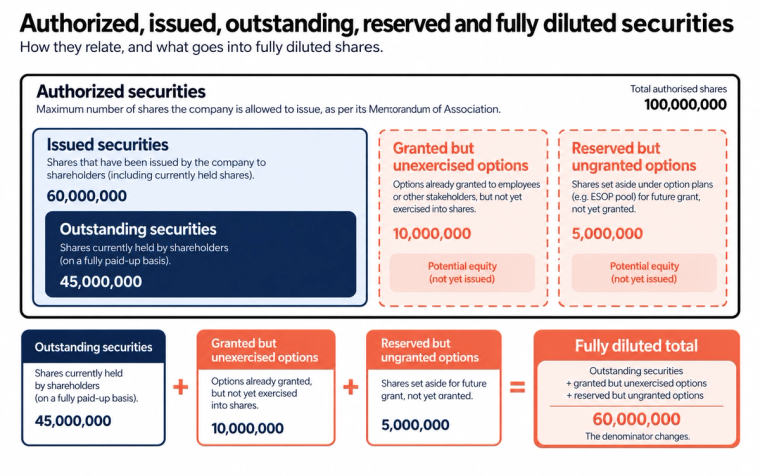
Authorized securities set the approved ceiling. Issued securities have been allotted, while outstanding securities remain held after permitted adjustments such as buybacks. Reserved options sit in an approved pool. A fully diluted capitalization assumes specified options, warrants, and convertibles become shares, so its denominator is larger.
The key share-count terms
- Authorized securities: The maximum amount the company is authorized to issue under its applicable constitutional and approval framework
- Issued securities: Securities allotted by the company
- Outstanding securities: Issued securities currently held by shareholders
- Reserved but ungranted options: Pool capacity approved for future awards
- Granted but unexercised options: Awards held by participants that may become shares subject to their terms
- Fully diluted capitalization: Outstanding shares plus the specified potential shares included in the model
Consider an illustrative company with 900,000 outstanding shares. Founder A owns 540,000, which equals 60% on an outstanding basis. The company also has 100,000 options in its pool.
On a fully diluted denominator of 1,000,000, Founder A holds 54%. The number of founder shares stays constant. The denominator changes.
What changes must be reflected in a cap table?
Founder issuances and funding rounds are common changes. ESOP events and corporate actions also alter share counts, percentages, rights, reporting, or several of these at once.
Equity-event checklist
- [ ] Founder issuances and vesting changes
- [ ] Funding rounds and new share classes
- [ ] Option-pool creation or expansion
- [ ] Grants, exercises, lapses, and cancellations
- [ ] Share transfers and secondary sales
- [ ] Convertible issuances and conversions
- [ ] Warrants
- [ ] Bonus issues
- [ ] Stock splits and consolidations
- [ ] Conversion-ratio changes
- [ ] Mergers, acquisitions, buybacks, or exits
- [ ] Parent and subsidiary restructuring where relevant
Each event needs an effective date and supporting evidence. The team should confirm whether it changes the outstanding denominator, fully diluted denominator, attached rights, or reporting treatment.
Cap table example: How ownership changes after a funding round
A concrete model makes dilution easier to see. The following example is illustrative and uses simplified assumptions.
Pre-round cap table
The company has 800,000 outstanding shares. Its ESOP pool contains 100,000 options, so fully diluted capitalization equals 900,000.
| Holder | Outstanding securities | Outstanding % | Fully diluted securities | Fully diluted % |
|---|---|---|---|---|
| Founder A | 480,000 | 60.00% | 480,000 | 53.33% |
| Founder B | 320,000 | 40.00% | 320,000 | 35.56% |
| ESOP pool | 0 | 0.00% | 100,000 | 11.11% |
| Total | 800,000 | 100.00% | 900,000 | 100.00% |
Post-round cap table
Assume an investor buys 200,000 newly issued shares. Outstanding shares rise to 1,000,000. Fully diluted capitalization rises to 1,100,000.
| Holder | Outstanding securities | Outstanding % | Fully diluted securities | Fully diluted % |
|---|---|---|---|---|
| Founder A | 480,000 | 48.00% | 480,000 | 43.64% |
| Founder B | 320,000 | 32.00% | 320,000 | 29.09% |
| Investor | 200,000 | 20.00% | 200,000 | 18.18% |
| ESOP pool | 0 | 0.00% | 100,000 | 9.09% |
| Total | 1,000,000 | 100.00% | 1,100,000 | 100.00% |
Both founders were diluted because their share counts stayed fixed while the denominator increased. If the investor requires a larger pool before closing, the fully diluted result changes again.
For example, adding 50,000 reserved options would increase fully diluted capitalization to 1,150,000. Founder A’s fully diluted percentage would become 41.74%. A pro forma review before signing shows who bears that dilution and helps the parties check the transaction documents.
What are the common challenges in cap table management?
Version confusion and formula errors are frequent challenges. Delayed updates become more serious as the company adds instruments, plans, entities, and stakeholder groups.
1. Version-control problems
Several spreadsheet copies create uncertainty about the approved record. A team member may update one file while finance models a transaction in another.
2. Broken formulas and manual errors
A copied formula can point to the wrong range. One error may distort several ownership percentages and scenario outputs.
3. Missing or delayed transaction updates
Exercises, transfers, and cancellations sometimes reach the cap table after a delay. Diligence then becomes a reconstruction exercise under time pressure.
4. Incomplete treatment of options and convertibles
A current-share view can understate potential dilution. Fully diluted reporting needs explicit assumptions for pools, warrants, and convertibles.
5. Weak permissions and data security
Cap tables contain personal, financial, and ownership information. Access should match each stakeholder’s role, supported by authentication and audit logs.
6. Growing structural complexity
Multiple plans and share classes increase the administrative load. Parent and subsidiary structures add another layer of records, approvals, and reporting views.
Cap table management best practices
Good practice starts with one controlled record and prompt updates. Regular reconciliation and clear accountability keep the model dependable between major transactions.
1. Maintain one controlled source of truth
Choose one approved system for live ownership data. Keep working scenarios clearly separated from the signed position.
2. Update the cap table after every approved event
Record each event when it becomes effective. Waiting for the next audit or fundraise increases reconciliation effort.
3. Reconcile records regularly
Compare the cap table with approvals, registers, grant records, and transaction documents. Finance data can provide another useful check for relevant cash and accounting entries.
4. Keep current and fully diluted views
Label both denominators. State which instruments and pool amounts are included in the fully diluted calculation.
5. Model transactions before approving them
Run scenarios for a funding round, pool expansion, conversion, or secondary sale. Save the assumptions beside each model.
6. Use role-based access and a complete audit trail
Give users the access their work requires. Preserve changes, approvals, and report history for accountability.
7. Assign clear ownership of the process
Name an internal owner. Define how finance and legal contribute, then include HR and the company-secretarial team where their responsibilities apply.
Control point
Schedule a reconciliation before each board cycle that includes equity actions. The owner should close open items before the cap table supports an approval or external report.
Spreadsheet vs. cap table management software
A spreadsheet can suit a simple early-stage structure. Dedicated cap table management software becomes useful when transaction volume, access needs, and instrument complexity increase.
The table below compares both approaches across the controls and workflows that matter as a company scales.
| Criterion | Spreadsheet | Dedicated software |
|---|---|---|
| Suitable company stage | Very early-stage companies with a simple structure | Funded startups, companies with group structures, and listed or enterprise-level organizations |
| Update process | Manual entry and formulas | Structured transaction workflows |
| Formula and entry risk | Depends heavily on reviewer discipline | Validation and controlled fields can reduce manual risk |
| Version control | File-based | Central record with controlled access |
| Permissions | Coarse sharing controls | Role-based access by stakeholder type |
| Audit history | Manual change log | System audit trail |
| Scenario modeling | Custom model | Repeatable funding and dilution scenarios |
| ESOP workflows | Separate schedules | Grant-to-exercise lifecycle workflows |
| Reports and documents | Manually assembled | Standard reports and linked evidence |
| Complex structures | Harder to maintain at scale | Designed for multiple entities and security classes |
1. When can a spreadsheet be enough?
A spreadsheet can work for a very early company with few holders. One simple security class and low transaction volume keep the model manageable.
The company still needs a named owner and disciplined controls. Protected formulas, documented assumptions, and regular backups support reliability.
2. When should a company move to dedicated software?
External fundraising often creates the first strong trigger. Employee option grants and convertibles add recurring events and future dilution.
Multiple classes, entities, and reporting cycles strengthen the case. Listed-company administration and enterprise-scale schemes usually require deeper permissions, controls, and audit history.
What should cap table management software include?
Evaluation should follow the company’s real workflow. Test how the system handles ownership events, ESOP administration, governance controls, corporate actions, security, and reporting.
1. Core ownership and transaction management
Look for multiple security classes and instrument types. A historical ledger should preserve issuances, transfers, buybacks, and conversions.
The system should produce a labeled fully diluted view and support scenario modeling. Each model needs visible assumptions.
2. ESOP lifecycle workflows
Check support for grants, vesting, exercises, lapses, cancellations, and pool tracking. Employees should receive controlled access to their own award information.
Some companies also need cash-out and auto-cash-out workflows. Exercise, auto-exercise, and ESOP financing may be relevant under approved plan terms.
3. Governance and enterprise controls
Approval workflows should match the company’s authority structure. Parent and subsidiary management matters when equity plans or reporting span a group.
Hissa supports configurable equity workflows for complex structures. The approved brand record includes parent and subsidiary management, performance-linked vesting, fractional options, allocation matrices, malus, and clawback controls where applicable.
4. Corporate-action support
A suitable system should process bonus issues, stock splits, consolidations, and conversion-ratio changes. Each action should update quantities while preserving history.
Hissa is designed to manage these corporate actions alongside the cap table. That keeps approved changes within the transaction record instead of relying on separate spreadsheet adjustments.
5. Security and privacy
Assess role-based permissions and two-factor authentication. Audit logs and password-protected reports add practical safeguards.
Review PII controls and the provider’s applicable security or privacy certifications. Hissa’s approved brand record lists ISO 27001, SOC 2, GDPR, and India’s DPDP framework among its security and privacy coverage. Buyers should verify the current certification scope during diligence.
6. Reporting, accounting, and integrations
Reports should serve founders, investors, auditors, and administrators without exposing unrelated confidential data. Export formats need to support the company’s review and filing processes.
Indian companies may also need equity-accounting support for applicable Ind AS 102 workflows. Check integrations with finance and HR systems, then assess legal, payroll, or other operational connections based on the company’s setup.
Who is responsible for cap table management?
Responsibility changes as the company scales. Founders often manage the opening record, while the finance or CFO team becomes the operational owner after fundraising and hiring increase activity.
A practical responsibility model
Company secretaries and legal counsel support governance and documentation. HR or rewards teams administer employee awards and manage participant communications.
The board and authorized approvers provide oversight for actions within their remit. Software supports the process, while internal accountability and professional legal, tax, accounting, or company-secretarial advice remain central.
Cap table management checklist
A short operating checklist helps teams spot missing records before a financing or audit. Assign each item to a named owner and review it on a fixed schedule.
Operational review
- [ ] Every security and holder is recorded
- [ ] Supporting documents are attached or traceable
- [ ] Current and fully diluted totals reconcile
- [ ] Grants, exercises, transfers, and cancellations are current
- [ ] Option-pool availability is accurate
- [ ] Convertibles are included in scenario models
- [ ] Permissions reflect stakeholder roles
- [ ] Audit history is preserved
- [ ] Regular reconciliations have an assigned owner
- [ ] Funding and corporate-action scenarios are modelled before approval
Manage your cap table and ESOP lifecycle with Hissa
Effective cap table management depends on accurate records and timely updates. Scenario planning, governance controls, and secure stakeholder access make those records useful when the company faces a decision.
Hissa brings cap table management together with ESOP administration, Ind AS 102 reporting workflows, corporate-action support, employee access, and liquidity workflows. The setup can serve growing startups, complex group structures, and listed companies according to their operating requirements.
Assess the platform against your ownership structure and equity plans. Include reporting needs, internal controls, and stakeholder access in that review. Hissa can then demonstrate the workflows that fit your company’s requirements.