A cap table can look accurate until the company raises a round, converts preference shares, expands an option pool or processes a stock split. That is when the real test begins: can the system carry one ownership event through every security, stakeholder view and report without creating a second version of the truth?
The best cap table management software platforms for Indian companies to evaluate in 2026 include Hissa, Qapita, EquityList, Vestd India, Carta, Ledgy, Pulley, Cake Equity, Eqvista, and Captable.io. Each platform caters to different business needs. Some focus on early-stage fundraising, others on international equity plans, while some help companies manage cap tables, ESOPs, accounting, and corporate actions within a single system.
Indian companies should evaluate cap table software based on their ownership structure, transaction complexity, and specific business requirements. A single-entity startup preparing its first institutional round has different requirements from a listed enterprise, a multi-entity group or a company managing complex preference rights.
What is cap table management software?
Cap table management software records who owns a company, which securities they hold and how transactions change that ownership. A capable platform maintains issued and fully diluted views, preserves transaction history, represents different share classes and instruments, and supports modelling and stakeholder reporting.
It is different from:
- ESOP management software, which adds plan rules, grants, vesting, exercises, accounting and employee workflows.
- Company secretarial software, which focuses on statutory registers, resolutions, filings and governance administration.
- Deal-modelling software, which may model transactions without maintaining the live ownership ledger.
- Investor portfolio software, which tracks an investor’s holdings across companies rather than one company’s complete ownership record.
Best cap table management software at a glance
The table below compares cap table management software platforms based on their ideal use cases, pricing approaches, and key features to help Indian companies identify suitable options.
| Tool | Best for | Pricing approach | Standout strength to verify |
|---|---|---|---|
| Hissa | Indian private and listed companies seeking connected equity infrastructure | Contact Hissa | Cap table, ESOP administration, Ind AS 102 reporting where applicable, corporate actions and liquidity workflows |
| Qapita | Growing and cross-border companies evaluating broad equity administration | Published tiers exist; confirm current India scope and total cost | Multi-entity and multi-jurisdiction administration |
| EquityList | Indian startups seeking straightforward cap table and ESOP workflows | Vendor page reports per-stakeholder pricing; confirm current quote | India-oriented records, instruments and ESOP administration |
| Vestd India | Scaling Indian companies evaluating cap tables and option management | Contact vendor | India offering developed following Vestd’s acquisition of Trica Equity |
| Carta | Cross-border companies prioritising a large global equity ecosystem | Confirm current plan and India coverage | Broad global equity-administration ecosystem |
| Ledgy | International companies managing employee equity across countries | Contact vendor | Multi-country equity-plan workflows |
| Pulley | Venture-backed startups prioritising fundraising scenarios | Confirm current plan | Fundraising and dilution modelling |
| Cake Equity | Early-stage teams seeking accessible administration | Free entry plan and paid tiers are published; date-check before buying | Startup-oriented cap table, modelling and migration experience |
| Eqvista | Companies evaluating cap table software alongside valuation services | Free and paid options are published; confirm service dependencies | Cap table tooling plus valuation-related services |
| Captable.io | Early-stage teams with focused ownership requirements | Verify current pricing and product support | Focused cap table experience |
Companies should compare these platforms based on their entity structure, the complexity of their equity instruments, statutory requirements, and internal capacity to manage equity administration.
How we evaluated the platforms
The comparison uses seven buying factors:
| Factor | Evaluation | What buyers should examine |
|---|---|---|
| Ownership and instrument depth | Core | Ordinary and preference shares, options, warrants, convertibles, transfers and history |
| Modelling and transaction workflows | Core | Rounds, dilution, exits, pool changes and separation of scenarios from live data |
| India statutory and accounting fit | Core | Required Companies Act, FEMA, demat and Ind AS 102 outputs |
| ESOP and stakeholder connection | Core | Whether grants, vesting, exercises and employee views share the ownership record |
| Enterprise configuration and corporate actions | Core | Multi-entity structures, permissions, approvals, bonus issues, splits and consolidations |
| Security and governance | Supporting | Certifications, audit trails, 2FA, report protection and PII controls |
| Implementation and total cost | Supporting | Migration, modules, services, administration and time to value |
The following comparison draws on information published by each vendor as of September 2026. Companies should confirm the listed features, capabilities, and pricing directly with the vendors before making a decision. The platforms are listed based on their relevance to Indian companies and their equity management requirements.
The 10 best cap table management software platforms in India
Here is a detailed look at the best cap table management software platforms in India, including their key features, ideal use cases, and factors to consider before choosing one.
1. Hissa: Best for connected cap table and ESOP management in India
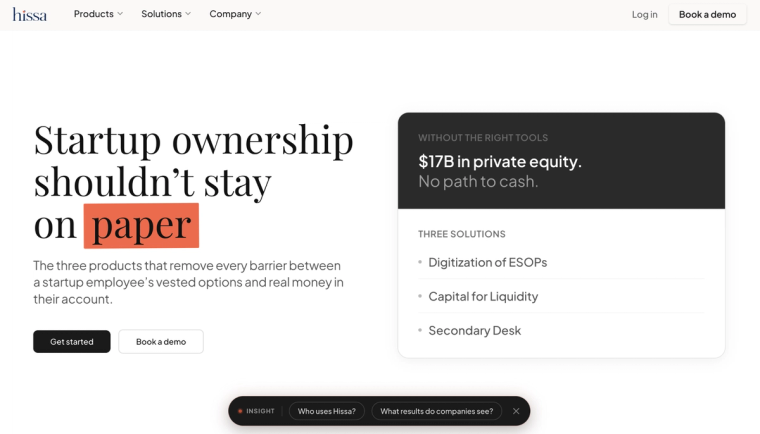
Best for: Founders, CFOs, finance, HR, and company-secretarial teams looking for one connected system to manage ownership, ESOPs, accounting, employee records, and corporate actions.
We bring cap table management and ESOP administration together in one platform built around the Indian equity lifecycle. You can track share issuances, transfers, buybacks, and conversions while maintaining current and fully diluted ownership records. Our platform also connects these records with ESOP grants, vesting, exercises, accounting outputs, and employee-facing views.
When an employee exercises stock options, for example, the transaction can flow through the relevant ownership records, plan balances, employee information, and reporting workflows. This gives your team a more connected view of equity management and reduces the need for recurring spreadsheet reconciliation.
What makes Hissa different
- Manage cap tables and ESOPs together with connected ownership records and equity plan administration
- Simplify Ind AS 102 reporting with calculations, disclosures, and audit-oriented outputs where applicable
- Handle complex organizational structures with parent and subsidiary administration, configurable permissions, and flexible vesting configurations
- Manage corporate actions such as bonus issues, stock splits, consolidations, and conversion-ratio changes
- Streamline employee workflows for option exercises and related tax processes
- Explore employee liquidity options through a separate fund-backed route for eligible employees, subject to eligibility, approvals, and transaction terms
- Support your equity management needs across private and listed-company use cases, depending on the modules and scope selected
Buyer considerations:
Every company has a different equity structure, from a straightforward ESOP plan to multiple subsidiaries, complex vesting schedules, and frequent corporate actions. A pricing model tailored to your requirements helps you choose the capabilities and level of support that fit your business, without paying for a standardized package that may not reflect your needs.
With Hissa, you can discuss your requirements with our team to determine the right combination of modules, implementation support, migration services, and ongoing administration. During the discussion, clarify the scope of each service, implementation timelines, and recurring costs so you can assess the total investment against your equity management requirements.
What to test in your Hissa Demo
Bring a representative set of equity data to see how Hissa handles your actual workflows.
- Rebuild your current and fully diluted cap tables using sample data
- Model a funding round without changing live records
- Process a preference conversion and stock split
- Demonstrate how an ESOP exercise updates ownership records and relevant accounting outputs
Use these scenarios to evaluate how well the platform fits your existing processes, reporting requirements, and future equity plans.
2. Qapita: Best for broad, multi-jurisdiction equity administration
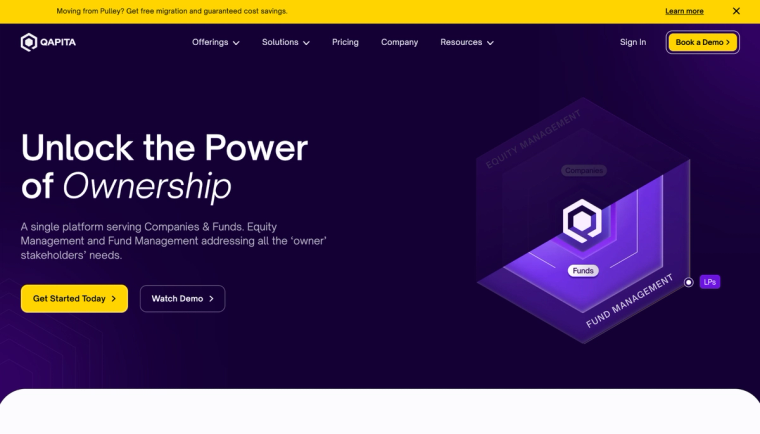
Best for: Growth-stage or cross-border companies evaluating a broad equity-management platform.
Qapita’s current public materials describe multi-entity cap tables and multi-jurisdiction plan administration across markets including India. It also publishes pricing tiers for some configurations, although an Indian buyer should confirm local modules, implementation services and the total contracted price.
Strengths to evaluate: Breadth across equity administration, multi-entity structures, employee plans and cross-border operations.
Buyer considerations: Do not infer Indian statutory outputs from general India availability. Ask which Companies Act, FEMA, demat, accounting and listed-company workflows are native, partner-delivered or manual.
Hissa versus Qapita: Qapita may suit a buyer seeking a broad regional ecosystem. Hissa is the more focused option where the decisive requirements are connected to Indian ESOP accounting, employee workflows, corporate actions and eligible liquidity infrastructure.
3. EquityList: Best for Indian startups seeking straightforward administration
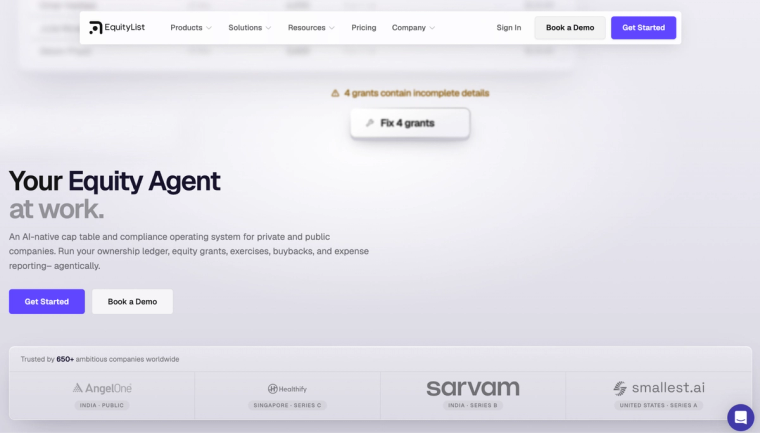
Best for: Venture-backed startups that need cap table and ESOP workflows without enterprise-level complexity.
EquityList’s public materials describe security tracking, convertibles and warrants, historical cap tables by funding round, multi-entity management, granular Indian share-certificate records, stock splits, ESOP administration and end-to-end exercise flows. Its comparison page also reports per-stakeholder pricing, which buyers should date-check in a formal quote.
Strengths to evaluate: India-oriented ownership records, startup onboarding and connected stock-option workflows.
Buyer considerations: Test complex preference rights, performance vesting, statutory outputs, audit support and the cost curve as stakeholder and entity counts increase.
Hissa versus EquityList: EquityList may suit teams prioritising simplicity. Hissa can be evaluated by buyers who need Ind AS 102 workflows where applicable, enterprise configuration, corporate actions, listed-company continuity or connected liquidity.
4. Vestd India: Best for scaling companies assessing the post-Trica platform
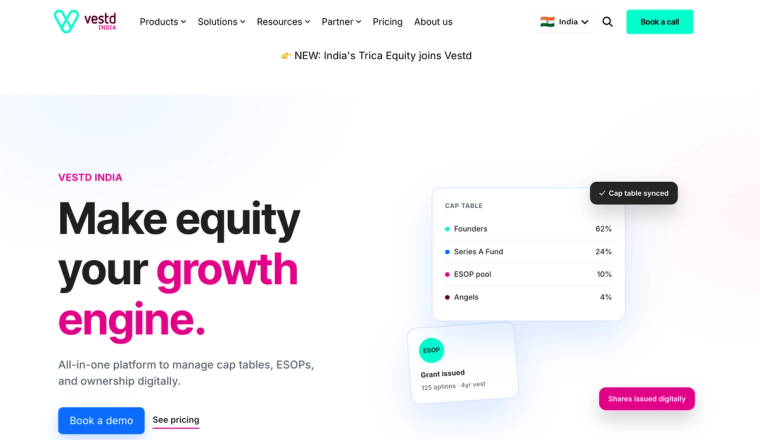
Best for: Indian companies evaluating cap table and option management under Vestd’s India offering.
Vestd’s India site markets cap table, ESOP and ownership management for Indian companies and describes its India presence in the context of Trica Equity. The key procurement question is not whether Trica once supported a workflow, but whether that workflow exists in the current product, contract and support model.
Strengths to evaluate: Indian market experience combined with Vestd’s broader ownership platform.
Buyer considerations: Ask which platform stores the data, how legacy customers were migrated, where support is delivered, and which India-specific statutory and accounting outputs are current.
5. Carta: Best for companies prioritising a global equity ecosystem
Best for: Cross-border businesses whose primary complexity is global ownership and equity administration.
Carta is widely evaluated for cap table administration, valuations, employee equity and investor-related workflows. For an Indian company, that breadth does not remove the need to test local fit.
Strengths to evaluate: Global ecosystem, integrations, stakeholder reporting and valuation-related products.
Buyer considerations: Confirm support for Indian entities, instruments, Companies Act and FEMA requirements, demat workflows, local implementation and data governance. Separate US-specific functionality such as 409A and ASC 718 from Indian requirements.
6. Ledgy: Best for international employee-equity programmes
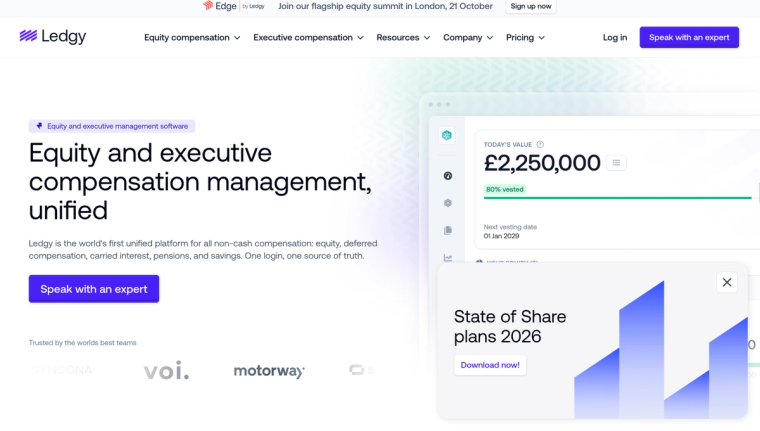
Best for: International teams administering equity plans across multiple countries.
Ledgy is commonly positioned around multi-country employee equity, stakeholder reporting, permissions and integrations. Indian buyers should treat global plan coverage and India-native compliance as separate questions.
Strengths to evaluate: International plan administration and distributed-workforce workflows.
Buyer considerations: Test Indian entity support, local tax and accounting outputs, corporate actions, implementation ownership and support coverage.
7. Pulley: Best for fundraising and dilution scenarios
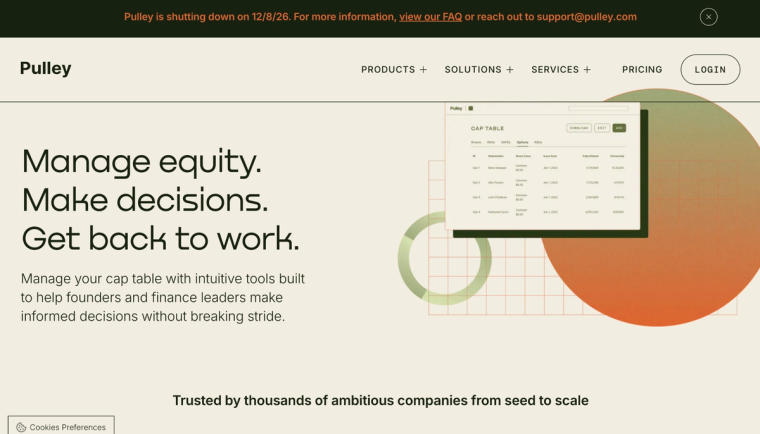
Best for: Venture-backed startups that prioritise financing models and founder-friendly cap table workflows.
Pulley is frequently evaluated for cap table usability, fundraising scenarios and dilution modelling. Those strengths are useful during a round, but Indian buyers should also test the live record after the model becomes a transaction.
Strengths to evaluate: Scenario modelling, financing events and stakeholder views.
Buyer considerations: Confirm treatment of Indian share classes and convertibles, statutory records, multi-entity administration, corporate actions, security and local support.
8. Cake Equity: Best for accessible early-stage administration
Best for: Startups seeking a low-friction entry point, transparent published pricing and migration support.
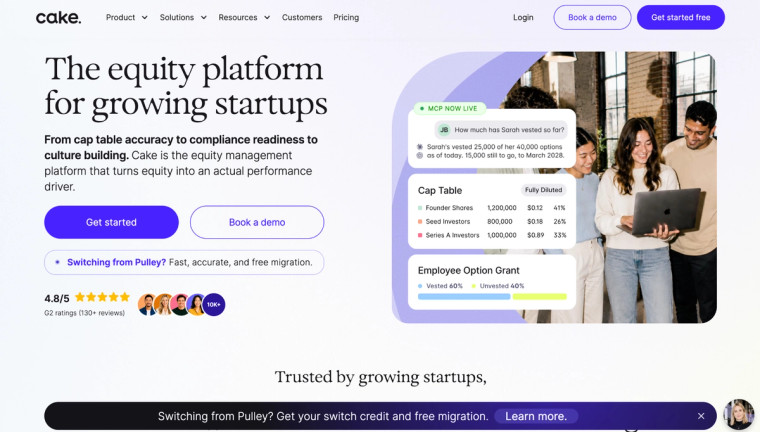
Cake’s September 2026 guide states that its platform supports cap tables, SAFEs and convertible notes, scenario modelling, investor and employee views, and free migration. It publishes a free plan for up to five stakeholders and paid plans beginning at a stated annual price; buyers should confirm the current plan, currency, taxes and included services.
Strengths to evaluate: Startup-oriented onboarding, modelling, migration and pricing transparency.
Buyer considerations: Test Indian entity support, preference shares, statutory outputs, accounting, corporate actions and depth beyond a straightforward startup structure.
9. Eqvista: Best when valuation services are central to the purchase
Best for: Companies comparing cap table software together with valuation-related services.
Eqvista markets cap table management and valuation offerings, including free and paid cap-table options. This can be useful when valuation support is a central requirement, but buyers should separate the software subscription from advisory or professional services.
Strengths to evaluate: Cap table administration alongside valuation-related support.
Buyer considerations: Confirm Indian applicability, transaction depth, ESOP workflows, corporate actions, migration responsibility and recurring software cost.
10. Captable.io: Best for simpler, focused requirements
Best for: Early-stage teams with a straightforward ownership structure.
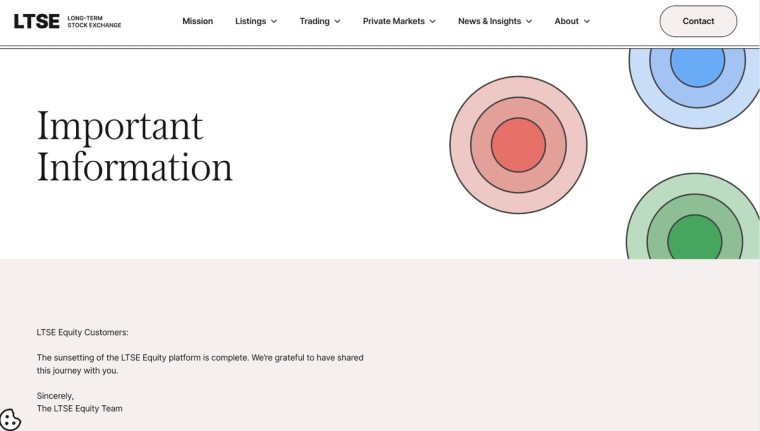
Captable.io has historically been positioned as a focused cap table product. Because current first-party evidence was limited during this review, buyers should verify active product support, ownership, pricing and security before including it in a final shortlist.
Buyer considerations: Test complex instruments, India entity fit, ESOP integration, corporate actions and the path to a more complex structure. If these cannot be demonstrated, replace it on the shortlist rather than buying for price alone.
Who needs cap table management software?
The need becomes operational when:
- ownership records are spread across spreadsheets, filings, board papers and email;
- current and fully diluted percentages change depending on who prepares them;
- convertibles, warrants or preference rights sit outside the main cap table;
- fundraising scenarios require manual dilution calculations;
- ESOP grants and exercises do not reconcile with ownership;
- investor, board or audit requests take days to answer;
- corporate actions require updates across several files; or
- parent and subsidiary companies lack a consolidated view.
Ask one question: Could the team reconstruct the current cap table, fully diluted cap table and complete transaction history from one source today? If not, it signals a deeper ownership-control gap that can affect accuracy and decision-making.
Capabilities to look for in cap table management software
A reliable system should cover the security-holder and transaction ledger, issued and fully diluted ownership, share classes, options and convertible instruments, scenario modelling, controlled stakeholder reporting, permissions and an audit trail.
Three areas deserve extra scrutiny:
1. Scenario models must remain separate from live ownership
A model should let the team test pre- and post-money ownership, option-pool changes and instrument conversions without altering the production cap table. The demo should show how an approved model becomes a controlled transaction.
2. Corporate actions expose weak records
Bonus issues, splits, consolidations and conversion-ratio changes must update securities, stakeholders and reports consistently. A platform that handles the headline share count but leaves grants or certificates unreconciled has not completed the workflow.
3. Cap table and ESOP records must reconcile
Granted, vested, exercised and issued equity are different states. When the cap table and ESOP system use separate records, teams repeatedly reconcile those states before audits, rounds and employee exercises.
How to choose the best cap table management software in India
- Start with the hardest ownership event: Use a real round, conversion, restructuring or stock split as the demo case.
- Map every entity and instrument: Include all share classes, options, warrants, convertibles and special rights.
- Decide whether ESOPs require one system of record: Trace grants, exercises, accounting and employee views into ownership.
- List India-specific outputs: Name the exact Companies Act, FEMA, demat, Ind AS 102 and listed-company requirements.
- Assign migration responsibility: Establish who cleans history and signs off the opening cap table.
- Test governance: Examine permissions, approvals, audit history, 2FA, report protection and PII controls.
- Name the administrator: Decide what the internal team owns and what remains vendor- or partner-managed.
- Compare first-year and steady-state cost: Include subscription, modules, implementation, migration, integrations, services and internal administration.
A useful evaluation step is to see how each shortlisted vendor handles your company’s most complex real-world transaction using a representative scenario.
Which cap table management platform may suit your business?
- Hissa may suit companies seeking connected cap table management, ESOP administration, accounting, and corporate-action workflows tailored to the Indian equity lifecycle.
- Qapita may be worth evaluating for companies with broad, multi-jurisdiction equity administration needs.
- EquityList may appeal to Indian startups looking for straightforward ownership and ESOP management.
- Vestd India may be relevant for companies whose needs align with its current India offering and post-Trica product capabilities.
- Carta may be a strong candidate for companies prioritizing a global equity-management ecosystem.
- Ledgy may fit international businesses managing employee equity across multiple countries.
- Pulley may appeal to venture-backed startups that prioritize fundraising scenarios and dilution modelling.
- Cake Equity may suit early-stage companies seeking accessible administration and published entry-level pricing.
- Eqvista may be worth considering when valuation-related services are an important part of the requirement.
- Captable.io may be an option for companies with simpler ownership structures, subject to verification of current product support.
The right choice depends on your equity structure, compliance requirements, transaction complexity, and implementation needs. Comparing two or three shortlisted platforms against a realistic ownership event expected over the next 24 months can help reveal which solution best fits your business.
Choose cap table management software that grows with your business
The right cap table management software should maintain accurate ownership records while handling complex equity transactions. It should also connect ESOP administration with relevant accounting workflows and meet your company’s Indian compliance requirements.
At Hissa, we bring cap table management and ESOP administration together in one platform built around the Indian equity lifecycle. Our connected approach helps you manage ownership changes and corporate actions while supporting Ind AS 102 reporting where applicable, with a solution tailored to your requirements.
Book a Demo with Hissa to see how our platform can support your company’s evolving equity needs.