
An investor reviewing a company wants clear answers. Who owns the business today? Which founder or investor holds the controlling stake? How would a new funding round or additional stock options change those positions?
Founders need the same clarity when designing an ESOP program. They must understand how much equity is available for employee grants and how those grants could affect existing shareholders and future fundraising. Every ownership figure should also be traceable to the security terms and transactions that produced it.
This guide explains what belongs in a cap table, how issued ownership differs from a fully diluted view, and how to maintain and reconcile the record as the company grows.
What is a cap table?
A cap table explains how a company’s equity ownership is structured. It helps identify which shareholder owns which type of security, such as issued and outstanding shares or fully diluted capital.
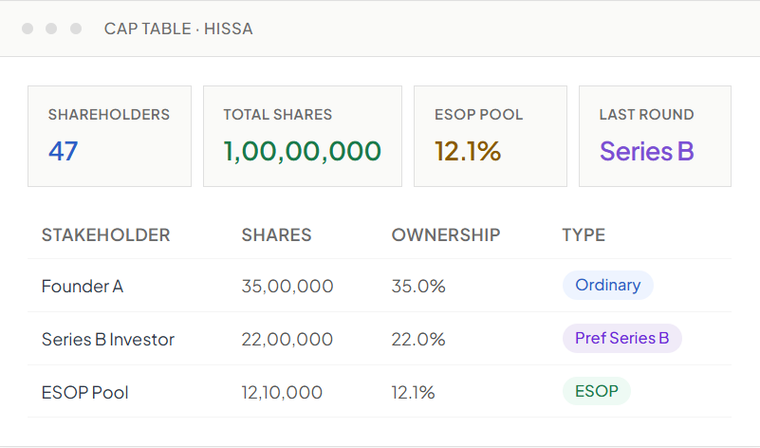
The model gives investors a consolidated view of ownership. It supports decisions about dilution, option pools, funding terms, voting control and potential exits.
Under Section 88 of the Companies Act, 2013, companies must maintain prescribed registers of members and other security holders. The cap table should reconcile with those records, along with depository data where applicable.
What does a well-structured cap table look like?
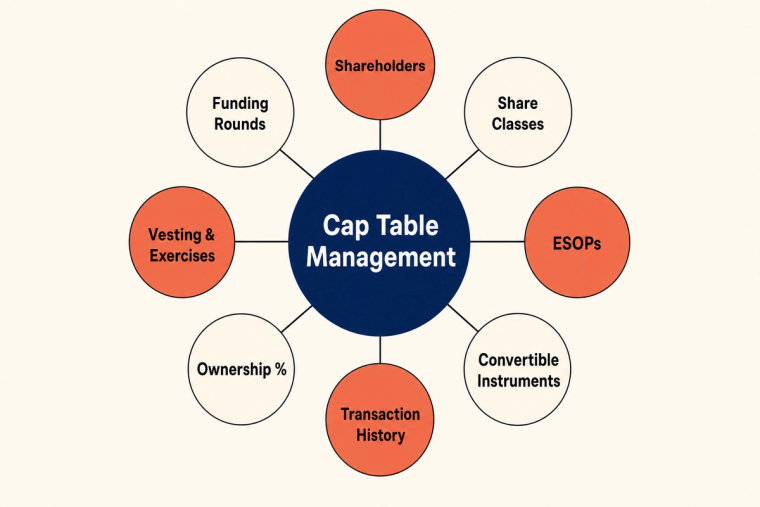
A well-structured cap table records each holder, security, transaction date, and relevant instrument terms. Its structure can remain simple for an early-stage startup and expand as the company adds share classes, employee options, convertible instruments, and funding rounds.
Look at the table below to understand all the components of a cap table.
| Field | What it records | Why it matters |
|---|---|---|
| Holder | Legal holder or option holder | Supports identity checks and reconciliation |
| Security or instrument | Equity shares, preference shares, options, warrants or convertibles | Determines how the position enters each ownership view |
| Share class | Class and series | Connects units with voting and economic rights |
| Units | Shares, options or principal amount | Provides the base quantity for calculations |
| Issue or grant date | Effective date of the transaction | Establishes transaction order and history |
| Issue or exercise price | Amount paid or payable per unit | Supports transaction and accounting review |
| Vesting or exercise status | Granted, vested, exercised, lapsed or canceled | Separates potential dilution from issued ownership |
| Conversion terms | Ratio, valuation cap, discount or trigger | Supports scenario calculations |
| Ownership percentage | Issued or fully diluted shares | Shows control and dilution on a labeled basis |
A simple structure usually has three levels.
- Holder data
- Instrument terms and transaction dates
- Summary percentages
The holder register identifies people and entities. The instrument ledger records securities and their terms. The summary view calculates ownership under selected assumptions.
How do you read a cap table?
An ownership percentage depends on which securities the calculation includes. Issued ownership reflects current issued shares, while a fully diluted view incorporates additional securities according to the selected scenario assumptions.
Consider a company with 800,000 issued shares. Founder A holds 480,000, Founder B holds 240,000, and an investor holds 80,000. The company has also reserved 200,000 options, of which 50,000 have been granted and remain unexercised.
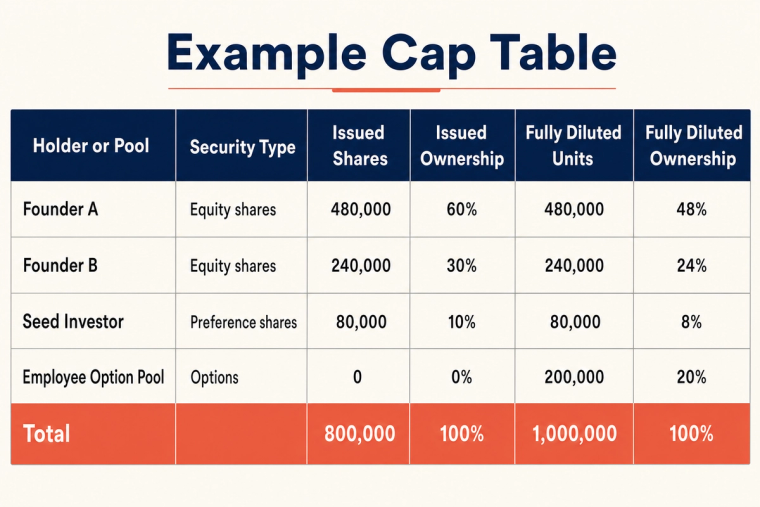
The issued formula is straightforward.
Issued ownership percentage = holder’s issued and outstanding shares ÷ total issued and outstanding shares
Founder A therefore holds 480,000 ÷ 800,000, which equals 60%.
The fully diluted calculation needs explicit assumptions.
Fully diluted ownership percentage = holder’s as-converted units ÷ total as-converted units included in the selected scenario
Here, Founder A holds 480,000 ÷ 1,000,000, which equals 48%. The calculation includes the whole reserved option pool. A calculation that includes only granted options would produce a different result.
Point to remember
State how the calculation treats ungranted options, unvested grants, warrants, and convertible instruments. These assumptions determine the denominator and make ownership comparisons meaningful.
SAFEs and convertible notes require a scenario model based on their documents. Record the valuation cap, discount and conversion trigger, then apply the relevant term in the scenario. Keep the instrument separate from issued shares until conversion becomes effective.
Option-pool increases also affect negotiations. Investors may require a larger pool before closing, which places the dilution on existing holders. Model the pre-money and post-money cases side by side so each party can see the result.
When should a cap table be updated?
Update a cap table whenever a legally effective equity event changes ownership or instrument terms. Here are some common triggers that should prompt you to update the cap table.
| Trigger | Cap-table change | Evidence to retain |
|---|---|---|
| Share issuance or allotment | Add the holder, class, units and issue price | Approvals, subscription documents, allotment records and applicable filings |
| Share transfer or buyback | Change the holder or outstanding units | Transfer or buyback documents and approvals |
| Funding round | Add securities and update dilution scenarios | Transaction documents and closing records |
| ESOP grant, lapse or exercise | Update the option ledger and issued shares after exercise | Grant, vesting, lapse and exercise records |
| Convertible conversion | Replace scenario assumptions with issued securities | Conversion notice, approvals and governing terms |
| Stock split, consolidation or bonus issue | Restate units and per-share values consistently | Corporate-action approvals and updated records |
| Secondary transaction | Change ownership while preserving the primary capital total | Transfer and settlement documents |
A few best practices to keep the cap table accurate
- Run a monthly control review to identify discrepancies that individual transaction updates may miss.
- Compare opening balances, current-period movements, and closing balances for each share class.
- Investigate manual overrides and missing supporting documents, then track unresolved items until the records agree.
How should a cap table be reconciled in India?
Indian companies should connect each cap-table entry to the documents and records that establish the transaction. The control chain begins with approvals and signed agreements, then moves through the transaction ledger into statutory and depository records.
Section 88 of the Companies Act, 2013 covers registers of members and other security holders. Companies should confirm current forms and filing requirements with a qualified company secretary or legal adviser.
Use this reconciliation sequence.
- Transaction documents: Confirm the signed agreement, approval and effective date.
- Cap-table ledger: Match the holder, class, units, price and transaction type.
- Register of members: Reconcile issued holdings by class under the applicable corporate records.
- Employee option records: Match grants, vesting, exercises, lapses and cancellations.
- Depository records: Reconcile dematerialised holdings where the requirement applies.
- Regulatory filings: Match relevant ROC and FEMA or RBI records for applicable transactions.
The Ministry of Corporate Affairs states that the Companies Act, 2013 received presidential assent on 29 August 2013 and was notified in the Official Gazette on 30 August 2013. Current rules and amendments still need transaction-specific review.
Legal review checkpoint
Confirm form names, deadlines and transaction-specific obligations against current MCA and RBI sources before publication or execution. Corporate structure and investor residency can change the applicable process.
Cross-footing provides a simple mathematical test. The sum of holder-level units should equal the class total. Class totals should then tie to the overall issued capital, after accounting for the distinction between authorised, issued, subscribed and paid-up capital.
A separate exception log keeps unresolved items visible. Record the issue, owner, source document and target resolution date. Close the exception only after the model and authoritative record agree.
The top 10 common cap table mistakes
Frequent cap-table errors include stale transactions and inconsistent denominators. Missing convertibles, mixed option statuses and undocumented adjustments create further confusion during diligence.
1. Showing an ownership percentage without its denominator
A figure such as 12% has limited meaning until you state the issue type. It may refer to issued shares, outstanding shares or a fully diluted scenario.
What to do: Label each ownership column and state the assumptions used to calculate it.
2. Updating the model only before a fundraise
Delayed entries force the team to reconstruct approvals, transfers and option events under deadline pressure. Old email threads then become part of a high-stakes reconciliation exercise.
What to do: Post each effective transaction within a defined service period. Run a monthly review even when transaction volume is low.
3. Omitting convertible instruments
A current issued view may look accurate while future dilution remains understated. SAFEs, convertible notes and warrants need a separate instrument schedule with scenario assumptions.
What to do: Record each instrument at signing. Capture its principal amount or units, valuation cap, discount and conversion trigger.
4. Treating the option pool inconsistently
One model may include the entire reserved pool while another includes granted options only. Both calculations can be mathematically correct, although they answer different questions.
What to do: Name the pool basis in every scenario. Show reserved, granted, vested and exercised quantities in separate fields.
5. Mixing grants with issued shares
An option grant gives the employee a right subject to plan terms. Issued ownership changes after a valid exercise and allotment process.
What to do: Maintain an option ledger linked to the cap table. Move units into issued shares only after the relevant steps become effective.
6. Applying corporate actions to only part of the record
A stock split changes unit counts and per-share values across affected holdings. Partial restatement produces mismatched totals and incorrect exercise prices.
What to do: Use a controlled corporate-action workflow. Recalculate every affected instrument, then reconcile class totals before reopening the model.
7. Keeping several spreadsheet versions
Multiple files create competing answers. Manual edits also weaken the audit trail when a formula or assumption changes without review.
What to do: Designate one controlled record with named owners and access levels. Preserve transaction history and approval evidence.
8. Skipping reconciliation with authoritative records
A polished model can still disagree with the member register or depository position. Diligence teams will test the source records behind the summary.
What to do: Schedule periodic reconciliation. Complete an additional review before financing and audit events.
9. Recording a secondary transfer as primary capital
A secondary sale changes the holder of existing shares. A primary issuance increases the company’s issued capital and brings funds into the company.
What to do: Use distinct transaction types. Reconcile cash movement and issued units separately.
10. Sharing more personal data than the user needs
Cap tables can contain addresses, tax identifiers and transaction details. Broad access increases privacy and security exposure.
What to do: Apply role-based permissions and minimise displayed personal information. Use password-protected reports when sensitive data must leave the system.
Spreadsheet or cap table software: when should you switch?
A spreadsheet can work for an early-stage company with a simple ownership structure and limited transaction activity. As the company adds share classes, frequent ESOP grants, convertible instruments, or corporate actions, maintaining consistent records becomes more demanding.
The need for software becomes clearer when teams spend increasing time verifying changes, resolving version conflicts, or rebuilding ownership scenarios before a funding round or audit.
A cap table management software becomes valuable when the company manages several classes, frequent option grants, convertible instruments or recurring corporate actions. Multi-entity structures and stakeholder portals create additional control needs.
Assess the system against the operating work.
- Transaction history: Every adjustment should retain its date, source and reviewer.
- Scenario modeling: Funding and option-pool cases should use controlled assumptions.
- Access control: Employees, investors and administrators should receive role-appropriate views.
- Document linkage: Entries should connect to approvals, agreements and supporting records.
- Reporting: The system should produce consistent ownership and dilution reports.
- Exportability: Finance and legal teams should be able to extract usable records for diligence.
When should you switch?
Switch when maintaining and reviewing the ownership record consumes more time than processing transactions, or when multiple teams need controlled access to the same data.
How Hissa can help you build a cap table and keep it accurate
Hissa moves updating, forecasting and reconciliation into a controlled cap table management platform. Live ownership records keep holder positions and transaction history connected, while grant and transaction workflows reduce the need to transfer the same information between files.
Scenario modeling helps teams assess dilution from funding rounds, option-pool changes and convertible instruments using defined assumptions. Role-appropriate access gives employees, investors and administrators the view they need without circulating the full working record.
Hissa also connects cap-table administration with ESOP management and Ind AS 102 compliance. That connection keeps grants, vesting activity and equity-accounting workflows closer to the ownership data that supports them.
Book a Demo to review how the platform can support your equity operations.