PhonePe’s ₹700 to 800 crore ESOP buyback in 2025 made headlines across the startup press. Divided among its 1,000-plus eligible staff, that pool comes to at most about ₹80 lakh a person, before sale caps and tax.
ESOP buybacks are one of the few ways staff at private Indian companies can turn vested equity into cash before an IPO. Public announcements, though, tend to report the pool and leave out the terms that decide your own payout.
The examples in this article run from 2018 to 2026, and each is read through the four numbers that set a payout. Two further sections cover who funded the cash and what tax took out.
With Hissa, you can see what your own vested options are worth at each board-approved valuation before the next window opens.
How Big Have ESOP Buybacks Been in India?
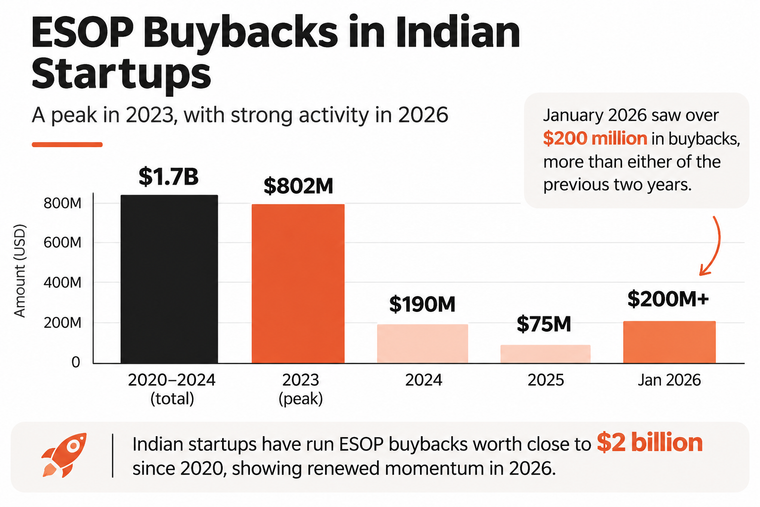
Entrackr counted about $1.7 billion of ESOP buybacks, liquidity and payout programmes by Indian startups from January 2020 to October 2024. The pace then slowed, to roughly $190 million for 2024 and just over $75 million for 2025.
January 2026 reversed that trend. BrowserStack and Innovaccer between them returned about $200 million to employees and early investors, more than either full year before.
Activity peaked in 2023 at $802 million. Flipkart paid $700 million of that as compensation for the fall in ESOP value after the PhonePe spin-off, and other startups added $102 million.
Inc42 counts 12 startups that ran buybacks in 2025 for more than 9,265 employees, worth over ₹1,409 crore. Its total includes PhonePe’s announced ₹700 to 800 crore programme, which explains why it runs higher than Entrackr’s. In 2024 the same tracker recorded 23 startups and ₹1,448 crore, so fewer companies paid out in 2025 for a similar total.
What Decides How Much an Employee Receives?
Your payout depends on four terms far more than on the headline pool. Look for each one in any offer you receive.
- Pool: The total cash on offer
- Eligible people: Current staff, and sometimes former staff, who could sell
- Sale cap: The share of a vested holding each person could sell
- Price basis: The price per option or share and how it compares with the last round
What Did Employees Receive in India’s Largest Buybacks?
The eight examples below cover the largest disclosed programmes from 2018 to 2026. Each one reports the four terms above wherever the company or the press made them public.
1. Flipkart (2025 and 2026)
Flipkart announced a $50 million (about ₹430 crore) plan in July 2025 for 7,000 to 7,500 employees, split across two events. Staff could sell up to 5% of options vested in the previous three years, at $174.32 per option in the first event.
The second event, approved in July 2026, priced options at ₹713.4 each with payouts scheduled for August, as Inc42 reported. Flipkart had moved its domicile to India in between, so the 2025 price works out to about ₹672 per option on the new basis, and the 2026 price was about 6% higher.
2. PhonePe (2021 and 2025)
PhonePe launched a buyback of ₹700 to 800 crore in September 2025, with at least 1,000 employees eligible, before filing its draft IPO papers. Its first programme in November 2021 was worth about ₹135 crore, according to PhonePe’s announcement.
The founders stayed out of that 2021 offer. Top leadership could sell a tenth of their vested options, while other staff could sell up to a quarter.
3. BrowserStack (2026)
BrowserStack’s January 2026 buyback set aside $125 million for early investors and more than 500 current and former employees. It was the company’s third, taking the cumulative total past $275 million.
Profits funded it entirely, and Entrepreneur India reports that nearly half was reserved for employees.
4. Innovaccer (2026)
Innovaccer completed a ₹600 crore (about $75 million) buyback for current and former employees with vested options, as Entrepreneur India reported. Some holders of restricted stock units also took part.
It followed a $275 million Series F that mixed primary and secondary capital, and the headcount stayed undisclosed.
5. Swiggy (2018 to 2024)
Swiggy ran five liquidity events before its IPO, together worth over ₹1,000 crore for more than 3,200 employees. The fifth, in July 2024, offered up to $65 million to employees across levels. That sale reportedly valued Swiggy at $9 billion to $10 billion, below the $10.7 billion of 2022.
6. Razorpay (2018 to 2022)
Razorpay’s fourth sale, in May 2022, covered 650 current and former employees within a $75 million transaction led by Lightspeed. Staff could sell up to 30% of their vested shares, and former employees received the same rate as current ones. Eligibility grew with each round, from 140 people in 2018 to 750 in 2021.
7. Urban Company (2024)
Urban Company’s fifth ESOP sale, announced in May 2024, was worth about ₹203 crore for 446 current and former employees. Dharana Capital and two existing investors, Vy Capital and Prosus, bought the shares. Across five programmes, 784 people have sold ESOPs worth ₹306 crore.
8. Unacademy (2026)
Unacademy’s ₹50 crore buyback came at a valuation well below its last fundraise, according to founder Gaurav Munjal. He said 8 employees would get more than ₹1 crore each and 17 more than ₹50 lakh. Another 38 would receive over ₹10 lakh.
| Company | Year | Pool | Eligible people | Sale cap | Price or funding note |
|---|---|---|---|---|---|
| Flipkart | 2025 to 2026 | $50M across two events | 7,000 to 7,500 | 5% of options vested in prior 3 years | $174.32 (about ₹672 after redomicile), then ₹713.4 per option |
| PhonePe | 2025 | ₹700 to 800 Cr | 1,000+ | Not disclosed | Before IPO filing |
| BrowserStack | 2026 | $125M, nearly half for staff | 500+ | Not disclosed | Funded from profits |
| Innovaccer | 2026 | ₹600 Cr | Not disclosed | Not disclosed | After $275M Series F |
| Swiggy | 2024 | Up to $65M | Not disclosed | Not disclosed | Below 2022 valuation |
| Razorpay | 2022 | Part of $75M deal | 650 | 30% of vested shares | Same rate for former staff |
| Urban Company | 2024 | About ₹203 Cr | 446 | Not disclosed | Bought by investors |
| Meesho | 2024 | ₹200 Cr | About 1,700 | Not disclosed | Fourth buyback |
| Unacademy | 2026 | ₹50 Cr | Not disclosed | Not disclosed | Below last round |
What Did Smaller Startups Offer Their Teams?
Smaller programmes rarely make headlines, and several offered more generous sale caps than the largest ones. Six from Inc42’s 2025 review show the range of terms.
Decentro let early team members sell up to half of their vested options and said they earned 3x to 10x their strike price.
Darwinbox completed its third buyback in four years, worth ₹86 crore, for more than 350 employees. Univest limited its ₹1.61 crore programme to people who joined at the seed and pre-Series A stages.
| Startup | Month in 2025 | Size | Who could sell | Notable term |
|---|---|---|---|---|
| Darwinbox | June | ₹86 Cr | 350+ employees | Third buyback in four years |
| Decentro | June | Not disclosed | Early team | Up to half of vested options |
| Even Healthcare | March | $500K | Not disclosed | Primary valuation, no discount |
| SpeakX | November | $1M | 15 of 20 team members | First buyback |
| Univest | June | ₹1.61 Cr | Seed and pre-Series A joiners | First buyback |
| InsuranceDekho | October | $2M | About 150 current and former staff | Partial encashment |
A small pool can still mean a large slice for each holder. Terms such as a half-holding cap or a rule reserved for early joiners often matter more to you than the size of the cheque.
What is the Average Payout per Employee?
You can estimate an average payout by dividing a buyback pool by the number of eligible people. The figures below use only pools that went to employees, and they are calculations from public disclosures.
Actual payouts were lower for anyone who sold below their cap or kept everything. Meesho’s ₹200 crore buyback for about 1,700 people joins the comparison here.
| Company | Pool | Eligible people | Pool per person (calculated) |
|---|---|---|---|
| PhonePe (2025) | ₹700 to 800 Cr | 1,000+ | Up to about ₹70 to 80 lakh |
| Urban Company (2024) | About ₹203 Cr | 446 | About ₹45.5 lakh |
| Swiggy (five events) | Over ₹1,000 Cr | Over 3,200 | About ₹31 lakh |
| Darwinbox (2025) | ₹86 Cr | 350+ | Up to about ₹24.6 lakh |
| Meesho (2024) | ₹200 Cr | About 1,700 | About ₹11.8 lakh |
| Flipkart (2025 to 2026) | About ₹430 Cr | 7,000 to 7,500 | About ₹5.7 to 6.1 lakh |
| BrowserStack (2026) | About $62.5M for staff | 500+ | Up to about $125,000 |
Averages hide a steep skew. Urban Company says its grant sizes lean toward critical roles and top performers, and early joiners hold more options at lower strike prices.
Unacademy’s tiers show the effect in numbers. Going by the minimum of each disclosed tier, at least ₹20.3 crore of the ₹50 crore pool was set for 63 people.
Who Paid: The Company or New Investors?
Buyback cash comes either from the company’s own reserves or from investors buying the shares. The source shapes the price and how often a programme can repeat.
BrowserStack paid from profits, and Headout funded its July 2025 buyback for more than 250 employees fully from its balance sheet. Company-funded programmes depend on cash flow and board appetite, so profitable businesses can run them more easily.
Urban Company and Razorpay sold employee shares to existing or incoming investors, so the company’s own cash stayed untouched. Investor buyers also negotiated the price, and Swiggy’s 2024 sale went through below its 2022 valuation.
A third route exists for employees of growth-stage companies. Hissa Fund, a SEBI-registered Category II AIF with a $35 million corpus, buys vested ESOP shares at the board-approved fair value. Cash settles in T+5 business days, with no impact on the company’s balance sheet.
What Did Employees Keep After Tax?
Your tax depends on what you sold and who bought it. Two cases cover the examples above.
1. Exercised shares sold in a buyback
Exercising an option creates a perquisite tax on the difference between fair market value and the exercise price, taxed as salary. Selling the shares later adds capital gains, measured from the fair market value at exercise.
When a company bought back its own shares between 1 October 2024 and 31 March 2026, the payout counted as a deemed dividend. The Finance Act 2026 returned buybacks to capital gains from 1 April 2026, with an additional tax on promoters.
2. Vested options bought back before exercise
Employers have usually treated cash paid for surrendered, unexercised options as salary and deducted tax at source. In July 2026, the Income Tax Appellate Tribunal’s Bangalore bench took a different view in Pramod Kumar Jain.
A Flipkart employee had 2,653 vested options repurchased for about ₹2.33 crore in assessment year 2020-21.
Read the tax note, then check it
The tribunal said an offer letter’s tax note does not settle how the income is taxed. A sale to investors and a company buyback can also fall under different rules. Have a tax adviser review the offer before you accept a large payout.
What Patterns Show Up Across These Buybacks?
Five patterns repeat across the examples, and each one shapes what you can expect from the next offer.
- Partial caps are the norm: Sale caps ranged from 5% at Flipkart to half the vested holding at Decentro. A buyback usually returns a slice of your equity.
- Buybacks follow funding rounds: Darwinbox and Innovaccer ran theirs soon after raising new capital. New investors can join the cap table through the sale.
- Former employees can take part: Razorpay paid former staff the same rate as current staff. BrowserStack’s 2026 offer also covered past employees.
- Repeat programmes build trust: Swiggy and Urban Company each ran five sales, and BrowserStack has run three. Staff who see repeat windows can plan around them.
- Prices can fall below the last round: Unacademy priced well below its last fundraise, and Swiggy sold below its 2022 valuation. Even Healthcare, by contrast, matched its primary valuation.
How Can Founders Plan a Buyback Employees Trust?
You can make a buyback credible by fixing the funding source and the sale cap before you announce it. Publishing the price basis, and including former staff where possible, answers the questions employees ask first.
Clean records make the offer faster to run. Each sale changes the cap table, and each exercise before a sale needs a tax calculation for payroll.
Hissa logs buybacks and transfers in the cap table with a full audit trail and recalculates ownership on each entry. In ESOP management, employees see their perquisite tax before they exercise and pay online, and finance teams export PDF and Excel audit packs.
Work Out Your Payout Before You Reply
When your next offer letter arrives, start with your own line in it. Multiply your vested holding by the sale cap, then by the price per option, and you have your gross payout before tax.
Then check whether you’re selling exercised shares or unexercised options, since that decides which tax applies. Take both figures to a tax adviser before you sign.
If you’re a founder, send each employee an estimated payout with the offer letter. That way nobody has to work out their share from the headline pool.
Teams that want buybacks, exercises and the cap table in one system can Book a demo with Hissa.
Suggested reads