An ESOP begins as a compensation promise but quickly creates linked work across HR, finance, legal, secretarial and employee teams. Every grant can affect the option pool, vesting schedule, accounting expense and ownership records, making disconnected spreadsheets difficult to control.
Adoption is also rising. ETCFO reported that 78% of 160 startups polled offered ESOPs in 2024, up from 59% in 2021. Mint reported that 26 unlisted Indian startups initiated ESOP buybacks in 2024, compared with 19 in 2023.
Employee stock option management software connects this lifecycle in one controlled system. This guide explains how it works, when companies need it and what Indian buyers should evaluate.
What is employee stock option management software?
Employee stock option management software is a system that helps a company design ESOP plans, manage option pools, issue grants, automate vesting and exercises, produce accounting and compliance records, and give employees access to their equity information. It keeps these activities connected to a common, controlled equity record.
The software sits at the intersection of several related systems. Understanding those boundaries helps a buyer avoid choosing a tool that solves only one part of the problem.
- ESOP administration software manages plans, grants, vesting, forfeitures, exercises and participant records.
- Cap table software records the company’s ownership structure, share classes, issuances, transfers and dilution.
- Compensation modelling software helps teams plan grant sizes, pool usage, hiring scenarios and dilution before grants are issued.
- An employee equity portal shows each option holder their grants, vesting progress, exercise position and, where supported, valuation and tax scenarios.
These functions can exist in separate products, but separation creates a reconciliation burden. If an exercise is completed in the ESOP system but not reflected correctly in the cap table, finance and secretarial teams may work from different ownership numbers. A connected platform reduces that risk by carrying an event through each relevant record.
When does a company need ESOP management software?
A company usually needs ESOP management software when the number of grants, plans, entities or reporting events makes manual administration difficult to verify. The strongest signal is not headcount alone. It is the growing cost and risk of keeping multiple equity records consistent.
The warning signs below show when a spreadsheet-based process is beginning to strain.
- Grant data is spread across spreadsheets, grant letters and email threads.
- The option pool, ESOP register and cap table do not reconcile easily.
- Vesting changes and employee exits require manual calculations.
- Finance rebuilds expense schedules during every reporting period.
- Employees depend on HR for basic grant and vesting information.
- Board, audit or investor reports take days to prepare.
- The company manages multiple plans, entities or approval structures.
- Historical corrections are difficult to trace to an approver and date.
A spreadsheet may still be adequate for a very small, static plan with few participants and infrequent events. Its hidden cost rises when exceptions appear. A resignation during a cliff, a performance condition, a retrospective correction or a stock split can force one team to update several linked files. Software becomes valuable when those events need repeatable rules, approvals and audit trails.
How does ESOP software manage the employee equity lifecycle?
ESOP software manages the equity lifecycle by converting plan rules into controlled workflows for pools, grants, vesting, accounting, exercises and settlement. Each event updates the relevant records so that company teams and employees see consistent information.
The stages below show what a complete workflow should cover.
1. Plan and option-pool configuration
The company first records the ESOP plan, pool size, eligibility rules, vesting templates, exercise windows and treatment of employee exits. Approval requirements and authorised users should also be configured at this stage.
Good configuration matters because every later event inherits these rules. If the platform cannot represent the approved plan accurately, teams will manage exceptions outside the system and gradually recreate the spreadsheet problem they intended to solve.
2. Grant issuance and acceptance
Once approvals are in place, administrators issue grants against the available pool. The system should record the number of options, grant date, exercise price, vesting schedule, conditions and supporting documents.
A reliable workflow also preserves who approved, issued and accepted the grant. That audit trail helps finance, company secretaries and auditors distinguish an authorised grant from a draft or proposed allocation.
3. Vesting, performance conditions and employee exits
The platform calculates time-based or performance-based vesting according to the plan. It should also handle cliffs, pauses, accelerations, forfeitures and corrections without losing the history of the original schedule.
Employee exits are a crucial test. The platform must apply the relevant good-leaver or bad-leaver rules, stop or adjust future vesting, calculate exercisable options and track the applicable exercise window. A generic “inactive” status is not enough.
4. Accounting, valuation and reporting
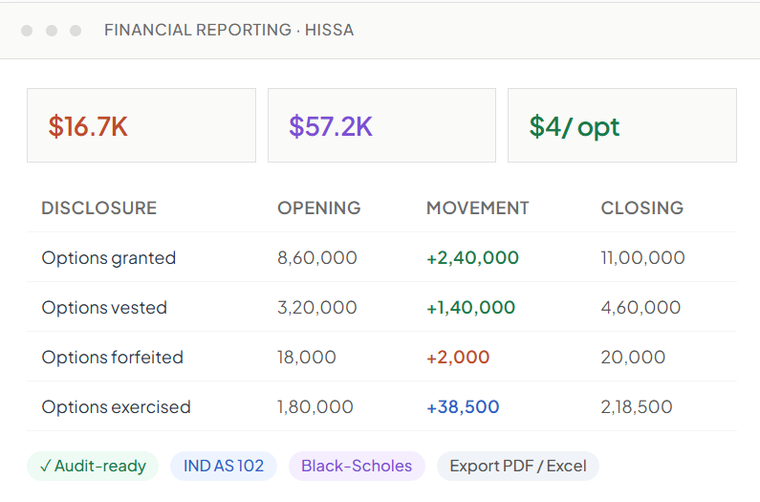
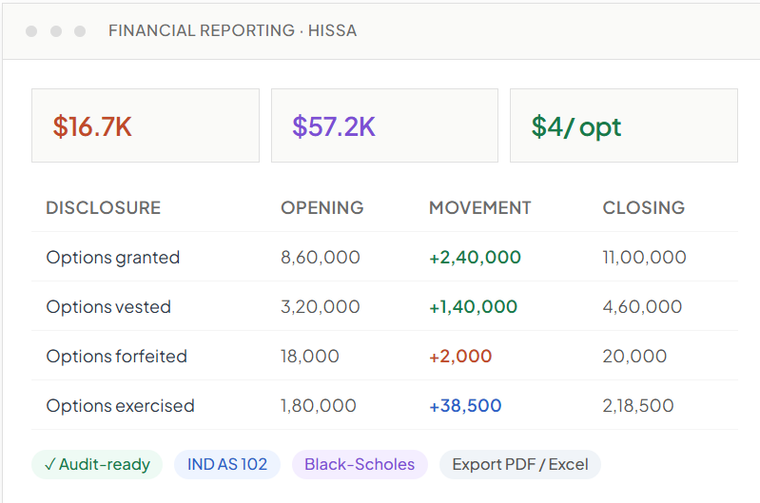
Grant data must feed the company’s accounting workflow. For companies applying Ind AS 102, this may include fair-value inputs, expense recognition, reserve movements, modification or forfeiture treatment, disclosures and audit schedules.
Software can automate calculations and produce reports, but it does not replace professional judgement. Finance teams and auditors still need to confirm the accounting policy, valuation assumptions and treatment of unusual events.
5. Exercise, settlement and liquidity
When an employee decides to exercise, the workflow may need to capture intent, exercise price, tax calculations, approvals, payment and the resulting share issuance or transfer. The completed event should then reconcile with the cap table and statutory records.
Liquidity is related but distinct. An exercise turns an option into a share, subject to the plan and applicable process. A buyback or secondary transaction involves a further sale and may depend on eligibility, company approvals, transfer restrictions and agreed transaction terms.
Which features should Indian companies evaluate?
Indian companies should evaluate ESOP software across administration, accounting, compliance, employee experience, security and corporate action support. A long feature list is less useful than proof that the platform can handle the company’s actual rules and produce verifiable outputs.
The table below turns each capability into a practical question and a piece of evidence to request during a demo.
| Capability | Question to ask | Evidence to request |
|---|---|---|
| Plan and pool management | Can the platform represent every approved plan, pool and allocation rule? | A configured sample using one of your plans |
| Grant administration | Can it issue individual and bulk grants with approvals and acceptance records? | Grant register and audit trail |
| Vesting and exits | How does it handle cliffs, performance conditions, pauses, forfeitures and leavers? | A completed resignation or vesting exception workflow |
| Cap table integration | Does an exercise update the ownership record without separate re-entry? | Before-and-after cap table and reconciliation report |
| Ind AS 102 workflow | Which calculations, schedules and disclosures are produced natively? | Sample expense schedule and auditor-ready export |
| Employee portal | What can employees see and model without contacting HR? | Employee grant, vesting and exercise view |
| Permissions | Can access and approvals be separated across HR, finance and secretarial teams? | Role matrix, approval log and access history |
| Corporate actions | How are stock splits, bonus issues and conversion changes applied? | Worked corporate action example |
| Integrations | Which HRMS, payroll, finance, SSO and API connections are supported? | Technical documentation and data-flow map |
| Data portability | Can the company export complete current and historical records? | Full export sample and migration format |
1. Core plan, grant and vesting administration
The platform should support multiple plans and pools, bulk grant issuance, configurable vesting schedules and reliable exception handling. Companies with more complex arrangements should also test performance conditions, fractional options and custom allocation matrices.
Configuration depth matters because two plans that both use “four-year vesting” may behave differently when an employee changes role, takes approved leave, misses a performance condition or exits before a milestone.
2. Cap table integration and reconciliation
Granted, vested, exercised, forfeited and available options are not isolated numbers. Exercises can affect issued share capital and ownership, while new pools or pool increases can affect dilution analysis.
A buyer should confirm whether the ESOP and cap table modules share one record or merely exchange periodic files. Native connection reduces re-entry, but the team should still inspect reconciliation reports and exception handling.
3. India-native accounting and compliance
Indian businesses may need to account for share-based payments under Ind AS 102 and maintain records and approvals under the Companies Act, 2013. Listed companies may also face relevant SEBI requirements, while cross-border grants or participants may introduce FEMA considerations.
The exact obligations depend on the company, plan and transaction. Buyers should therefore ask which reports are generated natively, which require external inputs, and where legal, valuation, tax or accounting review remains necessary.
4. Employee portal and tax visibility
An employee portal should show grant terms, vested and unvested options, the exercise price, relevant dates and completed events. Where valuation and tax modelling are supported, it should distinguish the tax treatment at exercise from the tax treatment on a later sale.
For Indian employees, the spread between fair market value and exercise price may create a perquisite tax consequence at exercise, while a later disposal can create a capital gains consequence. Software can model scenarios, but individual outcomes depend on applicable law and personal circumstances.
5. Enterprise controls and configurability
Larger private companies, multi-entity groups and listed companies should test parent-subsidiary structures, role-based access, multi-stage approvals and regulated-plan controls such as malus and clawback.
The aim is to keep governance inside the platform. If every non-standard rule requires an offline approval and manual edit, the system may not support the company’s operating model.
6. Security and privacy
ESOP data includes compensation, identity and ownership information. Buyers should evaluate data protection, access controls, hosting, retention, incident response and vendor management, not just a logo for a security standard.
The checks below help procurement and security teams examine the operating controls behind a vendor’s claims.
- Confirm the current scope and validity of ISO 27001 or SOC 2 evidence where claimed.
- Review alignment with India’s Digital Personal Data Protection framework and other applicable privacy requirements.
- Test two-factor authentication, role-based access and session controls.
- Check whether reports can be password-protected and unnecessary PII removed.
- Review audit logs, backup practices and breach-notification terms.
- Confirm data-export and deletion procedures at contract end.
7. Corporate-action support
Bonus issues, stock splits, consolidations and conversion-ratio changes can affect many grants at once. A platform should apply the approved treatment consistently while preserving the pre-event record and calculation trail.
This capability becomes especially important during restructuring, fundraising, pre-IPO preparation or post-listing administration. Manual updates across hundreds of grants create avoidable reconciliation risk.
8. Integrations and data portability
ESOP administration frequently touches HRMS, payroll, finance, identity and document systems. Integrations should reduce duplicate entry without turning an HR event into an unreviewed equity event.
Buyers should ask which system remains authoritative, how failed syncs are handled, and whether an administrator can review a proposed change before it affects a grant. Complete historical exports are equally important because the company must retain control of its records if it changes providers.
How do spreadsheets compare with ESOP management software?
Spreadsheets provide flexibility at low initial cost, while ESOP software provides rules, controls and connected records as a programme grows. The right choice depends on complexity, but spreadsheets become harder to defend when multiple people update linked equity data.
The comparison below shows where the operating differences become material.
| Area | Spreadsheets | ESOP management software |
|---|---|---|
| Source of truth | Often split across files and owners | Central record with controlled access |
| Vesting | Formula-driven and manually maintained | Rule-based schedules and event workflows |
| Version control | Dependent on file discipline | Audit history and permissions |
| Ind AS 102 reporting | Separate models and repeated reconciliation | Connected grant data and reporting workflows |
| Employee visibility | Statements or HR queries | Self-service portal |
| Exits and exceptions | Manual calculations | Configured rules with review steps |
| Corporate actions | Bulk formula changes across files | Controlled event with calculation history |
| Scalability | Simple at low volume | Better suited to multiple plans, entities and events |
The decision should not be reduced to licence cost. A spreadsheet can appear free while consuming significant finance, HR and secretarial time during audits, exits and reporting cycles. Software earns its place when it lowers repeated reconciliation work and makes exceptional events easier to verify.
How should buyers evaluate an ESOP management platform?
Buyers should evaluate an ESOP platform by asking the vendor to run difficult, real workflows and produce the resulting records. A guided feature tour shows what the interface contains; a scenario test shows how the system behaves when accuracy matters.
The following scenarios reveal more than a standard demonstration can.
- Configure a grant from a parent company to an employee of a subsidiary.
- Apply a performance-linked vesting condition and show an unmet outcome.
- Process a resignation during a cliff or exercise window.
- Correct a historical vesting event without erasing the audit trail.
- Apply a stock split or bonus issue across affected grants.
- Generate an Ind AS 102 expense schedule and supporting export.
- Show an employee exercise scenario with separate tax stages.
After each scenario, ask for an output rather than a verbal confirmation. Useful evidence includes an option register, approval history, employee statement, accounting schedule, cap table reconciliation, permission log and migration exception report.
How should total cost of ownership be calculated?
Total cost of ownership includes more than the subscription. Buyers should request a commercial breakdown covering implementation, data migration, modules, integrations, support, advisory services and future changes in headcount or plan count.
Internal work also matters. Estimate the time required from HR, finance, legal, secretarial, payroll, IT and security teams during migration and each reporting cycle. A lower licence price can cost more if the product shifts administration back to the customer.
How should a company implement ESOP management software?
A successful implementation begins with reconciled source data, documented plan rules and named owners for every output. Software can automate a clean process, but it cannot resolve contradictory records without human decisions.
The sequence below reduces the risk of carrying historical errors into the new platform.
- Inventory the records: Gather approved plans, pool changes, grants, vesting events, exercises, forfeitures, employee identities and cap table totals.
- Reconcile the source data: Resolve duplicate grants, inconsistent dates, missing approvals and mismatched option balances before import.
- Document rules and exceptions: Record vesting, leaver, exercise and approval rules, including past exceptions that need to remain visible.
- Configure roles and workflows: Define who can view, propose, approve, execute and report each event.
- Validate each stakeholder view: Ask finance, HR, legal, secretarial and selected employee users to test their outputs.
- Run parallel checks: Compare pool utilisation, vesting, expense schedules and employee balances with approved records before go-live.
- Set post-launch governance: Assign data owners, reconciliation frequency, access reviews and an audit calendar.
Migration is complete only when the company can explain every material difference between the old and new records. A signed reconciliation report is more meaningful than a successful file upload.
What mistakes should companies avoid?
The most common mistake is choosing software from a broad feature checklist without testing the company’s hardest workflows. Other failures usually stem from weak source data, unclear ownership or assumptions about what “compliance” includes.
The points below identify the issues to resolve before signing or going live.
- Do not treat the cap table, accounting schedule and employee portal as unrelated datasets.
- Do not migrate unverified spreadsheets and assume the platform will correct them.
- Do not ignore leaver rules, retrospective changes or performance conditions.
- Do not assume “compliant” means every required report is generated natively.
- Do not underestimate implementation work and internal sign-off.
- Do not accept security claims without checking current scope and evidence.
- Do not promise liquidity without explaining eligibility, approvals and transaction terms.
- Do not leave ownership of post-launch data quality undefined.
How can Hissa support ESOP management in India?
Hissa supports Indian companies across the ESOP lifecycle by connecting plan and pool administration, grants, vesting, exercises, accounting, employee visibility and liquidity workflows. The platform is designed for founders, HR teams, finance leaders, company secretaries and employees working from the same equity record.
The support areas below show how Hissa fits the operational and governance needs discussed in this guide.
- Plan and pool administration: Structure ESOP policies and pools, issue grants, and monitor granted, vested, exercised and forfeited options.
- Configurable workflows: Support parent and subsidiary structures, performance vesting, custom allocation matrices, fractional options, and controls such as malus and clawback.
- Finance and reporting: Connect grant records with Ind AS 102 accounting, Black-Scholes valuation workflows, expense calculations, reserve tracking and audit-ready exports.
- Employee experience: Give employees access to their grants, vesting schedules and equity information, with modelling for exercise and Indian tax scenarios.
- Exercise and liquidity workflows: Coordinate exercises, buybacks and cash-outs from employee intent through settlement while preserving approvals and records.
- Corporate actions: Manage bonus issues, stock splits, consolidations and conversion-ratio changes within the equity system.
- Company-stage coverage: Support private, public-unlisted and listed-company equity programmes with role-based governance requirements.
Hissa also operates a separate SEBI-registered Category II Alternative Investment Fund that may provide a route to liquidity for eligible transactions. Software administration does not guarantee a transaction; availability remains subject to eligibility, approvals and agreed terms.
Book a demo to test Hissa against your most complex ESOP workflow and review the resulting reports.