A startup can promise employees meaningful ownership and still leave them waiting years to turn that value into cash. As private companies remain unlisted for longer, that delay can weaken the practical value of an Employee Stock Option Plan (ESOP).
A tender offer, buyback, and secondary sale can each create pre-Initial Public Offering (IPO) liquidity. The decisive differences are who buys, who starts the process, how broadly the offer applies, and what changes on the cap table.
Tender offer vs buyback vs secondary sale
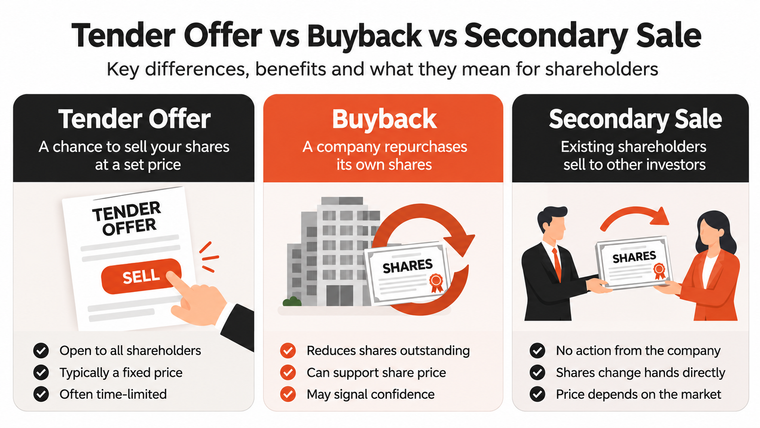
A tender offer is a broad transaction format, a buyback is a company-funded repurchase, and a secondary sale is a transfer to an external buyer. A company can run a tender offer with itself or an outside fund as buyer, so the buyer determines the legal and cap table consequences.
Here’s a quick side-by-side look at the three:
| Feature | Tender offer | Buyback | Secondary sale |
|---|---|---|---|
| Buyer | The company or an approved investor or secondary fund | The company | An outside investor, fund, existing shareholder, or approved platform participant |
| Initiator | Company leadership or a lead investor working with the company | The company | An employee or shareholder, subject to company approval |
| Structure | Broad, organised, time-bound offer for an eligible group | Company-funded corporate action | Individually negotiated private transfer |
| Price | Fixed price or common formula | Board-approved price supported by valuation | Negotiated between buyer and seller, subject to valuation rules |
| Cap table effect | Depends on the buyer | Repurchased shares are extinguished | Ownership changes while total shares remain constant |
| Company cash use | Depends on the buyer | Yes | Usually limited to administration costs |
| Typical reach | A defined employee group or security class | A defined group under the buyback | One employee or a small seller group |
What happens when the company buys shares
The company pays participating shareholders from permitted resources. It then extinguishes the repurchased shares through the applicable statutory process.
The outstanding share count falls after cancellation. Continuing shareholders can hold a higher ownership percentage even though they purchase zero additional shares.
What happens when an outside investor buys shares
An investor-funded transaction transfers existing securities from the employee to the buyer. The company issues zero new shares, so the number of outstanding shares stays the same.
Ownership percentages can still move. The seller reduces or exits a position, while the incoming investor acquires the corresponding stake and may receive rights under the shareholders’ agreement.
What is a tender offer in a startup?
A tender offer is a company-approved event that invites eligible shareholders to sell a stated quantity of shares at a set price within a defined window. The company controls the process even when an external investor or secondary fund supplies the capital.
Eligible participants receive the same rules. The offer documents normally state who can sell, the maximum quantity, the purchase price, the deadline, and the allocation method.
How a tender offer works
A private-company tender offer usually follows these steps.
- Set the objective: The board defines the employee, retention, ownership, or financing outcome.
- Choose the buyer: The company selects itself, an existing investor, a new investor, or a secondary fund.
- Set the terms: Eligibility, price, sale limits, allocation rules, and deadlines are documented.
- Open the window: Eligible holders receive the offer and elect whether to participate.
- Resolve excess demand: A disclosed proration method applies when requested sales exceed buyer demand.
- Close the event: Approvals, transfer documents, payment, tax records, and cap table updates are completed.
A tender offer often accompanies a primary funding round. A new investor may purchase newly issued shares from the company and existing shares from employees in one coordinated closing.
Who can participate?
Eligibility comes from the offer terms. A company may include current employees or former employees. Founders, early investors, or selected security classes may also qualify.
Vested options and shares are different assets. An employee may need to exercise vested options, pay the strike price, and address perquisite tax before selling the resulting shares.
Some plans support a cashless sequence in which exercise and sale occur through one closing. The ESOP plan and transaction documents must permit that treatment.
How are tender offers priced?
A fixed offer price creates consistency across eligible sellers. The board and buyer still need a defensible valuation basis, especially when a recent primary funding round involved preferred shares with rights that employee-held common shares lack.
The offer should explain the following elements.
- Valuation date: The date used for the pricing analysis
- Security class: The rights attached to the shares being sold
- Transaction limit: The maximum capital or share quantity available
- Individual limit: The maximum each participant may offer
- Proration method: The allocation rule used when demand exceeds the limit
A primary round price cannot automatically serve as the employee sale price. Liquidation preference, anti-dilution protection, information rights, and governance rights can create a meaningful difference between preferred and common share value.
Why do companies use tender offers?
A tender offer gives several employees liquidity through one controlled event. Common terms also support consistent treatment across the eligible group.
Companies may use the process to reward tenure or strengthen retention. It can also let an investor increase ownership without requiring the company to issue the entire stake as new equity.
Participation remains voluntary under the offer terms. Employees who decline keep their shares and retain exposure to future value, subject to the governing documents.
What is a company buyback?
A buyback occurs when the company uses permitted funds to repurchase its own shares. In India, Section 68 of the Companies Act, 2013 and the related rules govern the corporate process.
A buyback can use a tender-style window to gather employee elections. The tender describes the participation method, while buyback law governs the company’s authority to purchase its securities.
How does a buyback work in India?
Section 68 permits funding from free reserves or the securities premium account. Proceeds from an issue of other specified securities can also be used, subject to the statutory conditions.
The process includes six core controls:
- Check the articles: The articles of association must authorise the buyback.
- Obtain approval: The board or shareholders approve the transaction at the applicable threshold.
- Test the limits: The company checks transaction size and the post-buyback debt ratio.
- Confirm eligibility: The securities offered for repurchase must be fully paid.
- Complete the process: The company follows the required timetable, filings, and solvency steps.
- Extinguish the shares: Repurchased securities are cancelled and the statutory records are updated.
The Ministry of Corporate Affairs publishes the Companies Act, 2013. Legal advisers should verify the rules and notifications in force when the company approves its transaction.
How does a buyback affect the company?
The company pays sellers from its balance sheet. That outflow can compete with hiring, product investment, debt service, or operating reserves.
Cancellation reduces the share count. It can improve Earnings Per Share (EPS) when earnings stay constant, although private startups usually focus on cash, solvency, ownership, and financing capacity.
Hissa’s cap table management software records buybacks and transfers with an audit trail. That record helps teams reconcile the corporate action across equity views.
When can a buyback work well?
A buyback can serve a company with sufficient permitted reserves and a clear reason to fund liquidity directly. It can also consolidate small holdings or provide a planned employee cash-out window.
The board should model the post-transaction cash position before committing. An investor-funded tender offer may serve the same employee objective while preserving company capital.
What is an employee secondary sale?
An employee secondary sale transfers existing shares to an external buyer. The employee usually starts or accepts the opportunity, while the company applies its approval process and transfer restrictions.
The employee receives cash and the buyer receives the shares. Total outstanding shares remain constant because the transaction changes ownership without creating new equity.
How does a secondary sale work?
A private secondary transaction generally follows six steps.
- Confirm ownership: The seller verifies that the shares are issued and transferable.
- Review restrictions: The company checks the articles, shareholders’ agreement, ESOP plan, and grant terms.
- Identify a buyer: The employee or an approved intermediary finds an eligible investor.
- Agree terms: The parties negotiate price, quantity, representations, and closing conditions.
- Process rights: The company handles board consent and contractual transfer procedures.
- Close the transfer: Payment, documents, taxes, statutory registers, and cap table entries are reconciled.
A marketplace match alone cannot complete a private-company transfer. Existing contractual rights continue to govern who may buy and how the sale proceeds.
Which transfer clauses matter?
A Right of First Refusal (ROFR) may let the company or existing investors match a third-party offer. A Right of First Offer (ROFO) may require the seller to approach specified parties before seeking an outside buyer.
Tag-along rights can allow protected shareholders to join a qualifying sale. Drag-along rights can require holders to participate in an approved company sale, although they are less common in an ordinary employee-led transfer.
Board consent provisions let the company review the buyer and transaction. The exact order of these rights matters because one notice can start deadlines for several stakeholders.
Why is secondary pricing difficult?
One seller and one buyer can negotiate a price, but private shares have limited price discovery. The latest funding-round price may reflect preferred rights that the employee’s shares do not carry.
A buyer may also apply a discount for transfer restrictions or uncertain exit timing. The company should document the valuation basis and check tax rules that can substitute fair market value when consideration falls below prescribed thresholds.
A term sheet marks the start of execution
An agreed price can still face valuation, consent, tax, diligence, and documentation conditions. Employees should assess expected net proceeds after those requirements are clear.
Which employee liquidity route should a startup choose?
Match the mechanism to the source of capital and the company’s objective. A broad programme funded by an investor points toward a tender offer, while surplus company cash can support a buyback.
A single employee with an approved buyer may use a secondary sale. Consistent review principles help the company handle later requests fairly.
| Company objective | Stronger route | Reason |
|---|---|---|
| Give several employees one sale window | Tender offer | Common rules and one closing support consistent execution |
| Reduce outstanding shares | Buyback | The company purchases and cancels its shares |
| Preserve operating cash | Investor-funded tender or secondary sale | External capital funds employee liquidity |
| Process one approved employee transfer | Secondary sale | A bilateral transaction avoids a company-wide event |
| Add investor ownership during a funding round | Investor-funded tender offer | Primary and secondary purchases can close together |
Compare cash use before comparing transaction labels
A company-funded event affects liquidity reserves. An investor-funded event changes the shareholder base and can introduce a buyer with information or governance expectations.
The board should model both outcomes before selecting the structure. That model should show cash after closing, ownership after closing, employee participation assumptions, and the effect of oversubscription.
Compare employee choice and fairness
A broad programme can provide common terms across a defined population. A one-off transaction gives one seller flexibility but may create questions from other employees seeking similar access.
Clear eligibility principles reduce those questions. The company should document tenure requirements, vesting cut-offs, sale caps, and treatment of former employees before invitations are sent.
Compare execution demands
Tender offers centralise many sellers in one process. Buybacks add corporate-law controls and company funding. Secondary sales place greater weight on buyer diligence and transfer restrictions.
Each route requires accurate ownership data. A mismatch between the grant ledger and cap table can delay consent, alter sale quantities, or create tax reporting errors.
What should employees check before accepting liquidity?
Employees should evaluate net cash, retained ownership, and the value they give up. The headline price alone cannot answer those questions.
Use this checklist before signing an election or transfer document.
- Security status: Confirm whether you hold vested options or issued shares
- Exercise requirement: Check whether exercise must occur before the sale
- Sale quantity: Review the individual cap and any proration rule
- Price basis: Understand the valuation date and the rights attached to the priced security
- Tax sequence: Model perquisite tax at exercise and capital gains tax at sale where applicable
- Transfer rights: Review consent, Right of First Refusal, Right of First Offer, and tag-along provisions
- Net proceeds: Deduct exercise cost, tax, and transaction charges from expected cash
- Retained exposure: Calculate the shares and future upside remaining after the sale
- Payment timing: Confirm closing conditions and the expected settlement date
India’s ESOP tax sequence can create a cash requirement before sale proceeds arrive. Hissa’s guide to perquisite tax on ESOPs explains the exercise-stage calculation, while its ESOP liquidity guide covers the wider set of exit routes.
Work from net proceeds instead of the offer value
An employee with 10,000 vested options cannot treat the offer price multiplied by 10,000 as spendable cash. The exercise cost and tax can materially reduce the result.
A transaction calculator should display each component separately. Employees can then compare a partial sale with retaining all shares or selling the permitted maximum.
Decide how much equity to retain
Selling every eligible share removes future exposure from that holding. A partial sale can fund tax or personal goals while preserving some ownership.
Personal finances and concentration risk shape the decision. Independent tax and financial advice can help because the company’s transaction team manages the company’s process.
How should a company execute the transaction?
A liquidity event should run as one connected equity operation. Legal approval, seller elections, payment, tax records, and cap table reconciliation need shared data and named owners.
Prepare before announcing the event
The company should reconcile grants, exercises, certificates, and shareholder records before setting the sale limit. It should also identify expired options, leavers, liens, and incomplete transfer paperwork.
Next, the board can model participation at several levels. Those scenarios reveal the required capital, likely proration, and post-closing ownership before employees receive an offer.
Make the offer documents answer practical questions
Employees need a plain-language summary beside the legal documents. It should show eligibility, price, maximum quantity, tax handling, deadlines, closing conditions, and the consequences of declining.
The company should provide one channel for questions and record answers consistently. Individual guidance should stop short of personal investment or tax advice.
Reconcile every record after closing
Closing requires more than payment confirmation. The company should update the register of members, cap table, employee portal, accounting records, and transaction audit trail.
A company-funded repurchase also requires share extinguishment records. An external purchase requires the incoming holder’s rights and classifications to be reflected accurately.
The right route starts with the source of capital
A tender offer provides a structured sale window. A buyback uses company cash and reduces outstanding shares, while a secondary sale transfers ownership without changing the share count.
Start with who supplies the money. Then test the governance, tax, and employee consequences so the offer terms and equity records stay aligned through settlement.
Ready to build employee liquidity into your equity operations? Book a demo with Hissa to connect ESOP administration, cap table governance, and liquidity workflows.