Inc42 counts over 15 new-age tech companies listed on Indian exchanges in 2025. Every one of them that carried an ESOP scheme across the IPO now answers to SEBI for each fresh grant.
That rulebook is the SEBI (Share Based Employee Benefits and Sweat Equity) Regulations, 2021, shortened here to the SBEB Regulations. A new grant cycle or a draft offer document sends company secretaries back to it, often with an auditor’s questions attached.
This guide sets out each obligation in the order a listed company meets it, with its regulation number, and gives pre-IPO companies their own section. With Hissa, you can run grants, vesting and SEBI disclosures for a listed scheme from one ESOP record.
What are the SEBI ESOP Regulations?
SEBI notified the SBEB Regulations on 13 August 2021, and the consolidated text on sebi.gov.in includes amendments up to 4 December 2025. They replaced the 2014 SBEB Regulations and the 2002 sweat equity regulations, both repealed by Regulation 46.
Whether they apply to you turns on Regulation 1(4). You’re covered if your equity shares are listed on a recognised Indian stock exchange and your scheme benefits employees through the company’s securities, with a group link such as being set up, funded or controlled by your group. If you’re still unlisted, the Companies Act route in our ESOP compliance guide applies instead.
Regulation 1(3) names six types of benefit, and each comes with one headline rule worth knowing. Five are schemes you run for employees, and the sixth is sweat equity. When your team says “ESOPs”, they almost always mean the ESOS row.
| Type | Headline rule | Regulation |
|---|---|---|
| Employee stock option scheme (ESOS) | Minimum vesting period of one year | 18(1) |
| Employee stock purchase scheme (ESPS) | Shares locked in for at least one year from allotment | 22(2) |
| Stock appreciation rights (SAR) | Minimum vesting period of one year | 24 |
| General employee benefits scheme (GEBS) | Trust holdings from market purchases capped at 2% of paid-up capital | 3(11) |
| Retirement benefit scheme (RBS) | Same 2% cap as GEBS | 3(11) |
| Sweat equity shares | Up to 15% of paid-up capital a year and 25% at any time | 31 |
SEBI’s FAQs on the regulations add two clarifications, which Cyril Amarchand Mangaldas discusses in detail. RSUs structured like one of the listed schemes fall within the regulations, while cash-settled phantom stock stays outside because it involves no dealing in shares. Our guide to types of stock option plans compares these instruments in practice.
Who Counts as an Employee Under the SBEB Regulations?
Regulation 2(1)(i) draws a wide circle and then takes out anyone with control. Inside that circle, your compensation committee decides who actually gets grants, under Regulation 4.
- Designated staff: People the company designates as employees, in India or abroad.
- Directors: Whole-time and non-executive directors outside the promoter group.
- Group staff: Employees and directors of group, subsidiary, associate and holding companies.
Then come the exclusions, which remove people who already hold control or an oversight role. Holdings through relatives count toward a director’s 10% threshold.
- Promoters: Promoters and members of the promoter group.
- Independent directors: Any independent director on the board.
- Large holders: Directors holding more than 10% of outstanding equity, directly or indirectly.
If a director sits on your board as an institution’s nominee, they need a written agreement with that institution on whether they can accept grants. Under the Regulation 4 explanation, you file a copy with every exchange where your shares are listed.
Cyril Amarchand Mangaldas traces how the 2021 text widened employee scope compared with the 2014 rules. Promoter status matters most around an IPO, so the pre-IPO section covers the 2025 rule for that case.
What Approvals Does a Listed Company Need Before Granting Options?
There are five steps between your board’s decision and the first grant letter. Skip one, and the exchange can hold up listing of the shares employees get on exercise.
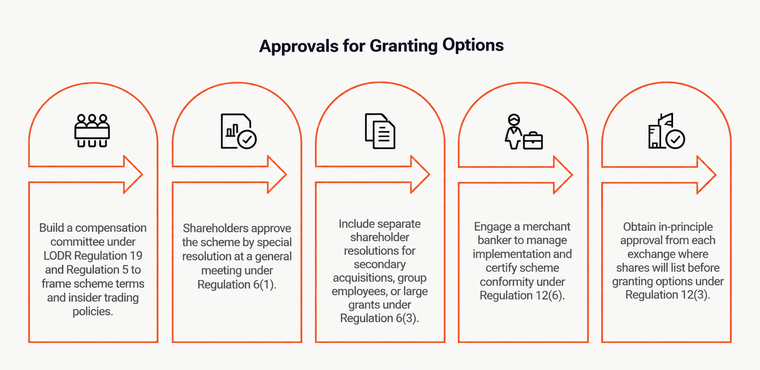
1. Form the compensation committee
Your scheme needs a compensation committee to run it, built under the board-committee rules in LODR Regulation 19, as Regulation 5 requires. You can also designate your nomination and remuneration committee for the role. The committee frames the detailed scheme terms and the policies that keep the trust and employees within insider trading rules.
2. Pass a special resolution
Before anyone gets a grant, shareholders approve the scheme by special resolution at a general meeting, under Regulation 6(1). The explanatory statement follows Part C of Schedule I, so it lists the total options on offer, the vesting requirements, the pricing formula and whether you’ll run the scheme directly or through a trust.
3. Add separate resolutions where needed
Some situations need their own shareholder resolution under Regulation 6(3). Give each one a separate item in the notice so none gets missed.
- Secondary acquisition: Market purchases for the scheme, with the percentage stated.
- Group employees: Grants to employees of a subsidiary or holding company.
- Large grants: Grants to identified employees of 1% or more of issued capital in one year.
4. Appoint a merchant banker
You will need a merchant banker to run implementation until the exchanges grant in-principle approval, under Regulation 12(6). The banker also certifies, in the statement you file with the exchanges, that your scheme conforms to the regulations.
5. Get in-principle approval before the grant
Each exchange where the shares will list has to give in-principle approval before you grant options, under Regulation 12(3). Your application carries the statement in Part D of Schedule I, as Regulation 10(b) sets out.
Want to change the terms later? Varying unexercised terms, or repricing after a market fall, goes back to shareholders as a special resolution and must protect employees’ interests, under Regulation 7.
Should a Scheme Run Directly or Through a Trust?
You choose the route when shareholders approve the scheme, under Regulation 3(1). Switching later takes a fresh special resolution, and the change must protect employees’ interests.
A trust becomes compulsory once your scheme buys shares in the market or receives them as a gift. Those market purchases stay within 2% of paid-up capital in any financial year, measured at the previous year end, under Regulation 3(10).
If you use a trust, its trustees hold the shares but can’t vote them, under Regulation 3(5). Shares bought in the market stay with the trust for at least six months under Regulation 3(13), apart from exits such as open offers or buybacks under Regulation 3(14)(b).
In your exchange disclosures, trust holdings show as non-promoter, non-public shareholding, so they sit outside the 25% minimum public float under Regulation 3(9). You can also lend money to the trust to buy shares under Regulation 3(8), subject to the Companies Act and its share capital rules.
| Scheme group | Cap on trust holdings from secondary acquisition | Regulation |
|---|---|---|
| ESOS, ESPS and SAR | 5% of paid-up equity capital | 3(11) |
| GEBS and RBS | 2% of paid-up equity capital | 3(11) |
| All schemes combined | 5% of paid-up equity capital | 3(11) |
Caps are measured against paid-up capital at the end of the year before shareholders approve the purchases, adjusted for corporate actions such as bonus issues and splits. As a rule of thumb, direct issue suits you if you’re comfortable diluting, and a trust earns its cost when you plan to buy existing shares.
What Do the Rules Say on Pricing, Vesting and Leaving?
You’re free to set the exercise price under Regulation 17, as long as you follow the accounting standards in Regulation 15. Options vest at least one year after grant, under Regulation 18(1), and tracking those dates for every employee is the daily work of ESOP management software.
Options can’t be transferred or pledged under Regulation 9, so each grant stays personal to the employee. When someone leaves, a fixed rule applies to each kind of exit.
- Death: All granted options vest in the legal heirs or nominees on the date of death.
- Permanent incapacity: All granted options vest in the employee on that day.
- Resignation or termination: Unvested options expire, and vested options stay with the employee on the committee’s terms.
- Retirement: Vesting continues on the original schedule under company policy.
Option holders gain dividend and voting rights only once shares are issued on exercise, under Regulation 19. Money an employee paid toward the option can be forfeited if the exercise period lapses unused, under Regulation 20. Lock-in on exercised shares is optional for ESOS, at the company’s choice under Regulation 18(2).
Exercise funding under Regulation 9(2)
Your company or its ESOP trustee can fund an employee’s exercise price, tax and related costs, where law permits. Either can also let empanelled stockbrokers arrange the funding, with the amount recovered from the sale of the employee’s shares.
What Must a Listed Company Disclose and Certify Each Year?
At every AGM, your secretarial auditor has to certify that the scheme followed the SBEB Regulations and your shareholder resolution, under Regulation 13. That’s why your grant files need to reconcile all year round.
Regulation 14 and Part F of Schedule I set the annual disclosure. Your Board’s report states any material change in the schemes and confirms compliance, with the scheme details posted on your website.
For accounting, you follow the standards notified under section 133 of the Companies Act, including the ICAI guidance on share-based payments, under Regulation 15. Part F also asks for diluted EPS on shares issued under the schemes, and Ind AS 102 governs how you measure the expense.
Each exercise needs its own notice to the exchanges in the Part E format of Schedule I, under Regulation 10(c). Table 3 puts the full sequence in order, from set-up to the AGM.
| Stage | Obligation | Regulation |
|---|---|---|
| Set-up | Constitute compensation committee or designate the NRC | 5 |
| Set-up | Decide the direct or trust route | 3(1) |
| Approval | Special resolution with the Part C explanatory statement | 6(1), 6(2) |
| Approval | Separate resolutions for market purchases, group employees and grants of 1% or more | 6(3) |
| Listing | Merchant banker until in-principle approval | 12(6) |
| Listing | Part D statement and in-principle approval before the grant | 10(b), 12(3) |
| Grant | Part G disclosures to prospective grantees | 16(2) |
| Exercise | Notice to the exchanges in the Part E format | 10(c) |
| Annual | Part F disclosures in the Board’s report and on the website | 14 |
| Annual | Secretarial auditor’s certificate at the AGM | 13 |
Hissa’s public-listed ESOP management covers SEBI compliance and regulatory reporting for listed companies. It tracks fair market value and disclosures. Insider trading enforcement and audit trails run on the same platform.
How do the SBEB Regulations Apply to Pre-IPO Companies?
If you’re preparing to list, your existing scheme comes with you across the IPO. Shares from options granted before the IPO list on exercise, subject to the ICDR Regulations, under Regulation 11. Teams on that path can start with public unlisted ESOP management.
Fresh grants under a pre-IPO scheme have to wait for two things under Regulation 12(1). The scheme must conform to the SBEB Regulations, and your shareholders must ratify it after the IPO, at any point before the next grant.
Existing pre-IPO grants keep their terms unless shareholders pass a special resolution, under Regulation 12(2). That covers repricing and vesting changes, though adjustments for corporate actions are allowed. After listing, fresh grants follow the same sequence as any listed company, including in-principle approval before each grant under Regulation 12(3).
Founders get some comfort from Regulation 9A, in force since 8 September 2025. If you’re named a promoter in the draft offer document, you keep and can exercise grants made at least one year before the filing, as Bar & Bench summarised.
Pre-IPO checklist
Start these tasks before the draft offer document is filed. Each one shortens the work after listing.
Compare each scheme clause with the SBEB Regulations
List grants to likely promoters, with grant dates
Draft the post-IPO ratification resolution
What Changed in the 2025 Amendments?
SEBI amended the SBEB Regulations twice in 2025. Regulation 9A came first, on 8 September 2025, settling the promoter-employee question above for founders and senior staff with options granted before the IPO filing.
The Second Amendment followed on 2 January 2026 and defined “valuer” by reference to section 247 of the Companies Act. Valuing the know-how or IP behind sweat equity now goes to an independent registered valuer under Regulation 34, and merchant bankers have nine months to finish assignments already under way, as AZB & Partners notes.
Get Your SBEB File Ready for the Next Grant
Pick one scheme this quarter and test it against Table 3, row by row. Pull the shareholder resolution, the Part D statement and the grant register, and mark any step that has no document behind it.
If an IPO is on the plan, start the scheme review before the draft offer document is filed. That leaves time to list promoter grants and draft the ratification resolution before listing deadlines begin.
For the records behind every row, public-listed ESOP management in Hissa keeps grants and disclosures in one place. Pre-IPO teams can start with public unlisted ESOP management.