The right equity management platform should support the workflows your team manages across finance, HR, legal, and employee equity. A platform may maintain an accurate cap table while your finance team still calculates Ind AS 102 expenses in a spreadsheet.
Qapita and Hissa both go beyond basic cap-table administration. Qapita offers equity management, valuation services, stock-plan administration, and liquidity solutions across multiple markets. Hissa focuses on Indian companies, offering cap-table management, configurable ESOP plans, Ind AS 102 accounting, employee tax visibility, and fund-backed liquidity solutions.
We’ll compare Qapita and Hissa across the areas that matter when you evaluate an equity management platform, including cap table management, ESOP administration, accounting, employee visibility, and liquidity. We’ll also look at which platform best fits different company structures and equity workflows.
Qapita vs Hissa at a glance
The key difference is the scope each platform brings to equity management. Qapita offers broader international coverage, while Hissa focuses on India-specific equity, accounting, employee tax, and liquidity needs.
The table below highlights how these differences show up across core requirements.
| Decision area | Qapita | Hissa | What to consider |
|---|---|---|---|
| Core proposition | Broad equity-management and private-market platform | India-focused equity, compensation modeling, and ESOP lifecycle platform, with $3.5B in ESOP grants managed | Whether you need international breadth or deeper alignment with Indian workflows |
| Geographic orientation | International, with coverage across 60+ countries | Primarily focused on India | Entity locations, employee locations and applicable regulations |
| Cap-table management | Cap-table administration for companies with varied ownership and stakeholder needs | Cap-table administration covering multi-series CCPS, CCDs, convertible notes and warrants, connected to ESOPs, accounting, corporate actions and liquidity | Entity complexity, historical records, stakeholder rights and reporting |
| ESOP and equity-plan administration | Stock-plan administration across broader and multijurisdictional operations | Configurable Indian ESOP, RSU, SAR and phantom stock workflows, including complex vesting and performance conditions, with an automatically maintained SH-6 register | Your actual plan rules, subsidiaries, forfeitures, exercises and approval processes |
| Accounting | ASC 718 and related reporting capabilities | Ind AS 102 expense calculations, reserve tracking, disclosures and reports; outputs also support IFRS 2 reporting | The standards that apply to each reporting entity |
| Valuation | Valuation services, including 409A-related requirements | Black-Scholes valuation integrated into ESOP accounting workflows; registered-valuer and merchant-banker valuations through partner valuers | Whether you need valuation services, valuation software or both, and whether valuations stay connected to the cap table and accounting |
| Employee experience | Employee access to grant and equity information | Grant, vesting and value visibility with Indian tax and exercise context | What employees can see and which decisions they can complete themselves |
| Liquidity | Tender offers and broader liquidity solutions | Eligible employee liquidity through a ₹300 crore SEBI-registered Category II AIF and Secondary Desk, with T+5 settlement and no funding required from the company’s balance sheet | Capital source, eligibility, approvals, transaction structure and settlement |
| Pricing | Public positioning includes transparent pricing, free migration and cost-saving claims subject to terms | Tailored plans scoped to the modules, stakeholder base and workflows each company needs; quoted on request | Total cost across software, migration, implementation, services and transactions |
Qapita overview
Qapita is an equity-management platform with an international orientation. It covers cap-table and stock-plan administration, valuations, fund administration, and liquidity.
Its accounting and valuation capabilities include workflows related to ASC 718 and 409A, which may matter for companies managing equity across multiple jurisdictions.
Qapita publicly positions its pricing around transparency, free migration, and guaranteed cost savings, subject to applicable terms and proposals. For Indian companies, it depends on how well it supports local plan rules, statutory reporting, employee requirements, and implementation needs.
Hissa overview
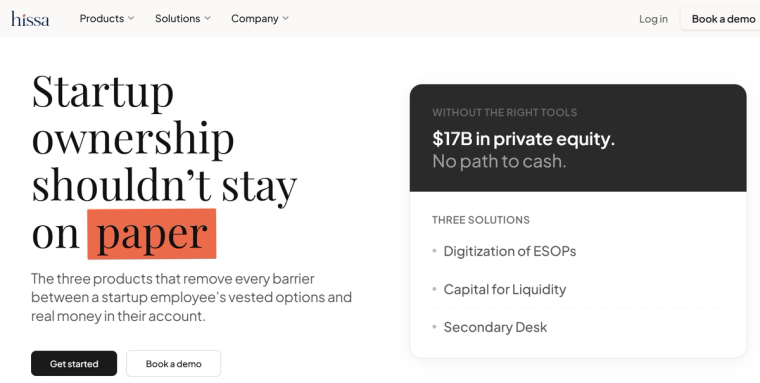
Hissa is an India-focused equity and ESOP lifecycle platform. It connects cap-table management, configurable ESOP administration, employee workflows, financial reporting, and liquidity. The platform manages more than $3.5B in ESOP grants and tracks over 350M stock options.
Its accounting capabilities include Ind AS 102 expense calculations, reserve tracking, disclosures, and Black-Scholes valuation. The employee experience provides grant and vesting visibility, current equity-value context, and modeling for perquisite tax and capital gains. Its security and privacy framework covers ISO 27001, SOC 2, GDPR, and DPDP.
Hissa also operates the Hissa Fund, a ₹300 crore SEBI-registered Category II Alternative Investment Fund, registration IN/AIF2/23-24/1439, for eligible private-market liquidity transactions, alongside its Secondary Desk.
Hissa does not use fixed pricing tiers. Each company receives a tailored plan scoped to its plan structure, accounting requirements, implementation needs, and liquidity requirements.
Qapita vs Hissa: Feature-by-feature comparison
1. Cap-table management
Qapita
Qapita supports cap-table administration as part of a wider equity-management platform. Its broader orientation may matter for companies managing international entities, employees, or investors and looking to connect ownership records with other equity and private-market services.
Hissa
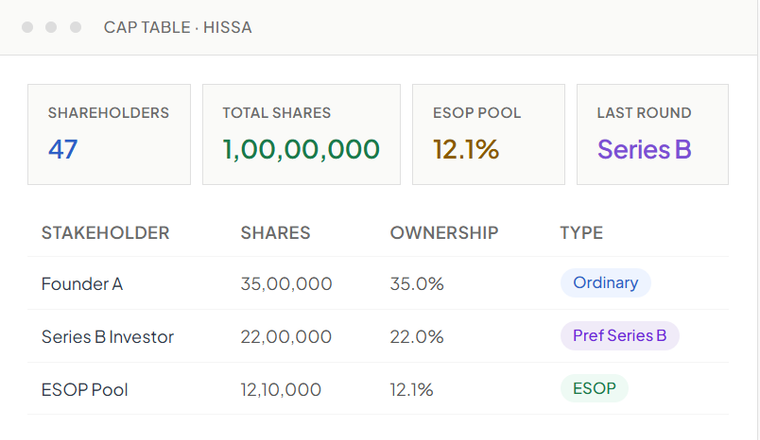
Hissa positions the cap table as the system of record for the wider equity lifecycle. It records share issuances, transfers, buybacks, and conversions, maintains an audit trail, and updates ownership as transactions occur.
Its stated scope also includes stakeholder-rights matrices, funding-round and exit modeling, parent-subsidiary structures, listed-company support, and corporate actions such as bonus issues, stock splits, consolidations, and conversion-ratio changes.
Hissa also models the instruments Indian startups commonly raise on, including multi-series CCPS, CCDs, convertible notes, and warrants. Shareholder-agreement terms such as anti-dilution protection and liquidation preferences are applied within the platform, while waterfall modeling shows how a priced round or exit would change ownership and distributions. The cap table can also be exported in a structured format for due diligence.
What to consider
The comparison matters most for your ownership structure. Stakeholder types, share classes, entities, historical transactions, conversions, and corporate actions can all affect how well each platform supports your cap table.
For an India-focused company, Hissa’s broader ownership and corporate-action workflows may provide a more connected approach as the cap table becomes more complex.
2. ESOP and equity-plan administration
Qapita
Qapita’s stock-plan administration covers grant management and the operating steps around vesting and exercise. Its international orientation may be relevant where equity operations span several countries or where different employee populations sit under different plans.
Hissa
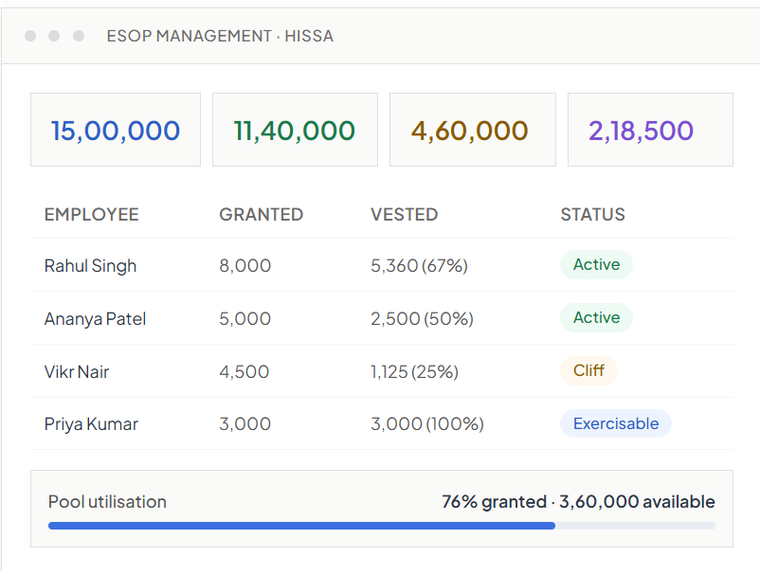
Hissa supports the ESOP lifecycle from pool and plan configuration through grants, vesting, exercise, forfeiture, and liquidity. Alongside ESOPs, it supports RSUs, SARs, and phantom stock, covering both equity-settled and cash-settled plans. Its documented depth includes parent and subsidiary management, complex and performance-linked vesting, custom allocation matrices, fractional options, malus and clawback controls, and exercise, cash-out, auto-exercise, and auto-cash-out workflows.
On the statutory side, Hissa maintains the SH-6 register of employee stock options automatically as grants, vesting, exercises, and lapses occur. It also supports workflows for ESOP-related filings such as MGT-14 for approvals and PAS-3 for allotments after exercise.
Recommended read: How to Set Up and Manage ESOPs in India
What to consider
Plan configuration depth matters when your ESOP structure includes performance conditions, subsidiary grants, or specific resignation and forfeiture treatments. Hissa may be more relevant for India-focused companies managing complex ESOP structures and detailed plan workflows.
3. Accounting and financial reporting
Qapita
Qapita supports ASC 718-related accounting and reporting within its international equity-management offering. Companies considering it should confirm the precise accounting outputs, modification treatment, valuation dependencies, and audit schedules included in the proposed product and service scope.
Hissa
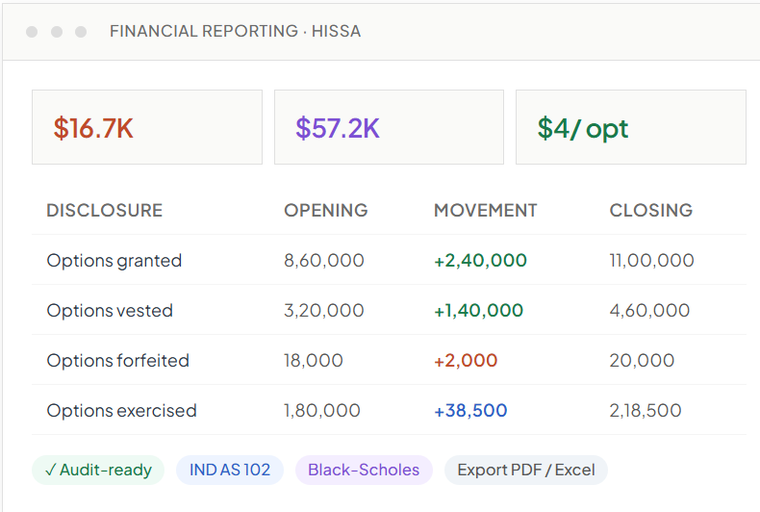
Hissa centres its accounting workflow on Ind AS 102. Its stated capabilities include Black-Scholes valuation, expense calculations, reserve tracking, financial disclosures, and audit-ready reports that can be exported to PDF or Excel for finance teams, auditors, and company secretaries. Because Ind AS 102 is converged with IFRS 2, the same calculations can also support IFRS 2 reporting where a company or its investors require it.
The accounting workflow connects directly to the underlying grant records, allowing changes in vesting or grant status to flow into reporting without maintaining a separate spreadsheet model.
What to consider
The applicable accounting standard should guide the comparison. The treatment of modifications, forfeitures, graded vesting, performance conditions, and corporate actions can affect expense, reserves, and disclosures.
The scope of platform capabilities and professional services also matters when assessing how much of the accounting workflow remains with your finance team.
For Indian companies, the distinction between a broad international accounting offering and an Ind AS 102-focused workflow can be important. Hissa connects grant records with accounting outputs, which can reduce the need for separate processes.
4. Valuation
Qapita
Qapita offers valuation services, including support for 409A-related requirements, alongside its equity-management platform. This may be relevant to companies that want valuation work connected to their cap-table and stock-plan records.
Hissa
Hissa incorporates Black-Scholes valuation into its ESOP and Ind AS 102 accounting workflow. The valuation inputs feed into expense calculations, reserves, disclosures, and reporting rather than sitting as a separate exercise.
For statutory requirements, Hissa facilitates registered-valuer valuations under the Companies Act and merchant-banker valuations under the Income Tax rules through partner valuers. Board-approved values then flow into the cap table, exercise pricing, and employees’ perquisite-tax calculations.
What to consider
The right approach depends on whether you need valuation software, an independent valuation service, or both. The applicable standard, valuation frequency, approval of assumptions, and flow of valuation inputs into accounting all matter.
For an India-focused ESOP programme, Hissa’s connected valuation and Ind AS 102 workflow may offer a more relevant operating model, as statutory valuations and option-pricing inputs both feed the same equity record.
5. Employee equity experience
Qapita
Qapita gives employees access to relevant grant and equity information. The specific grant details, documents, values, and exercise steps available to employees can vary by jurisdiction and setup.
Hissa
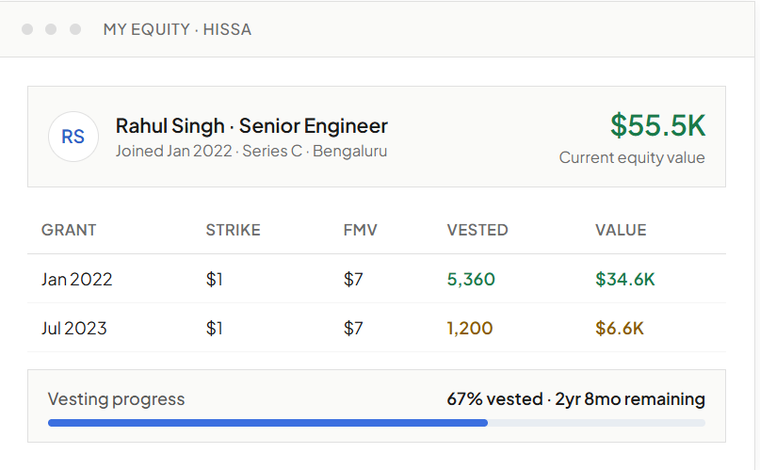
Hissa’s employee portal displays grants, vesting progress, and equity-value context. Its India-focused calculators help employees model perquisite tax and capital gains across exercise scenarios.
The wider workflow can also connect an employee’s grant information to exercise, financing, and eligible liquidity routes.
What to consider
The employee experience matters most when employees need to understand their equity without relying on HR. Hissa’s employee-facing tax context can be particularly relevant for Indian companies, where employees need visibility into the tax implications of exercising or selling their equity.
Permissions, document access, exercise workflows, and the level of HR involvement also deserve attention.
6. Liquidity
Qapita
Qapita supports tender offers and broader liquidity solutions. The structure of each transaction determines how participation, pricing, approvals, and administration are handled.
Hissa
Hissa offers a fund-backed route for eligible employee liquidity through the Hissa Fund, a ₹300 crore SEBI-registered Category II AIF, and its Secondary Desk. Its model uses institutional capital to purchase eligible equity, with T+5 business-day settlement where applicable.
The fund provides the capital, so the transaction does not draw on the company’s balance sheet, subject to eligibility, approvals, and transaction terms.
What to consider
The two platforms approach liquidity differently. Key considerations include who provides the capital, which employees and securities are eligible, how valuation is established, what approvals apply, and how settlement works.
For eligible Indian employees, Hissa’s fund-backed model provides a distinct route to liquidity that can sit alongside the wider equity-management workflow.
7. International coverage
Qapita
Qapita states that it operates across more than 60 countries. Its international coverage may be relevant to companies with entities, employees, or investors across several jurisdictions, particularly where 409A, ASC 718, or other cross-border equity requirements apply.
Hissa
Hissa takes an India-focused approach. Its product depth centres on Indian ESOP structures, Ind AS 102, employee tax context, local governance, and a liquidity mechanism designed for the Indian private market.
What to consider
Geographic coverage matters in relation to the jurisdictions your company actually operates in. If India remains your primary market, Hissa’s focus on Indian equity structures, accounting, tax visibility, and governance may be more relevant than broader international coverage.
8. Pricing
Qapita
Qapita publicly positions its offer around transparent pricing, free migration, and guaranteed cost savings, subject to terms. You should clarify the baseline subscription, pricing metric, migration scope, and any additional service or module charges in the proposal.
Hissa
Hissa does not use fixed subscription tiers. Each company receives a tailored plan scoped to the software modules, implementation work, support, accounting scope, and liquidity requirements it needs, so you pay for the workflows your equity operations require rather than for a bundled tier.
What to consider
You should compare both proposals across the full cost of ownership, including:
- Platform and recurring subscription fees.
- Implementation and data migration.
- Historical-data cleanup and reconciliation.
- Integrations.
- Ongoing support or managed administration.
- Valuation and accounting services.
- Employee or stakeholder access.
- Liquidity or transaction-related charges.
- Minimum terms, usage thresholds, or renewal conditions.
This gives you a clearer view of the cost of running your equity operations, including the manual work that remains outside the platform.
For an India-focused startup, Hissa’s connected equity, accounting, employee, and liquidity workflows may also reduce the need for separate tools or processes.
Qapita vs Hissa: Which platform may suit your needs?
Qapita may suit companies with international equity requirements or those looking for capabilities such as 409A, ASC 718, valuations, and tender offers within a broader platform.
Hissa is particularly relevant for India-focused companies, from early-stage startups to listed companies, where Ind AS 102, complex ESOP plans, employee tax visibility, and configurable workflows are important. Its India-focused approach connects equity administration, accounting, employee visibility, and liquidity within the same equity record.
The choice depends on a few practical factors. International entities and accounting standards may point towards Qapita, while India-specific accounting, complex ESOP administration, employee tax visibility, and connected liquidity workflows may make Hissa more relevant.
The level of configuration, reporting requirements, employee experience, and implementation support should also match your operating model.
How to evaluate Qapita and Hissa
The right comparison goes beyond feature lists. Your actual equity structure, accounting requirements, employee workflows, and liquidity needs can show where each platform may work better for your company.
Look at real equity workflows
A useful comparison should cover the scenarios your team is likely to manage. These may include:
- An Indian parent company and a subsidiary.
- Ordinary and preference shares.
- Time-based and performance-linked grants.
- An employee resignation and forfeiture event.
- An Ind AS 102 reporting period.
- A corporate action that affects the cap table or grants.
- An employee exercise or eligible liquidity scenario.
These scenarios can help you assess how each platform handles configuration, approvals, accounting, reporting, and employee interactions. It is also worth clarifying which capabilities come through the software and which depend on implementation or managed services.
Compare the areas that affect day-to-day operations
The following questions can help you assess where each platform may suit your requirements:
- How well does the platform support your actual plan rules and equity structure?
- How do grant changes, forfeitures, and performance outcomes flow into accounting?
- Which jurisdictions, entity structures, security types, and stakeholder classes are supported?
- How do permissions, approvals, and audit trails work across finance, HR, legal, and company-secretarial teams?
- What can employees see and manage through the platform?
- How are eligible liquidity transactions handled from request through settlement?
- What does migration involve, including data cleanup and reconciliation?
- What is included in the platform price?
- Which implementation, valuation, accounting, managed-service, or transaction costs are charged separately?
- What reports and documentation can the platform support for auditors?
For an Indian startup, Ind AS 102, plan configuration, employee visibility, corporate actions, and liquidity deserve particular attention. These areas can directly affect how much manual work your team retains after implementation.
Qapita vs Hissa: Which platform may suit your company?
The right choice depends on your current equity workflows and future requirements. Qapita may suit companies that prioritize international coverage, valuations, and tender offers. Hissa may suit Indian companies that need Ind AS 102, complex plan administration, employee equity visibility, and eligible liquidity connected to the same equity record.
If you operate across several countries, test Qapita against your entities, award types, and reporting needs. If India-specific accounting, flexible plan administration, and employee liquidity matter more, test Hissa using your actual equity structure and upcoming workflows.
For both platforms, use the same live scenarios during evaluation. Compare workflow coverage, implementation support, reporting, employee experience, and total operating costs.
If Hissa is on your shortlist, bring your cap table, plan rules, and upcoming equity events to a demo. You can see how Hissa handles your workflows in practice. Book a demo with Hissa.