An Indian startup can run a clean cap table on a global platform and still keep its SH-6 register in a spreadsheet. The split shows up at audit time, when two records disagree on how many options were granted.
Founders comparing Carta alternatives in India are usually weighing global reach against local depth. Carta is a global private-capital platform covering equity management and fund administration. Hissa is built for Indian companies, with the cap table and ESOPs connected to Ind AS 102 accounting and fund-backed employee liquidity.
We compare the two across eight areas, from cap tables to pricing. You will also find the scenarios worth testing before you sign a contract.
Carta vs Hissa at a glance
For teams weighing Carta alternatives in India, the home market is the core difference between the two platforms. Global coverage and US or IFRS reporting define Carta, while Hissa goes deep on Indian equity law and accounting.
Here is how that difference plays out across nine requirements.
| Decision area | Carta | Hissa | What to consider |
|---|---|---|---|
| Core proposition | Global private-capital platform spanning equity management and fund administration | India-focused equity and ESOP lifecycle platform managing $3.5B in ESOP grants | Global breadth or depth in Indian workflows |
| Home market | Global, with Singapore add-ons for ACRA filings | India, covering startups through listed companies | Where your holding company and employees are |
| Cap table | Cap table management, securities issuance and SAFE round modelling | CCPS across series, CCDs, notes and warrants, with corporate actions | The instruments your rounds actually use |
| ESOP administration | Option exercises and repurchases, with custom grant letters on Grow | ESOPs, RSUs, SARs and phantom stock, with an automatic SH-6 register | Plan rules, subsidiaries and statutory registers |
| Accounting | ASC 718 and IFRS 2 reporting on the Scale plan | Ind AS 102 expense, reserves and disclosures; outputs also support IFRS 2 | The standard your auditor reports against |
| Valuation | IFRS 13 and 409A valuations on Grow and Scale | Black-Scholes in the accounting workflow, plus Indian statutory valuations through partner valuers | Indian valuation reports or 409A |
| Employee experience | Stakeholder logins to track ownership and vesting | Perquisite tax and capital gains modelling, Aadhaar eSign and online exercise payments | What employees can decide without HR |
| Liquidity | Tender offers as a paid add-on | ₹300 crore SEBI-registered Category II AIF, T+5 settlement, capital from the fund | Who provides the capital |
| Pricing | Free Launch plan up to 25 stakeholders and $1M raised; paid plans quoted | Standard, Advanced and Listed plans, quoted on request; SSO on every plan | Total cost once you outgrow a free tier |
Carta overview
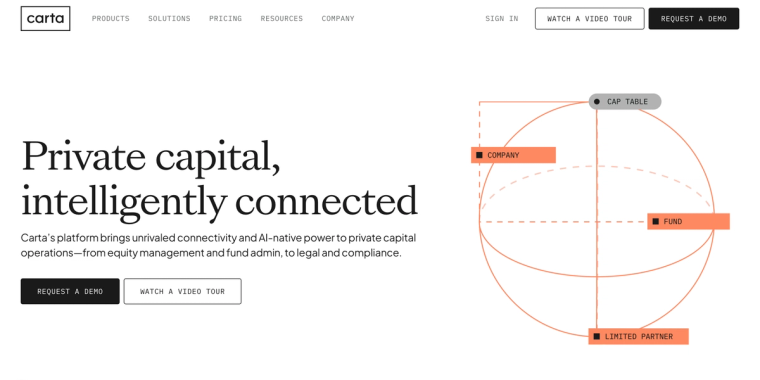
Carta positions itself as a connected platform for private capital, spanning equity management and fund administration. Its equity suite runs on four plans, starting with the free Launch tier and ending with Scale.
Accounting and valuation features follow US and international standards. On its Singapore plan page, IFRS 13 and 409A valuations arrive with Grow, while IFRS 2 and ASC 718 reporting arrive with Scale.
Local compliance add-ons on that page centre on Singapore, including an ACRA-registered filing agent. Indian companies should confirm how Ind AS 102 schedules and MCA filings would be handled.
Hissa overview
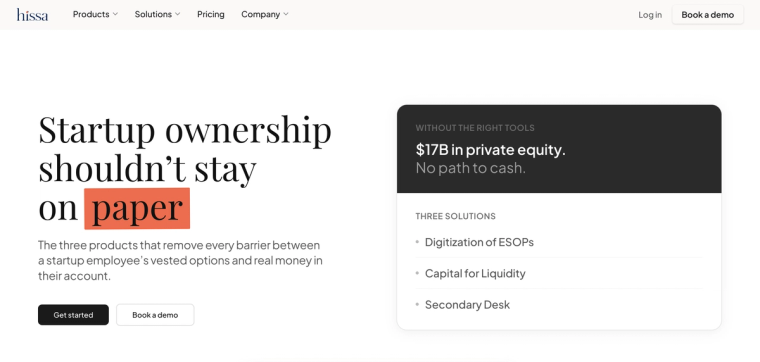
Hissa is an equity and ESOP lifecycle platform built for Indian companies, with more than $3.5B in ESOP grants managed. Its cap table and ESOP administration share one record with Ind AS 102 reporting.
Statutory work is built into the product. The SH-6 register updates automatically as grants move through their lifecycle, and workflows support MGT-14 and PAS-3 filings.
Eligible employees also get liquidity through the Hissa Fund, a ₹300 crore SEBI-registered Category II AIF (registration IN/AIF2/23-24/1439). SSO and maker-checker approvals come with every plan, and pricing is quoted per company.
Carta vs Hissa: Feature-by-feature comparison
When comparing Carta alternatives in India, eight areas decide how much manual work stays with your finance and HR teams after go-live.
1. Cap-table management
Carta
Core plans at Carta cover cap table management and securities issuance. SAFE round modelling is included from Launch, while Build adds advanced scenario and exit modelling. Data rooms come with every plan as well.
Hissa
Within Hissa, the cap table acts as the system of record for the whole equity lifecycle. Every transaction, from issuance to conversion, carries a full audit trail and updates ownership in real time. One-click investor-grade export makes the cap table data-room ready in minutes.
Multi-series CCPS and CCDs are modelled natively. Anti-dilution and liquidation preference terms apply on the platform, and waterfall modelling shows how a round or exit changes payouts. Bonus issues and stock splits flow through the same record, along with conversion-ratio changes.
What to consider
Start with the instruments your rounds actually use. SAFE modelling matters most for US-style rounds, while Indian investors usually subscribe to CCPS across several series.
An Indian-domiciled company gains most from a cap table that models CCPS conversion and SHA rights natively. Hissa’s cap table management keeps diligence exports consistent with the legal documents.
2. ESOP and equity-plan administration
Carta
All four Carta plans cover option exercises and repurchases, and custom grant letters start on Grow. ESOP advisory and equity admin services are available as paid add-ons.
Hissa
Across Hissa’s ESOP module, the lifecycle runs from pool design to liquidity, covering equity-settled and cash-settled plans. It handles parent and subsidiary schemes with performance-linked vesting.
Regulated plans can also carry malus and clawback controls. HR data syncs from Darwinbox or greytHR, so joiners and exits update grants without manual entry.
Recommended read: How to Set Up and Manage ESOPs in India
What to consider
Configuration depth matters most when grants span subsidiaries or depend on performance targets. Ask each vendor to configure one real resignation and forfeiture case from your scheme.
Auditors also expect the SH-6 register to match board approvals. Because Hissa maintains it inside the grant workflow, the register and the grants stay in step.
3. Accounting and financial reporting
Carta
ASC 718 and IFRS 2 reporting arrive with Carta’s Scale plan, alongside financial reporting support. Teams on Build or Grow should confirm how share-based payment expense would be produced.
Hissa
Ind AS 102 anchors Hissa’s accounting, combining Black-Scholes valuation with expense and reserve schedules. Reports export to PDF or Excel for auditors and company secretaries.
Those calculations also serve IFRS 2 reporting when investors ask, since Ind AS 102 closely mirrors IFRS 2. Grant changes flow into the schedules directly, so finance works from one model.
What to consider
Listed companies, and unlisted companies with net worth of ₹250 crore or more, must follow Ind AS. That threshold comes from Rule 4 of the Companies (Indian Accounting Standards) Rules, 2015.
Growth-stage companies crossing it need share-based payment schedules framed for Ind AS financial statements. With Hissa’s Ind AS 102 module, those schedules come from the same grant data as the cap table.
4. Valuation
Carta
Grow and Scale plans at Carta include IFRS 13 and 409A valuations, plus valuation audit support. A 409A report sets the fair market value of common stock for US tax purposes.
Hissa
Black-Scholes valuation runs inside Hissa’s ESOP accounting workflow, so its inputs feed expense and disclosures directly. Partner valuers provide registered-valuer reports under the Companies Act and merchant-banker reports under the Income-tax rules. Board-approved values then flow into exercise pricing and each employee’s perquisite tax calculation.
What to consider
Perquisite tax on exercise uses a fair market value set under the Income-tax rules, so Indian ESOP programmes depend on Indian valuation reports. Confirm which reports your auditor and tax adviser expect, since a 409A report serves a US entity.
5. Employee equity experience
Carta
Each Carta stakeholder gets a login to track ownership and vesting. HRIS and payroll integration is listed in every plan, including Launch.
Hissa
On Hissa’s employee portal, each grant appears with its vesting progress and current rupee value. Built-in calculators model perquisite tax and capital gains before an employee exercises.
Grant letters are signed with Aadhaar eSign through Digio. Exercise payments, including perquisite tax, are collected online through Easebuzz.
What to consider
Employees in India owe perquisite tax on ESOPs at exercise, before selling a single share. Showing that liability upfront reduces ad hoc equity and tax questions to HR.
6. Liquidity
Carta
Tender offers are Carta’s liquidity product, sold as an add-on with deal-structuring support and tax withholding estimates. In a tender offer, the company or participating investors supply the capital.
Hissa
Liquidity at Hissa is fund-backed, through the Hissa Fund. Vested shares from eligible employees of growth-stage startups are bought at board-approved fair value, and cash settles in T+5 business days.
Capital comes from the fund, so the company’s balance sheet stays untouched, subject to eligibility and approvals. ESOP financing can also cover the perquisite tax due on exercise.
What to consider
Ask who funds each transaction and how the price is set. Through the fund, eligible employees reach ESOP liquidity before an IPO, without a company-funded buyback.
7. International coverage
Carta
Coverage at Carta is global, and its Singapore site offers fund management across APAC and the Middle East. Companies with a US or Singapore parent, or staff spread across continents, gain from that reach.
Hissa
India is Hissa’s focus, from private startups through to listed companies. A dedicated Listed plan supports trust-based exercises and periodic exercise windows with SEBI reporting workflows. Security and privacy coverage spans ISO 27001 and SOC 2, along with GDPR and India’s DPDP framework.
What to consider
Match coverage to where your holding company is domiciled. Several large startups have moved their home, and Groww shifted its domicile from the US to India in 2024.
Once the parent is Indian, the cap table runs on Indian instruments and Indian filings. That is the work Hissa is designed around.
8. Pricing
Carta
Launch, Carta’s entry plan, is free for companies with up to 25 stakeholders and $1M raised. Paid plan prices depend on the package and the number of stakeholders, with a minimum annual fee. Add-ons cost extra, and SSO and IFRS 2 reporting both arrive with Scale, the top tier.
Hissa
Three plans are on offer from Hissa, each quoted on request. The Listed plan is built for companies on the stock exchange, with recurring exercises and trust operations.
Every plan includes SSO and maker-checker approvals. Audit trails and PII safeguards are standard too. Standard already includes the SH-6 register and employee tax calculators, and Advanced adds Black-Scholes valuation with Ind AS expense reporting.
What to consider
Compare both proposals on total cost of ownership, including:
- Platform subscription and stakeholder-based fees
- Onboarding and data migration
- Cleanup of historical records
- Valuation and accounting services
- Add-on services such as tender offers or advisory
- Minimum terms and renewal conditions
Free tiers help at incorporation, while costs climb once ESOPs and audits begin. Statutory registers and Indian reporting workflows are included in Hissa’s plans, with the SH-6 register from Standard and Ind AS reporting from Advanced.
Carta vs Hissa: Which platform may suit your needs?
Globally structured companies with a US or Singapore parent may prefer Carta, especially when they need 409A valuations. Very early teams can also set up a first cap table on its free Launch tier.
For Indian-domiciled companies, Hissa covers more of the equity workload in one system. Ind AS 102 accounting and the SH-6 register run from the same record as the cap table, with fund-backed liquidity on top.
Mixed structures deserve a closer look. Where a Singapore parent owns an Indian operating subsidiary, test how each platform handles both entities before deciding.
How to evaluate Carta and Hissa
Feature lists only go so far. Your real equity structure and upcoming events reveal which platform does more of the work for you.
1. Test real equity workflows
Run the same scenarios on both platforms, such as:
- Parent company in India with a subsidiary plan
- CCPS series with conversion terms and anti-dilution rights
- Time-based and performance-linked grants
- Employee resignation with forfeiture
- One Ind AS 102 reporting period
- Bonus issue or stock split
- Employee exercise with perquisite tax
Separate what the software does from what depends on services or add-ons. Demos built on your own data show that split clearly.
Shortlisting other Carta alternatives in India? Our Qapita vs Hissa and EquityList vs Hissa comparisons use the same criteria.
2. Ask about day-to-day operations
These questions show where each platform will save your team time:
- How does the platform handle your actual plan rules and instruments?
- Do forfeitures and performance outcomes flow into accounting automatically?
- Which statutory registers and filings does it maintain?
- What can employees see and do on their own?
- How is an eligible liquidity transaction handled through settlement?
- Does migration include data cleanup and reconciliation?
- Which services are priced outside the plan?
Indian startups should weigh Ind AS 102 and the SH-6 register most heavily. Those two areas shape your finance team’s monthly workload.
Choosing among Carta alternatives for your Indian company
Your current workflows and upcoming equity events should drive the decision. International groups that prioritise 409A valuations and tender offers may lean towards Carta.
Indian companies that want Ind AS 102 and eligible employee liquidity on one equity record will get more from Hissa. Use identical live scenarios with both vendors, then compare the outputs side by side.
Bring your cap table and next equity event to a Hissa demo, and see how the platform handles them in practice.