Only 12 Indian startups ran ESOP buybacks in 2025, down from 23 a year earlier, according to Inc42. Together they let about 9,265 employees cash out ₹1,409 crore.
Most employees with vested options are still waiting for their first buyback. Their exercise window closes on schedule anyway, and the HR email asks for the exercise price plus tax on the gain, which can run into lakhs of rupees for shares with no buyer yet.
ESOP financing is how you fund that bill before your options lapse. This guide works out the cash you need and the cheaper routes to try first, with a section for HR teams and founders. With Hissa, you can apply for financing and pay for your exercise from the same platform that holds your grant.
What is ESOP Financing in India?
ESOP financing in India is money an employee raises to pay the exercise price and the perquisite tax on vested stock options. Banks and non-banking finance companies (NBFCs) offer it as a loan secured on the shares, and some employers lend directly.
The phrase means something else in the US, where it describes a company or an ESOP trust borrowing to buy shares from retiring owners. Search results mix both meanings, so confirm which one a page uses before acting on its advice.
SEBI’s investor guide sets out the sequence behind the cost. Options vest after a set period of service, and you can then exercise them at the agreed price. If you’re new to the basics, start with what an ESOP is.
Why do Employees Need Financing to Exercise ESOPs?
An exercise triggers two payments at once, and neither comes with cash from a sale. The exercise price goes to the company, while the spread between fair market value (FMV) and that price is taxed as salary.
Your employer withholds perquisite tax on that spread through salary TDS. Shares in an unlisted startup rarely have a buyer on the exercise date, so the tax comes out of your savings or salary.
Find your deadline first
Vested options lapse once the exercise period in your plan ends. Plans can set a shorter window after resignation, so check the date in your grant letter before planning the cash.
Lapsed grants forfeit value you earned across years of vesting. Founders lose something too, since unexercised grants weaken the retention case for the whole plan.
How Much Cash Does an ESOP Exercise Need?
Cash on exercise equals the exercise price for every option plus tax on the perquisite value. Perquisite value is the Fair Market Value (FMV) per share on the exercise date minus the exercise price, multiplied by the number of options exercised.
Our example uses 5,000 vested options with an exercise price of ₹18 and an FMV of ₹312. Tax assumes the 30% slab plus 4% cess, with surcharge left out.
These figures are illustrative and describe no real grant. Swap in your own numbers from the grant letter and the company’s latest valuation report.
| Item | Full exercise | Partial exercise |
|---|---|---|
| Options exercised | 5,000 | 2,000 |
| Exercise price per option | ₹18 | ₹18 |
| FMV per share on exercise | ₹312 | ₹312 |
| Exercise price payable | ₹90,000 | ₹36,000 |
| Perquisite value | ₹14,70,000 | ₹5,88,000 |
| Tax at 30% plus 4% cess | ₹4,58,640 | ₹1,83,456 |
| Total cash on exercise | ₹5,48,640 | ₹2,19,456 |
Tax here is about five times the exercise price, so financing the price alone leaves most of the bill unpaid. Any rise in FMV before you exercise raises the tax while the exercise price stays fixed.
Employee portal calculators let you rerun the numbers for different exercise dates. Take the result to any lender or HR conversation, so everyone works from one figure.
Timing is as important as the amount. FMV for an unlisted company comes from its latest valuation report, so exercising before a new round lifts that value can keep the perquisite lower.
How Does ESOP Financing Work?
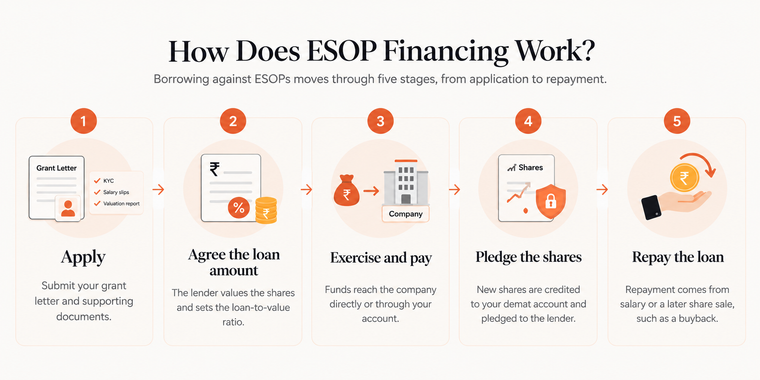
Borrowing against ESOPs moves through five stages, from application to repayment. Terms vary by lender, so treat the sequence as a list of questions to ask.
1. Apply with your grant documents
Lenders ask for KYC documents and the grant letter showing your vested options. Some also want salary slips and the company’s latest valuation report.
2. Agree the loan amount
The lender values the shares and lends a set share of that value, called the loan-to-value ratio. Ask whether the amount covers the tax as well as the exercise price.
3. Exercise and pay
Funds reach the company directly from the lender or through your account. Once it receives the exercise price and the TDS amount, the company allots the shares and deposits the tax.
4. Pledge the shares
New shares are credited to your demat account and pledged to the lender. Until the loan is repaid, selling or transferring them needs the lender’s release.
5. Repay the loan
Repayment comes from salary or from a later sale of the shares, such as in a buyback. On default, the lender can sell the pledged shares to recover what it is owed.
Ask about recourse
A recourse loan leaves you owing any shortfall if the pledged shares end up worth less than the debt. Get the lender’s answer in writing before you sign.
What are the Alternatives to an ESOP Loan?
Three routes can shrink the cash you need before you borrow anything. Try them in the order below, since the first two carry no interest cost.
1. Defer the tax at an eligible startup
Employees of eligible startups can postpone perquisite tax and the matching TDS. The company needs DPIIT recognition plus a certificate from the Inter-Ministerial Board (IMB) under Section 80-IAC.
Under the 1961 Act, the Income Tax Department’s ESOP guide ends the deferral at the earliest of three triggers. Tax then falls due within 14 days.
- Time limit: 48 months from the end of the assessment year of allotment
- Sale: Any sale of the deferred shares
- Exit: Leaving the employer
The Income-tax Act, 2025 took effect on 1 April 2026 and renumbered these provisions. Several practitioners read the new Act as extending the time limit to 48 months for allotments from that date, so confirm the period with payroll.
Your deferral status also decides when the tax shows up in your salary slip. The ESOP taxation guide covers that and the capital gains side.
2. Exercise in stages
Exercising part of your vested options cuts the cash you need in proportion. In Table 1, 2,000 options need ₹2,19,456 against ₹5,48,640 for the full grant. Check that your plan allows partial exercise, and track each tranche’s deadline.
3. Sell part of the shares to cover the cost
Where a buyer is ready on the exercise date, you can sell part of the new shares at once to fund the rest. Listed shares go through the exchange, while unlisted shares need a buyback or a secondary buyer.
The Hissa Fund is one such buyer, a SEBI-registered Category II AIF that buys vested ESOP shares at board-approved fair value. Cash reaches your account in five business days (T+5), and the company pays nothing.
| Route | Cash due on exercise in the example | Condition |
|---|---|---|
| Full exercise, no help | ₹5,48,640 | None |
| Tax deferral | ₹90,000 | Eligible startup with IMB certificate |
| Partial exercise of 2,000 options | ₹2,19,456 | Plan allows partial exercise |
| Partial exercise with deferral | ₹36,000 | Both conditions above |
| Sale to cover | Set by the buyer’s terms | A buyer ready on the exercise date |
How Can You Help Employees Fund an exercise?
Company-side help starts before the exercise window opens and ends at the payment screen. HR and finance teams control four levers that change how much cash each employee needs on the day.
1. Send the cash estimate early
Issue the exercise notice well before the window opens, with a cash estimate for each employee. Three months gives enough time to apply for deferral or a loan.
2. Offer an employer loan within the law
Section 67(2) stops a public company from funding purchases of its own shares, and Section 67(3)(c) carves out loans to employees. Directors and key managerial personnel are excluded, and each loan is capped at six months’ salary or wages.
Section 67(2) applies only to public companies, so a private company has more room to lend. Loans to directors still fall under Section 185, where the MCA’s 2015 exemption adds conditions on corporate shareholders and borrowings. Ask your company secretary to confirm the position before you offer any loan.
3. Add a financing partner on the equity platform
Financing offered inside the equity platform lets employees apply without leaving their grant record. Hissa’s integrations include ESOP financing that helps employees fund an exercise without paying the full amount upfront.
4. Collect payments online
An Easebuzz connection in Hissa collects the exercise price and perquisite tax online, recording each payment against the grant. Reconciliation then runs from one record in place of bank transfer screenshots.
What to put in the exercise notice
One email with these details saves employees a round of questions. Attach the latest valuation certificate for anyone who asks to see it.
FMV per share used for tax
Last date to exercise
Estimated tax at the employee’s slab
Deferral status and payment link
What Should You Check Before Taking an ESOP Loan?
Seven terms decide whether a loan against ESOPs costs more than it saves. Raise each one with the lender and get the answers in the sanction letter.
- Interest and fees: Compare the all-in annual cost, including processing and pledge charges.
- Loan-to-value: Confirm the amount covers both the exercise price and the tax.
- Recourse: Find out whether you owe any shortfall if the shares lose value.
- Tenure: Match the repayment date to a realistic liquidity date for the company.
- Plan rules: Verify that the ESOP plan and shareholders’ agreement allow a pledge.
- Leaving the company: Ask what happens to the loan and the pledge if you resign.
- Capital gains: Budget for capital gains tax when you finally sell the shares.
Clear written answers on recourse and tenure matter most, since those two decide what happens if the company takes longer to reach a liquidity event.
Fund Your Exercise in the Right Order
Start this week with two dates, your exercise deadline and the date of the company’s next valuation report. Between them, they set how much cash you need and how long you have to find it.
Run your numbers through the employee portal, then ask payroll whether your company qualifies for deferral. Borrow only for the amount left after that, and take the checklist above to every lender you speak to.
Once the shares are yours, the ESOP liquidity guide sets out ways to sell them. If you run HR or finance and want financing and payments inside the equity record, Book a Demo with Hissa.