The Centre recognised more than 55,200 startups in financial year (FY) 2025-26, the most in any single financial year since Startup India began, Inc42 reported. That took the total past 2.23 lakh by 31 March 2026.
DPIIT recognition is the door into Startup India’s benefits, and it takes an afternoon online. Even so, founders often skip it, or expect more from it than it gives. So which benefits will you get, and which need a second approval?
The rules changed in February 2026, when DPIIT replaced the 2019 startup definition with a wider one, and plenty of guides still quote the old limits. If you run your equity on Hissa, you can line up your ESOP plan with what recognition allows from day one.
What is Startup India Registration?
People say “registration”, but what you apply for is recognition, and the difference matters for what you receive.
Startup India registration is the online process of getting your business recognised as a startup by DPIIT, the government’s industry department. You register on the Startup India portal and apply for DPIIT recognition there, and a successful application ends with a recognition certificate. That certificate adds to your incorporation and doesn’t replace it.
Recognition is also separate from Udyam registration for micro, small and medium enterprises (MSMEs), and from the IMB certificate needed for the tax holiday. A company can hold all three, and each opens a different set of doors.
Who is Eligible for DPIIT Recognition in 2026?
The current test comes from DPIIT’s notification General Statutory Rules (G.S.R.) 108(E), issued on 4 February 2026. An entity qualifies as a startup when it meets the four conditions below.
- Entity type: It’s a private limited company, an LLP, a partnership firm, or a cooperative society registered under state or multi-state law.
- Age: It’s within 10 years of its incorporation or registration.
- Turnover: Its turnover hasn’t crossed ₹200 crore in any financial year since it was set up.
- Business model: It’s working on innovating or improving products, processes or services, or runs a scalable model with high potential for jobs or wealth.
A business formed by splitting up or reconstructing an existing business doesn’t qualify. Sole proprietorships fall outside the listed entity types, so founders usually incorporate first.
The February 2026 notification doubled the turnover limit from ₹100 crore and let cooperative societies in for the first time. It also restricts how recognised startups use their money, keeping funds out of unrelated land and buildings, loans, securities, and luxury or speculative assets, unless they’re part of the ordinary business.
Deep tech startups get more room in return for proving their technology. The table below compares the two categories.
| Condition | Regular startup | Deep tech startup |
|---|---|---|
| Maximum age | 10 years from incorporation | 20 years from incorporation |
| Turnover limit (any year) | ₹200 crore | ₹300 crore |
| Extra attributes | None | New science or engineering knowledge, high research and development (R&D) spend, novel IP |
| Extra records | None | Research spending, technical progress, IP and commercialisation plans |
How Do You Register on the Startup India Portal?
Once you know you qualify, the application itself is short. Here are the steps in the order most founders work through them.
- Incorporate the business as one of the eligible entity types.
- Create an account on the Startup India portal.
- Fill in the recognition form with your entity details, founding team, sector and stage.
- Upload the certificate of incorporation or registration and a write-up on your innovation or scalability.
- Add supporting material such as a pitch deck, patents or funding details.
- Submit the form, then track its status and answer any queries from DPIIT.
- Download the recognition certificate once it’s approved.
There’s no government fee to apply. Deep tech applicants follow the same steps and add proof of their research intensity and IP.
What Documents Do You Need?
A couple of documents are essential, while supporting proof often decides how smoothly an application goes. Here’s what to keep ready.
- Certificate of incorporation or registration. Every applicant needs this.
- Write-up on the business. It explains how you’re innovating or how the model can scale, and it’s the part reviewers read most closely.
- Founder and entity details. The Permanent Account Number (PAN) and the details of directors or partners.
- Supporting proof. Patents, awards, growth metrics or a letter from an investor or incubator all strengthen the case.
A vague write-up, or a trading business with no innovation story, invites queries. A clear, specific write-up is the best way to avoid them.
Which Benefits Come With DPIIT Recognition?
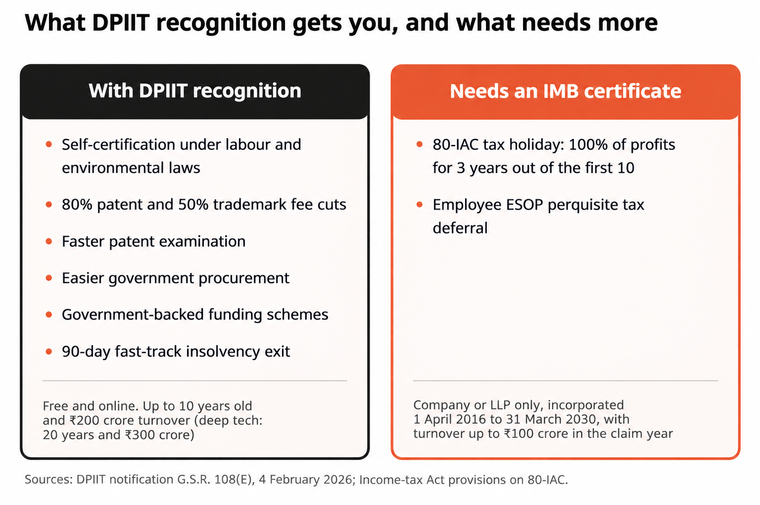
Recognition on its own brings a useful set of benefits, and none of them needs further approval. These five are the ones founders use most.
1. Self-certification under labour and environmental laws
Recognised startups can self-certify compliance with six labour laws and three environmental laws, with no labour inspections for five years. That frees up management time in the early years, when it’s scarcest.
2. Lower IP fees and faster patent examination
Startups pay 80% less in patent filing fees and 50% less in trademark fees, and can ask for fast-track examination of patent applications. The separate Scheme for Facilitating Startups Intellectual Property Protection (SIPP), which paid facilitators’ fees, ended on 31 March 2026, but the fee cuts continue.
3. Easier public procurement
Recognised startups can sell on the Government e-Marketplace (GeM) and can be exempted from prior experience, prior turnover and earnest money deposit (EMD) requirements in government tenders. They still have to meet the tender’s quality and technical specifications.
4. Access to government-backed funding
Recognition opens access to the Fund of Funds for Startups, the Startup India Seed Fund Scheme and the Credit Guarantee Scheme for Startups. In February 2026, the Union Cabinet approved a ₹10,000 crore Fund of Funds 2.0 aimed at deep tech and technology-led manufacturing.
5. A faster exit if the business fails
Startups other than partnership firms can use the fast-track insolvency process under the Insolvency and Bankruptcy Code (IBC). It’s meant to finish within 90 days, with up to 45 more days if the tribunal allows.
Which Benefits Need a Separate Approval?
The headline tax benefit is where most of the confusion lies, because recognition alone doesn’t deliver it.
1. The startup tax holiday
An eligible startup can deduct 100% of its profits for three consecutive tax years out of its first ten. Long known as section 80-IAC, the deduction now sits in section 140 of the Income-tax Act, 2025, which applies from 1 April 2026.
The conditions are stricter than recognition. Only companies and LLPs incorporated on or after 1 April 2016 and before 1 April 2030 qualify, turnover must be ₹100 crore or less in the year of the claim, and the startup needs a certificate from the Inter-Ministerial Board of Certification.
So a ₹150 crore turnover startup can be recognised and still miss the tax holiday. Partnership firms and cooperatives can be recognised too, but only companies and LLPs can apply for the IMB certificate.
2. Angel tax relief is now automatic
Recognition used to shield startups from tax on share premium under section 56(2)(viib) of the old Income-tax Act. Budget 2024 abolished that angel tax for all investors from assessment year 2025-26, so every startup now gets the same relief.
What Does DPIIT Recognition Mean for Your ESOPs?
Recognition also changes some ESOP rules, which matters to founders planning grants and to employees deciding when to exercise.
- Tax deferral for employees: Where the startup holds the IMB certificate, employees can defer perquisite tax for a limited period, or until they leave or sell.
- ESOPs for promoters: Under Rule 12 of the Companies (Share Capital and Debentures) Rules, a startup can grant ESOPs to promoters and directors holding more than 10% for up to ten years from incorporation.
- Sweat equity: Under Rule 8, a startup can issue sweat equity of up to 50% of its paid-up capital for up to ten years from incorporation.
Suggested read: What is an ESOP in India?
How Do You Keep Your Recognition?
Recognition isn’t permanent, so it helps to know when it ends and what can put it at risk.
A startup stops being one ten years after incorporation, or twenty for deep tech. It also loses the status once turnover crosses the limit in any year. Until then, follow the conditions on fund use and keep records that back up the claims in your application.
The IMB can also revoke a tax certificate obtained on false information, and the certificate is then treated as though it was never granted.
Start Your Equity Records the Day You’re Recognised
Recognition touches equity more than most founders expect, from ESOPs for promoters to your employees’ tax deferral. The cleaner your records are from the first grant, the easier every later step becomes, whether that’s an IMB application, a funding round or a buyback.
Hissa keeps your cap table and ESOP pool in one place, and covers the equity work a recognised startup runs into as it grows.
- Cap table management: Every issuance and transfer is recorded with an audit trail, so your shareholding is ready for an IMB application, a due diligence request or the next term sheet.
- Round modelling: You can model a funding round and the option pool top-up before you sign, and see each holder’s stake on a fully diluted basis.
- ESOP administration: Grants, vesting, exercises and exits run in one system, including grants to promoters that recognition allows.
- Employee portal: Employees see each grant’s vesting and current value, with the perquisite tax worked out before they exercise, and pay for an exercise online.
- Valuation and accounting: Black-Scholes values for each grant are calculated automatically, with Indian Accounting Standard (Ind AS) 102 expense schedules every quarter and audit packs in PDF and Excel.
- Liquidity before listing: Hissa Fund, registered with the Securities and Exchange Board of India (SEBI) as a Category II alternative investment fund (AIF), buys vested ESOP shares at the board-approved price and settles in T+5 business days, without using company cash.
Book a demo to set up your ESOP pool and cap table on Hissa while the company is still small.