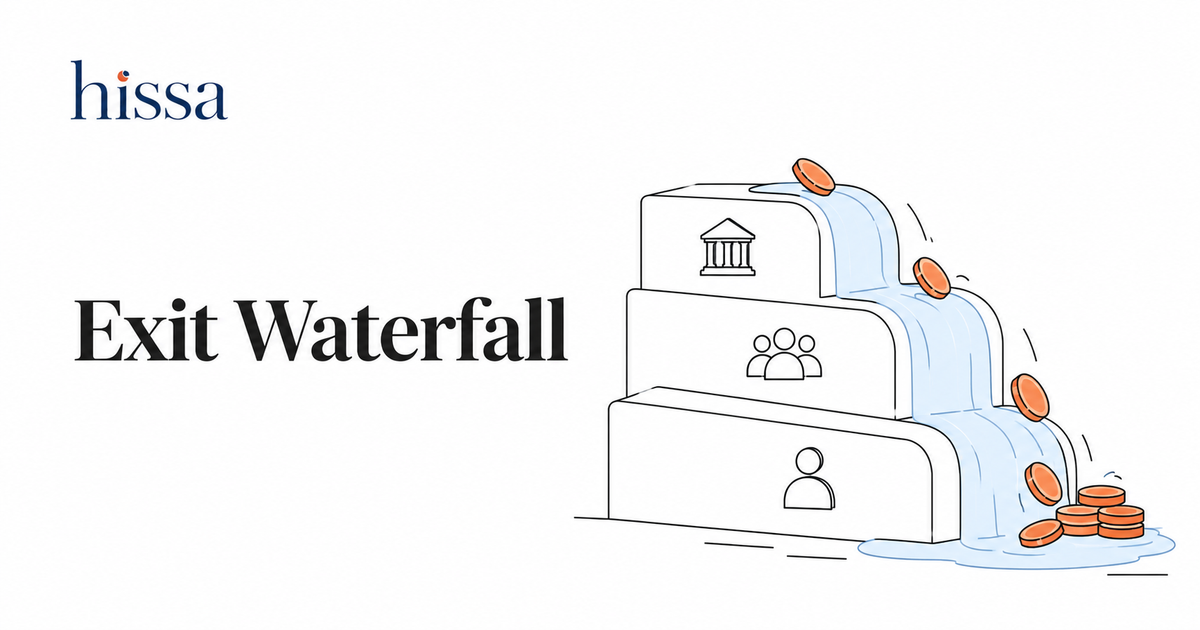
Teams often use ownership percentages on a cap table to estimate what founders and employees might receive when a company is sold. That approach misses a critical detail. Ownership does not determine payout on its own.
Liquidation preferences, investor seniority, and participation rights can change how exit proceeds are divided. As funding rounds accumulate, these terms become harder to assess by looking at the cap table alone.
An exit waterfall provides a clearer way to understand the distribution. It maps how proceeds move from creditor claims to preferred shareholders and, finally, to common shareholders, based on the company’s contractual terms.
Each stakeholder benefits from understanding the waterfall. Founders can assess how funding terms affect their returns, while investors can compare potential outcomes. Employees can also make more informed decisions about their equity.
This guide explains how liquidation preference works, compares participating and non-participating terms, and uses worked examples to show how stacked preferences affect exit payouts.
What Is a Liquidation Preference?
A liquidation preference gives preferred shareholders the right to receive a specified amount from an exit before common shareholders receive their distribution. The right is usually defined in the company’s financing documents and affects how the sale proceeds are divided.
1. How a liquidation preference works
Investors who purchase preferred shares often negotiate a liquidation preference as downside protection. A common arrangement is a 1x preference, which entitles the investor to receive up to the amount originally invested before common shareholders receive a payout, subject to available proceeds and other claims.
Suppose an investor puts ₹20 crore into a startup with a 1x liquidation preference. If the company is sold, the investor may receive the first ₹20 crore allocated to that preference before common shareholders receive a distribution.
The exact result depends on the other terms. Participation rights and seniority can change the distribution, especially when a company has raised several funding rounds.
2. What the exit waterfall determines
The exit waterfall sets the order in which available proceeds are distributed. The amount shown as the sale price is the starting point, because debt obligations and transaction expenses can reduce the pool available to shareholders.
The distribution commonly accounts for creditor claims before preferred shareholders receive their contractual entitlements. Any remaining proceeds can then flow to common shareholders and participating preferred holders, depending on the terms.
A founder with 40% ownership may receive less than 40% of the sale price if preferred claims absorb part of the proceeds first. The same applies to employees who hold common shares or have vested options.
Key point: Your ownership percentage shows your share of the equity. The liquidation waterfall determines how much of the available exit proceeds reaches that equity.
How Non-Participating Liquidation Preferences Work
A non-participating preference gives the investor a choice at exit. They can take the contractual preference or convert their preferred shares into common shares and receive their pro-rata share of the proceeds. They choose the option that pays more.
1. Compare the preference with the conversion value
Consider an investor who puts ₹20 crore into a startup for 20% ownership, with a 1x non-participating preference.
The investor compares the ₹20 crore preference with the amount they would receive from owning 20% of the exit proceeds. The table below assumes the exit proceeds shown are available for distribution after higher-priority claims and expenses.
| Exit proceeds | 1x preference | 20% conversion value | Investor receives | Remaining for common holders |
|---|---|---|---|---|
| ₹50 crore | ₹20 crore | ₹10 crore | ₹20 crore | ₹30 crore |
| ₹80 crore | ₹20 crore | ₹16 crore | ₹20 crore | ₹60 crore |
| ₹100 crore | ₹20 crore | ₹20 crore | ₹20 crore | ₹80 crore |
| ₹200 crore | ₹20 crore | ₹40 crore | ₹40 crore | ₹160 crore |
| ₹500 crore | ₹20 crore | ₹100 crore | ₹100 crore | ₹400 crore |
The investor’s choice changes at a ₹100 crore exit. At that point, 20% of the proceeds equals the ₹20 crore preference. Below that amount, the preference pays more. Above it, converting to common shares produces a higher return.
2. Calculate the conversion breakpoint
The breakpoint is the exit value at which the investor receives the same amount from the preference and from converting to common shares.
Breakpoint = Liquidation preference amount ÷ As-converted ownership percentage
In this example, the calculation is ₹20 crore ÷ 20%, giving a breakpoint of ₹100 crore.
The breakpoint helps founders understand how the terms affect different exit outcomes. A lower exit may leave common shareholders with less, while a higher exit can allow the investor to convert and share proceeds according to ownership.
3. Understand what common shareholders receive
Under a non-participating structure, the investor takes the preference or the conversion value, but never both. Once the investor converts, their payout follows their ownership percentage alongside the other common shareholders.
That distinction matters when comparing funding offers. A higher valuation can look attractive, but the liquidation terms also determine how proceeds are divided if the eventual sale price falls below expectations.
How Participating Liquidation Preferences Change the Payout
Participating preferred shares give the investor their liquidation preference first, followed by a share of the remaining proceeds. The investor therefore receives a preference payout and then participates in the residual distribution.
1. Calculate the double payout
Use the same investment terms. An investor puts ₹20 crore into the company for 20% ownership, this time with a participating preference. The company sells for ₹200 crore, and the full amount is available for distribution.
| Distribution step | Calculation | Amount |
|---|---|---|
| Investor’s preference | 1x original investment | ₹20 crore |
| Remaining proceeds | ₹200 crore − ₹20 crore | ₹180 crore |
| Investor’s share of remainder | 20% × ₹180 crore | ₹36 crore |
| Investor’s total payout | ₹20 crore + ₹36 crore | ₹56 crore |
| Common holders’ share | 80% × ₹180 crore | ₹144 crore |
The investor receives ₹56 crore under participating terms. Under the non-participating structure, the same investor would convert and receive ₹40 crore.
That ₹16 crore difference comes out of the proceeds that would otherwise be distributed to common shareholders. The company’s sale price and the original investment remain the same, but the contractual terms change the payout.
2. Understand capped participation
A participation cap limits the investor’s total payout to a specified multiple of their investment. A term such as “1x participating, capped at 3x” allows the investor to receive the 1x preference and participate in the remainder until their total payout reaches three times the original investment, subject to the contract.
For an investor who put in ₹20 crore, a 3x total-return cap would limit the payout to ₹60 crore. Once the cap is reached, further distributions follow the applicable agreement.
A cap can reduce the impact of participating terms at higher exit values. Founders reviewing a term sheet should check whether the cap includes the original preference and how conversion is handled once the limit is reached.
How Stacked Liquidation Preferences Affect Multiple Funding Rounds
Each preferred funding round may create a separate liquidation preference. When the company has raised several rounds, the seniority rules determine which investors receive payment first.
1. See how preferences accumulate
Suppose a startup has raised the following investments, each with a 1x liquidation preference.
| Funding round | Investment | Preference | Priority |
|---|---|---|---|
| Series A | ₹20 crore | ₹20 crore | Second |
| Series B | ₹100 crore | ₹100 crore | First |
| Total | ₹120 crore | ₹120 crore |
At a ₹120 crore exit, the Series B investor receives ₹100 crore first. The remaining ₹20 crore goes to Series A. Common shareholders receive nothing from the distribution.
The company has sold for ₹120 crore, but the preference stack absorbs the entire amount. Founders and employees holding common equity may therefore receive no payout, even if their ownership percentages appear substantial on the cap table.
2. Compare stacked and pari passu terms
Under stacked seniority, one round has priority over another. A later round may receive its full preference before earlier investors receive anything.
Under pari passu terms, preferred shareholders share the available proceeds at the same priority level, usually in proportion to their respective preference claims when the proceeds fall short.
Imagine the same ₹120 crore preference stack, but with only ₹60 crore available for preferred shareholders. Under pari passu treatment, Series A would receive ₹10 crore and Series B would receive ₹50 crore, assuming both preferences rank equally and no other terms change.
Under the stacked structure, Series B would receive the entire ₹60 crore, leaving Series A unpaid. The seniority clause can therefore change the distribution even when the total preference amount remains the same.
3. Check the entire preference stack before estimating returns
Review every funding round’s preference amount and seniority. The total preference stack gives you an initial indication of how much exit value may be needed before common shareholders receive proceeds, although creditor claims and other contractual terms can raise that threshold.
Model several realistic exit values instead of relying on a single valuation. This is particularly useful for employees assessing the potential value of their equity compensation.
What Else Affects the Exit Waterfall?
Liquidation preferences are a major part of the payout calculation, but the final distribution can depend on other obligations and equity terms. The amount available to shareholders and the number of shares participating both matter.
1. Debt and transaction costs
Debt and creditor claims are generally settled before shareholder distributions, subject to the relevant legal and contractual priorities. Transaction costs can also reduce the net proceeds available for distribution.
Start with the expected net proceeds rather than the headline acquisition price. The waterfall should use the amount actually available to the relevant shareholders after applicable obligations.
2. Escrow and holdbacks
An acquisition agreement may set aside part of the consideration in escrow or hold it back to cover specified obligations. The timing and release conditions depend on the deal terms.
That means part of the sale consideration may arrive later. When estimating your payout, check whether the stated proceeds include escrow amounts and how any later release will be distributed.
3. Employee stock options
Employees who have exercised their options generally hold common shares and participate according to the rights attached to those shares. Vested but unexercised options may be treated differently under the plan and transaction terms.
An option’s potential payout also depends on its exercise price. If the per-share exit value is ₹200 and the exercise price is ₹25, the gross value before tax and other costs is ₹175 per option, assuming the option is eligible for exercise and participates in the transaction.
4. Convertible instruments and dilution
SAFEs and convertible notes can convert into shares before the distribution calculation, depending on their terms. That conversion can change the fully diluted ownership percentages used to calculate each shareholder’s pro-rata return.
Use the post-conversion cap table when modelling the waterfall. A calculation based on an earlier ownership percentage may overstate the amount a founder or employee receives.
Before you estimate your payout: Confirm the net proceeds available for distribution, the preference terms for each funding round, and the share count after convertible instruments are resolved.
What Should You Check Before an Exit?
The best time to understand the waterfall is before you need to rely on it. Founders and employees can use the relevant company documents to understand the payout conditions and estimate what different exit scenarios could mean for them.
1. Identify the total preference stack
Add up the liquidation preferences across funding rounds, and check whether any round has a multiple above 1x. This gives you a starting point for estimating how much proceeds may be allocated to preferred shareholders.
2. Confirm participation and seniority terms
Review whether each preference is participating or non-participating. Then check whether the rounds rank pari passu or use stacked seniority.
The term sheet summary may not capture every condition. The company’s charter documents and financing agreements define the applicable rights, so review the governing documents with qualified legal or financial advisers.
3. Model multiple exit scenarios
Calculate the distribution at a lower exit value, a reasonable expected outcome, and a higher exit value. Include creditor claims and transaction costs where relevant.
Compare the results with your ownership percentage to understand the difference between headline equity value and potential proceeds. Employees should also review their exercise price and the rules that apply to their options.
4. Keep equity records clear with Hissa
Understanding the waterfall starts with knowing what equity has been issued and how the cap table changes across funding rounds. Hissa helps companies manage their equity records and cap table information, giving teams a clearer basis for reviewing ownership and modelling potential outcomes.
Explore Hissa’s equity management platform to learn how it supports equity recordkeeping as your company grows.